
Buying and offers
How Much Should You Offer on a House?
There is no universal percentage to offer below a house asking price. Begin with completed comparable sales, the property’s condition and what you can afford. Then decide what the home is worth to you and make an offer you can explain.
This is an estimate from comparable sales, not a RICS or mortgage valuation, and not a survey.
Start with the property, not the discount
Buyers often ask how much below the asking price they should offer. It is understandable, but it starts in the wrong place. An asking price is the seller's invitation to negotiate. It is not a reliable measure of what the home is worth, so a fixed percentage below it tells you very little.
A sensible offer has three parts: what the evidence suggests, what the property is worth to you and what you can actually proceed with. The last part includes the cost of buying, likely work and any borrowing constraints.
Work out what the asking price is based on
Look for recent completed sales of genuinely comparable homes. Check type, floor area, condition, location, tenure and the date of each sale. An attractive nearby listing is not proof of an achieved value. Neither is a sale of a much larger or better presented house.
Ask the selling agent which transactions support the price and what they see as the important differences. Their answer may be useful, but remember they act for the seller. You can check recorded transactions and make your own judgement about the comparison.
If there are few suitable sales, acknowledge the uncertainty rather than manufacturing a precise answer. Choosing comparable sales explains how to identify the stronger evidence.
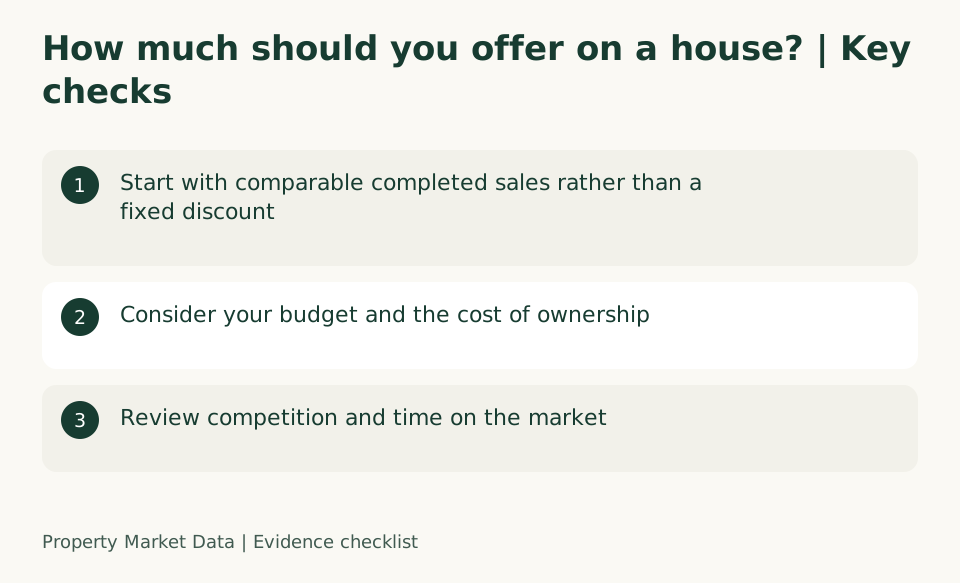
Start with comparable completed sales rather than a fixed discount; Consider your budget and the cost of ownership; Review competition and time on the market
Price is only one part of the offer
Think about your own position. Do you need to sell another property? Is your mortgage agreement in principle current? Do you have evidence of your deposit? Are you prepared to instruct a solicitor promptly?
An offer from a buyer who can proceed may be attractive to a seller, but that does not mean you should promise certainty you cannot provide. State your circumstances accurately and explain any dependencies.
Consider the property itself. If it needs substantial work, obtain informed cost advice where practical. Do not assume that every pound of anticipated work should automatically be deducted from the price. Some issues are reflected in the asking price already; others may be uncertain until a survey or specialist inspection.
Decide your limit before negotiations begin
Set a figure above which you would rather walk away. This is not necessarily the same as the most a lender would let you borrow. Include stamp duty where applicable, moving expenses, immediate repairs and the financial breathing room you want after completion.
Illustrative example. Two buyers like a home advertised at £400,000. One has substantial savings left after the purchase and does not need to move urgently. The other would be stretched by repairs and has a strict completion timetable. The same asking price and comparable sales do not create the same sensible offer for both buyers.
You may find the property is worth more to you because of its location or layout. That is a legitimate personal preference, but it should be a conscious choice rather than a claim that the market evidence proves the higher figure.
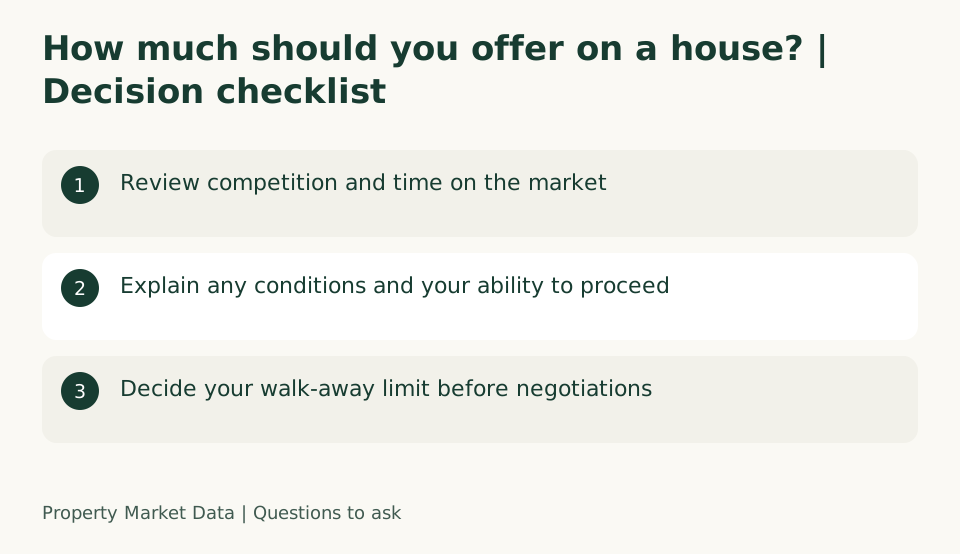
Review competition and time on the market; Explain any conditions and your ability to proceed; Decide your walk-away limit before negotiations
Make the offer clear and credible
Put the amount in writing. Include your position, funding arrangements and any important conditions or timing considerations. Ask the agent to confirm that the offer has been passed to the seller. Avoid attaching an arbitrary deadline simply to create pressure unless there is a genuine reason for one.
If the seller rejects your offer, ask whether they have given any indication of what would make it acceptable. Do not increase your bid automatically. Revisit your evidence and your limit. If several interested buyers are involved, decide in advance whether you are prepared to participate and what your final figure would be.
Best and final offers deals with that particular situation. Buyer position, chain and funding explains why sellers may consider more than the number.
What if the survey changes things?
An accepted offer does not eliminate the need for appropriate checks. A survey may reveal a material issue you could not reasonably assess during a viewing. Take professional advice about the findings and the likely cost before deciding whether to renegotiate.
That is different from using a survey as a routine excuse to reopen a price you already agreed. Renegotiating after a survey looks at the distinction.
If you want to examine the property evidence, a sample report shows how PMD presents comparable sales and assumptions. You can read about PMD's buyer report for a home you are considering.
An offer should be one you can explain to yourself even if the seller says no. The strongest explanation combines market evidence with an honest account of your circumstances and limits.
Sources
- HM Land Registry, Price Paid Data: Explains the nature and limits of recorded completed sale prices
- HM Land Registry, House Price Index: Provides background on published house price statistics