
Buying and offers
How to Tell If a House Is Overpriced
A house can look expensive without being overpriced. Perhaps it has a larger plot, a better layout or a location that matters to buyers. The question is whether the asking price is supported by evidence once those differences are taken into account.
This is an estimate from comparable sales, not a RICS or mortgage valuation, and not a survey.
Start by asking what the premium buys
You have seen two similar-looking houses advertised at noticeably different prices. One might be ambitiously priced. Or it might have something the other lacks: more internal space, a useful annexe, a quieter position or substantial recent work.
Before deciding that the expensive house is overpriced, list the features that could plausibly explain the difference. A larger garden may matter considerably in one location and much less in another. An extension might improve the living space but not justify its entire construction cost in the sale price.
Your task is to test the seller's asking figure, not to prove that it is wrong.
Use completed sales, not just other adverts
An advertised price is a request. A completed sale is evidence of what someone actually paid. Look for recent completed transactions involving homes of broadly similar type, size, condition, tenure and setting.
Do not automatically favour the nearest sale. A smaller house on the same road may be less informative than a closer match in a neighbouring street. Check when each transaction completed and whether the local market has moved since then.
HM Land Registry Price Paid Data is a useful source for recorded completed transactions, but the record does not establish the property's condition at sale or capture every relevant difference. How to choose comparable sales explains the selection process.
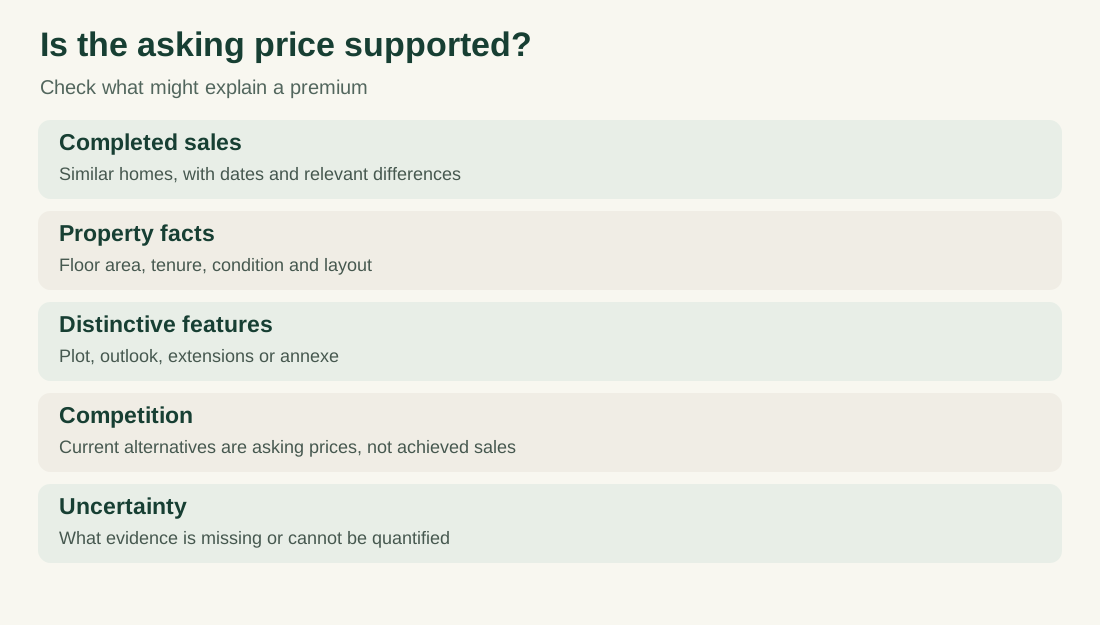
Completed sales: Similar homes, with dates and relevant differences. Property facts: Floor area, tenure, condition and layout. Distinctive features: Plot, outlook, extensions or annexe. Competition: Current alternatives are asking prices, not achieved sales. Uncertainty: What evidence is missing or cannot be quantified.
Make adjustments in words before reaching for a number
Suppose a comparable has a larger kitchen, a garage and a better outlook. Those are reasons to be cautious about treating its sale price as direct evidence for a smaller home. But it would be equally rash to assign a fixed cash value to each feature without supporting sales.
Write down the differences that might affect buyers' choices. Then ask whether you have enough transactions to judge their likely effect. If not, acknowledge a wider possible range. False precision is especially unhelpful when the property is unusual.
Check floor area rather than relying solely on bedroom count. Two four-bedroom houses can offer very different amounts of usable space. Condition, lease terms and running costs may also materially change the comparison.
An illustrative price test
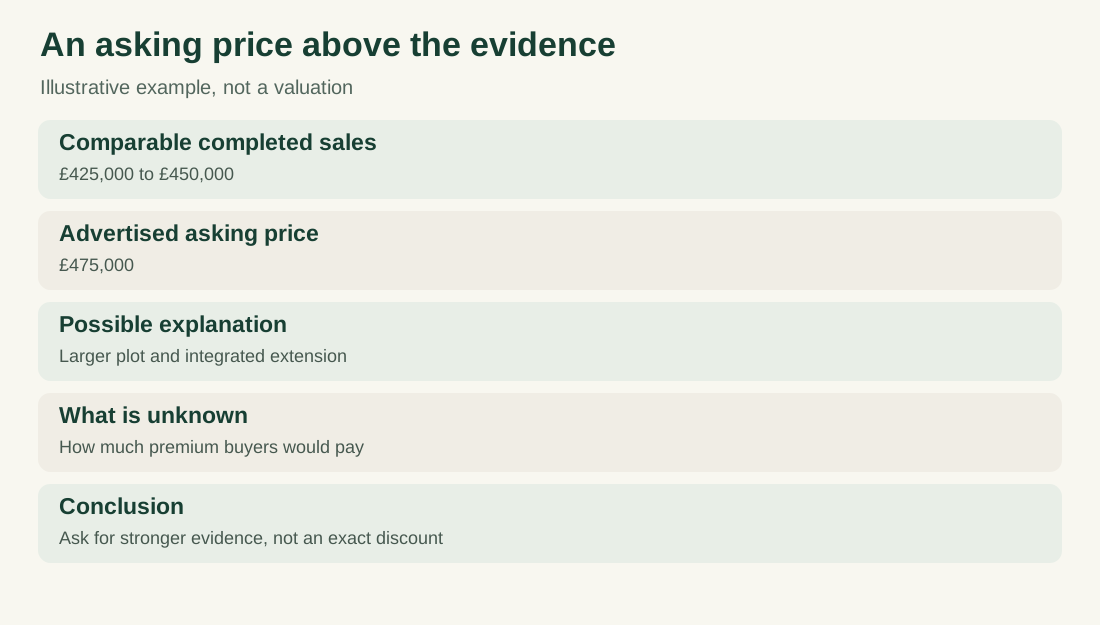
Illustrative example. A house is advertised at £475,000. Several reasonably comparable completed sales fall between £425,000 and £450,000. At first glance the asking price sits above that evidence.
Now suppose the advertised house has a significantly larger plot and a well-integrated extension. Those features might support a premium, but the available sales do not tell us how much. The defensible conclusion is that the asking price needs a stronger explanation, not that it is overpriced by exactly £25,000.
 Illustrative example
Comparable completed sales: £425,000 to £450,000. Advertised asking price: £475,000. Possible explanation: Larger plot and integrated extension. What is unknown: How much premium buyers would pay. Conclusion: Ask for stronger evidence, not an exact discount.
Ask the agent which completed sales they used and how they allowed for the differences. An explanation based only on what the seller hopes to achieve is not equivalent to market evidence.
Treat listing history as a clue, not a verdict
A long period on the market may raise questions, but it does not establish that the asking price is wrong. A sale may have fallen through. Access for viewings may have been difficult. The property may appeal to a narrow group of buyers.
Equally, a recent price reduction does not prove that the new price is fair. Look at the evidence as it stands today. The difference between an asking price, an estimate and a completed sale is covered in asking price versus market value versus sale price.
What to do with the conclusion
If the asking price appears weakly supported, decide what additional evidence would change your view. Ask about floor area, tenure, alterations and any unusual features. A survey may be needed to investigate physical condition; comparable sales cannot do that job.
This guide deliberately stops short of telling you what to offer. Your financing, alternatives and appetite for risk also matter. See how much to offer on a house for that separate decision.
You can read about PMD's buyer report for a home you are considering.
An asking price is justified by the evidence behind it, not by how confidently it is presented.
Sources
- HM Land Registry, About the Price Paid Data: Describes completed sale price records and their limitations