
Property valuations
How to choose comparable sales for a house valuation
A comparable sale is useful only when the property is genuinely similar to the home you are assessing. Distance alone is not enough. This guide shows how to build a shortlist, check important differences and recognise when the evidence is too weak for a confident conclusion.
This is an estimate from comparable sales, not a RICS or mortgage valuation, and not a survey.
Which sold properties are genuinely comparable?
A useful comparable is not simply the closest house on a map. It is a completed sale that helps you understand what buyers have paid for a property sufficiently similar to the one you are assessing.
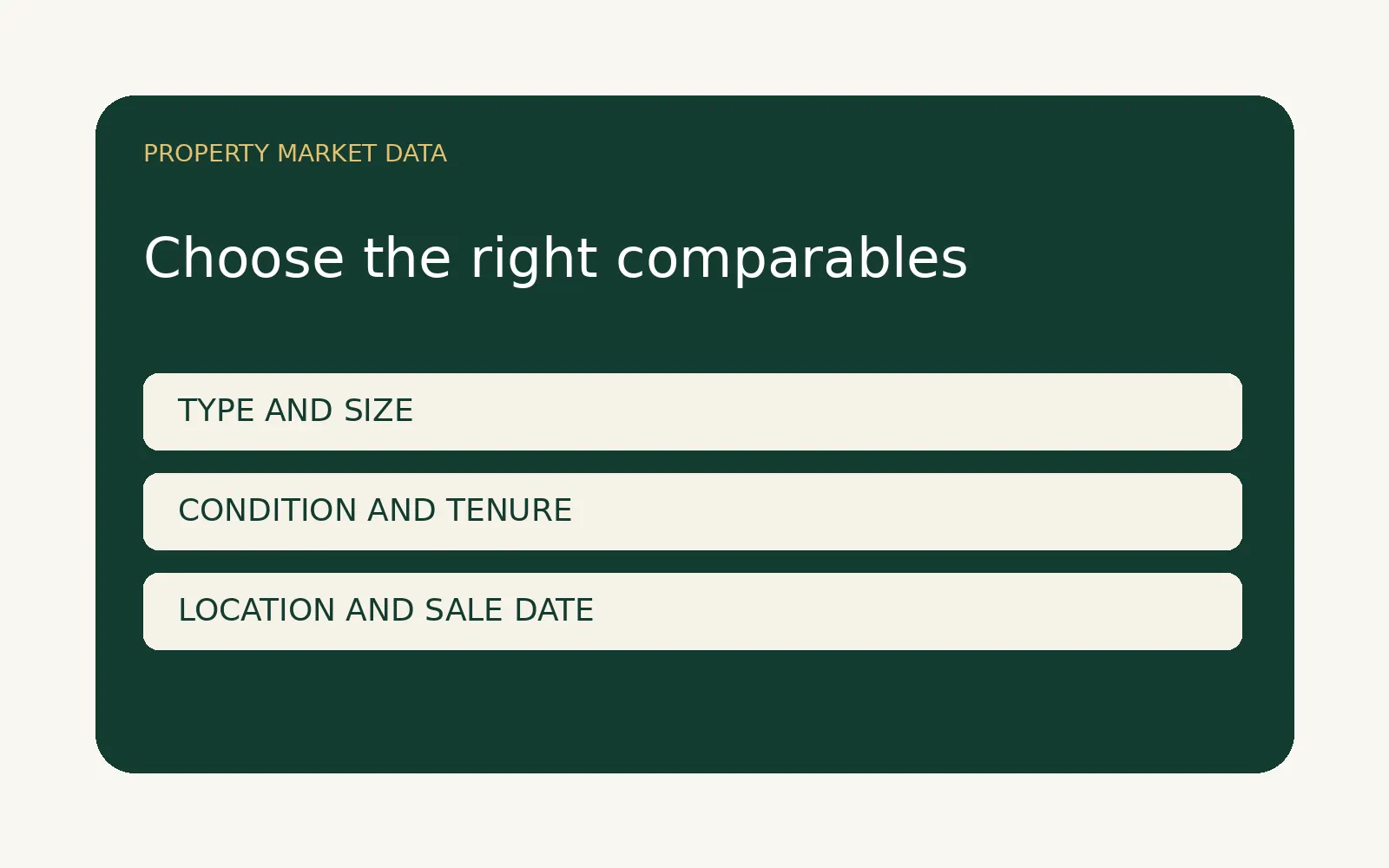
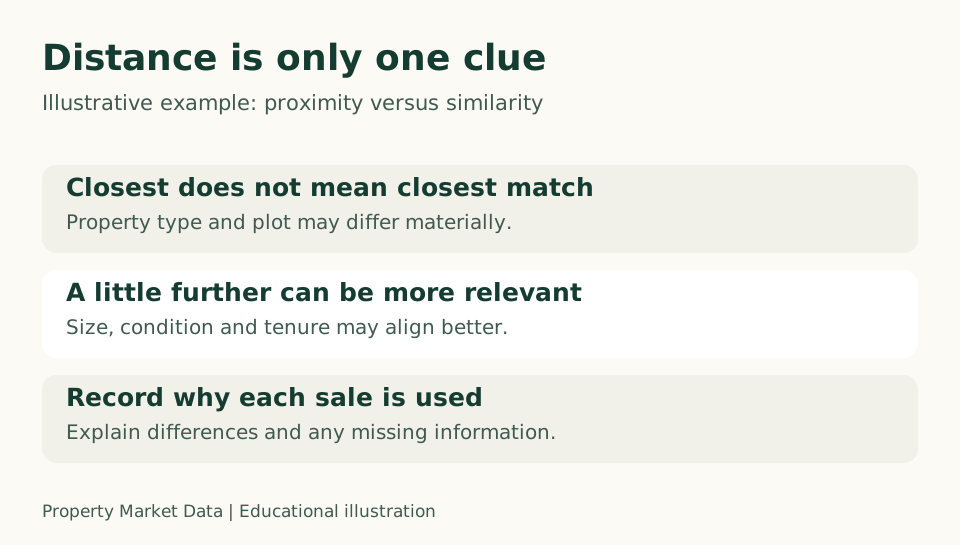
Start with the same broad property type, then check size, condition, tenure, location and the date of sale. A detached house with a large garden may be a poor match for a smaller detached house on the same street. A similar home a little further away may offer better evidence.
This matters because a valuation based on the wrong comparisons can look convincing. Several recorded sale prices do not necessarily make a strong case if the homes differ in ways that affect demand.
Use six checks to build your shortlist
Property type. Compare houses with broadly similar forms and uses. A bungalow, flat and detached family house can attract different buyers even when they have the same number of bedrooms.
Size and layout. Check internal floor area where reliable measurements are available. Bedroom count alone misses differences in living space, extensions and room arrangement.
Condition. Ask whether the sold home needed substantial work or had been recently refurbished. Photographs from old listings can help, but may not describe the condition at completion.
Tenure. Freehold and leasehold interests are not automatically equivalent. For leasehold properties, the remaining term and relevant charges may affect how meaningful the comparison is.
Location. Think beyond distance. A busy road, school catchment, outlook or nearby amenities can matter more than being a few streets closer.
Sale date. A recorded sale is evidence of what was paid at that time. It is not automatically a statement of today's value. Check what has changed in the local market since completion.
 Illustrative example
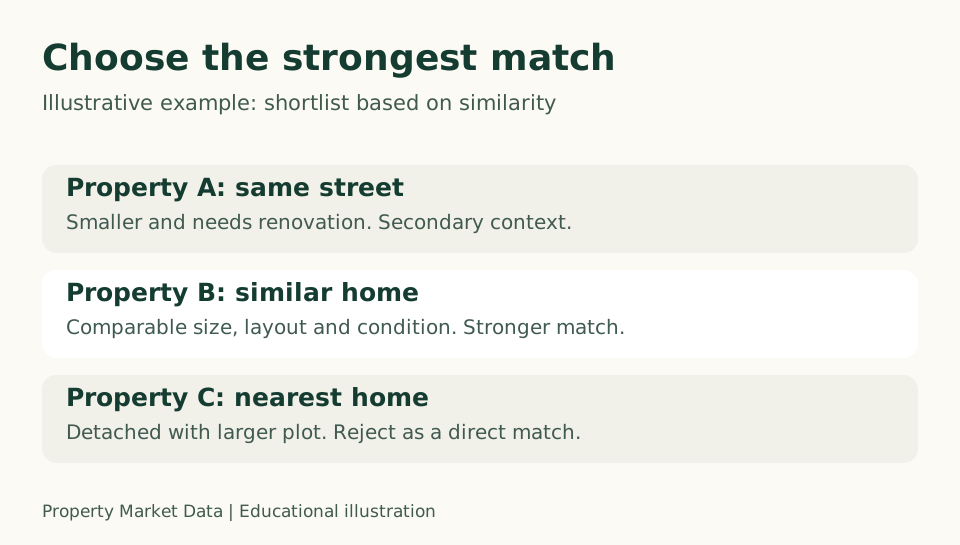
A similar property may be more useful than the nearest property.
A worked shortlist: choose similarity over distance
Illustrative example. Imagine you are assessing a three-bedroom semi-detached house with an extended kitchen and a modest garden. You find three completed sales.
- Property A: Same road and similar age, but substantially smaller and in need of renovation. Keep it as secondary context rather than your strongest comparison.
- Property B: A little further away, with similar floor area, layout and condition. This may be the most useful starting comparison if the local setting is broadly similar.
- Property C: Closest of all, but a detached house with a much larger plot. Reject it as a direct comparison, while noting what makes it different.
This is a judgement exercise, not a formula that proves one property is worth a particular amount. The point is to explain why you have included or excluded each sale. If you cannot explain the difference, the shortlist needs more work.
 Illustrative example
A location comparison cannot establish value without property characteristics.
What to do when the evidence is thin
Some homes have few convincing recent comparisons. This is common with unusual layouts, major extensions, rural locations or distinctive buildings. Do not disguise weak evidence by widening the search without explanation.
Instead, record what changed when you widened the search. Did you accept an older sale, a different street or a property with a different layout? Each choice adds uncertainty. The right response may be a broader estimated range, not a more precise figure.
HM Land Registry's Price Paid Data is useful for checking recorded transactions, but it does not by itself establish a property's present condition. Read the recorded transaction alongside other reliable property information.
For a separate explanation of what historic transaction records can and cannot show, see how to use sold house prices. For the strengths and weaknesses of floor-area comparisons, see price per square foot in house valuations. The wider context is covered in understanding local house values.
How to use comparables in your own decision
Write down your strongest two or three matches and why they qualify. Then list the differences that could affect the conclusion. Ask whether the evidence points in a reasonably consistent direction or whether it remains mixed.
If you are selling, use that shortlist to question the reasoning behind a proposed asking price. Ask the agent which completed sales support their recommendation and how they account for your property's differences. You do not need to assume that the highest or lowest suggestion is wrong.
A Property Intelligence Report can bring together relevant sales, property information and an explained estimate for your home. You can also view a sample report to see how the evidence is presented.
Next step: Compare the property characteristics before comparing the prices. A well-explained shortlist is more useful than a long list of loosely related sales.
Sources
- HM Land Registry, Price Paid Data: Explains completed transaction prices and the scope and timing of recorded sales
- Royal Institution of Chartered Surveyors, Automated Valuation Models roadmap: Discusses limitations of automated valuations and the importance of relevant property information
- Rightmove, How do online valuations work?: Explains how comparable property evidence affects online estimates