
Property valuations
Does Price per Square Foot Tell You What a House Is Worth?
Divide a sale price by floor area and you get a tidy number. That makes price per square foot attractive when comparing houses, especially where homes vary in size. Yet the number is only as useful as the measurements and the properties behind it. It is a cross-check, not a valuation formula.
This is an estimate from comparable sales, not a RICS or mortgage valuation, and not a survey.
A useful ratio can still conceal the important differences
Price per square foot is the sale price divided by the property's floor area. It is an easy way to compare homes of different sizes, which is why the figure appears in property discussions. But two homes can have identical floor areas and very different appeal to buyers.
A well-arranged three-bedroom home with a generous kitchen may work better than a larger home with narrow corridors and rooms that are difficult to use. Location, garden, parking, condition and architectural character can all matter more than a neat ratio.
Check what was measured
Before comparing ratios, establish whether the floor areas are measured on a consistent basis. Property listings may use different sources and may include or exclude spaces such as garages, outbuildings or restricted-height accommodation.
An EPC floor area can be a useful reference, but it is produced for an energy assessment and may not match a marketing floor plan or a professional measurement prepared for another purpose. Do not mix inconsistent figures without noting the limitation.
If a property's stated size is approximate, the calculated price per square foot is approximate too. More decimal places do not make the underlying measurement more accurate.
 Illustrative example
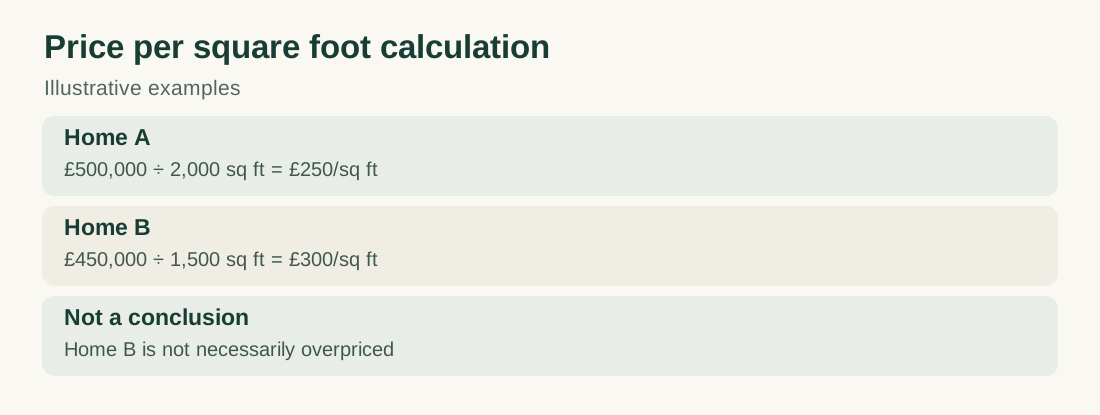
Home A: £500,000 ÷ 2,000 sq ft = £250/sq ft. Home B: £450,000 ÷ 1,500 sq ft = £300/sq ft. Not a conclusion: Home B is not necessarily overpriced.
Work through the calculation carefully
Illustrative example. Home A sells for £500,000 and is reported as 2,000 square feet. Its simple rate is £250 per square foot. Home B sells for £450,000 and is reported as 1,500 square feet, giving £300 per square foot.
That does not mean Home B is overpriced. It might occupy a better position, be in superior condition or offer more valuable outside space. Smaller properties can also command a higher rate per square foot than larger ones because the relationship between size and price is not linear.
Nor does it mean that adding 200 square feet to Home A would automatically add £50,000. Additional space can improve a home, but its contribution depends on usefulness, quality and the existing layout.
Compare like with like first
The ratio is most useful as a cross-check among homes with similar characteristics. If you are comparing a cluster of broadly similar modern houses on the same development, a striking difference may prompt a useful question.
If you are comparing a listed cottage with a new-build detached house, the ratio may tell you very little. The cottage may have low ceilings and an exceptional setting; the new home may have a conventional layout and less land.
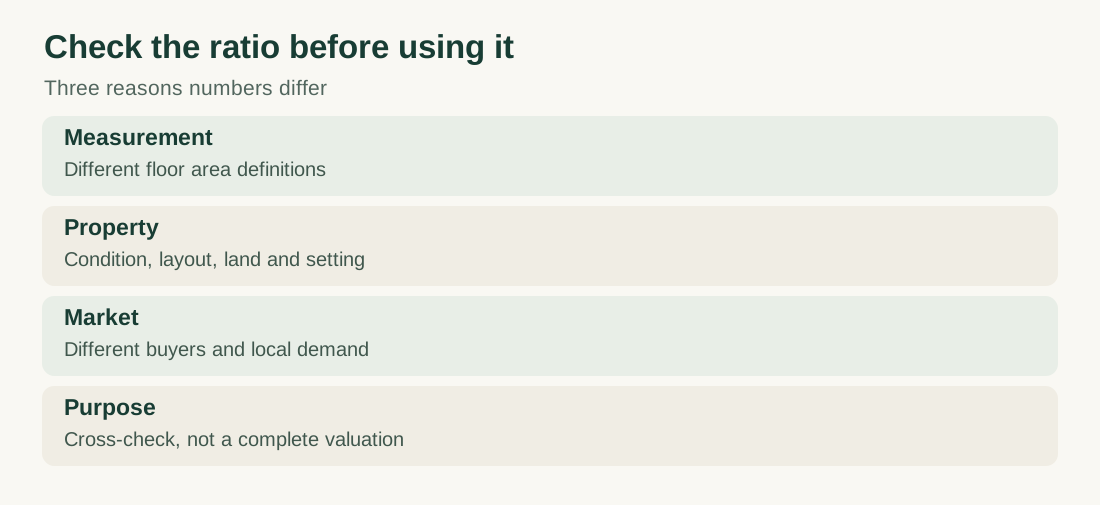
Measurement: Different floor area definitions. Property: Condition, layout, land and setting. Market: Different buyers and local demand. Purpose: Cross-check, not a complete valuation.
Ask why one property sits above or below the group rather than treating the average as a target. An apparent outlier might be an error in floor area, a superior plot or a transaction with unusual circumstances.
Avoid using a postcode average as a valuation formula
Applying the area's average price per square foot to your home's size assumes that all square feet in that area carry roughly the same value. They do not. A square foot of accommodation in a sought-after village centre cannot automatically be priced like one beside a busy road.
Look at completed sold prices to find relevant transactions, and then assess the property differences. Extensions and house value explains why extra floor area does not produce a guaranteed uplift.
For flats, lease terms and service charges may materially affect value even when floor areas match. For rural homes, land, outbuildings and setting can dominate the comparison.
Use the number to challenge, not settle, an estimate
If an agent recommends a high asking price, ask which comparable sales support it. The price-per-square-foot figure may help you notice an inconsistency, but the agent should explain why the home deserves a premium or discount.
PMD's Property Intelligence Report considers property-specific evidence and assumptions. A single size-based calculation cannot replace that analysis or a formal professional valuation where one is needed. PMD is a trading name and service of The Ivybridge Collection Ltd, whose registered nature of business is real estate agencies, and we also sell marketing subscriptions to estate agents.
Use price per square foot as a question generator. If the ratio looks unusual, investigate the home, the measurement and the transaction before deciding what the number means.
Sources
- HM Land Registry, About the Price Paid Data: Explains recorded completed sales, coverage and limitations