
Buying and offers
How to Compare Several Houses Before Buying
You have viewed three homes and each has something the others lack. One has the location, another has the space, and the third appears cheaper. Comparing them properly means using the same questions for each while recognising that some compromises matter far more than others.
This is an estimate from comparable sales, not a RICS or mortgage valuation, and not a survey.
Do not let the asking price choose the winner
The cheapest house on your shortlist may need substantial work. The most expensive may have a layout that avoids an extension later. A slightly smaller home may put you in a location that suits your daily life better.
Comparing asking prices alone misses these differences. So does dividing every price by the number of bedrooms. Before deciding which home offers value, separate the evidence about the property from the question of whether it suits you.
The first is partly measurable. The second depends on your priorities.
Set your non-negotiables before scoring anything
Write down the things you genuinely cannot compromise on. They might include a particular commute, accessible living space, room for a family member or an outdoor area suitable for a specific use.
Then identify preferences you would trade against price or other benefits. A larger kitchen may be attractive without being essential. A second reception room may matter less than the position of the house.
Do this before you fall in love with a property. Otherwise it is surprisingly easy to revise your criteria to justify whichever home made the strongest first impression.
Put comparable facts on the same sheet
For each home, record the asking price, tenure, approximate internal floor area, layout, condition, parking, outside space, location and any material restrictions you know about. Use the same measurement units and note the source of each fact.
A bedroom count can conceal substantial differences in usable space. Floor area helps, but a poorly arranged house may feel smaller than its measurements suggest. How price per square foot can mislead explores the limits of that metric.
If one property has missing information, leave the field blank and mark it for investigation. Do not turn an agent's estimate into a confirmed fact.
 Illustrative example
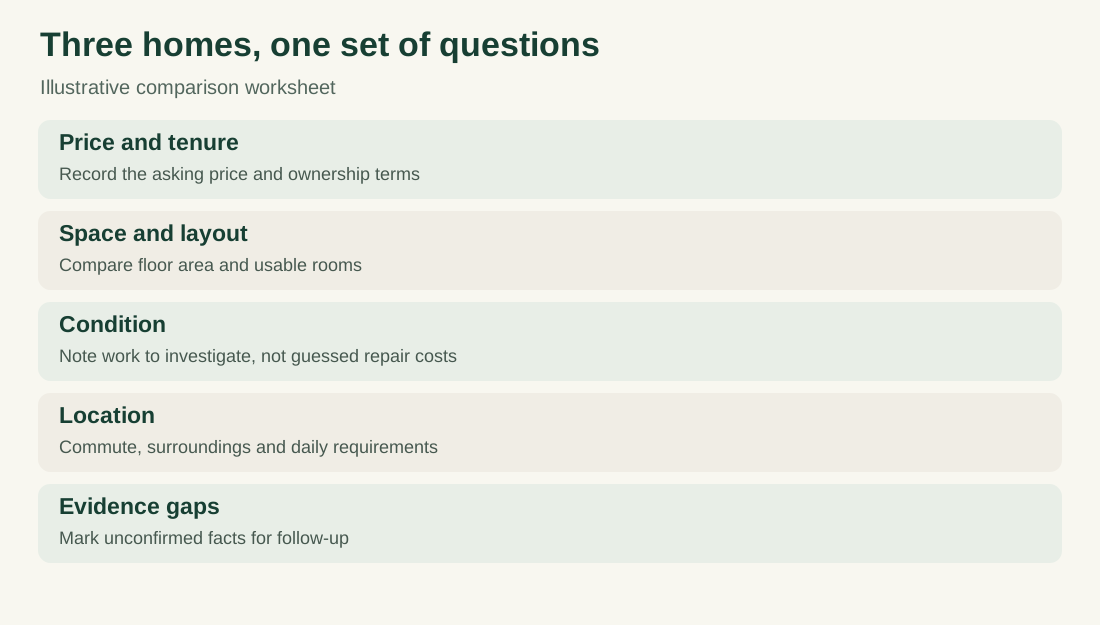
Price and tenure: Record the asking price and ownership terms. Space and layout: Compare floor area and usable rooms. Condition: Note work to investigate, not guessed repair costs. Location: Commute, surroundings and daily requirements. Evidence gaps: Mark unconfirmed facts for follow-up.
Compare the costs of owning, not just buying
Consider potential maintenance, energy use, service charges where applicable, insurance and any work you believe may be necessary. These are not all known at viewing stage. A survey, conveyancing enquiries and specialist quotations may change the picture.
Illustrative example. House A has a lower asking price than House B but appears to need a new heating system and significant roof work. It would be a mistake to add guessed repair costs and treat the resulting total as reliable. Instead, record the potential work, obtain appropriate evidence and revisit the comparison.
For leasehold properties, investigate the remaining lease term, ground rent, service charges and relevant documents with the appropriate professionals. A lower asking price does not cancel out long-term obligations.
Keep value and suitability as separate judgements
A property can be well priced but wrong for you. Another can be unusually suitable but priced above the evidence. These are different conclusions.
Assess the likely market position using relevant completed sales, property differences and the date of those transactions. Then assess how well the home fits your priorities. Do not hide one judgement inside the other.
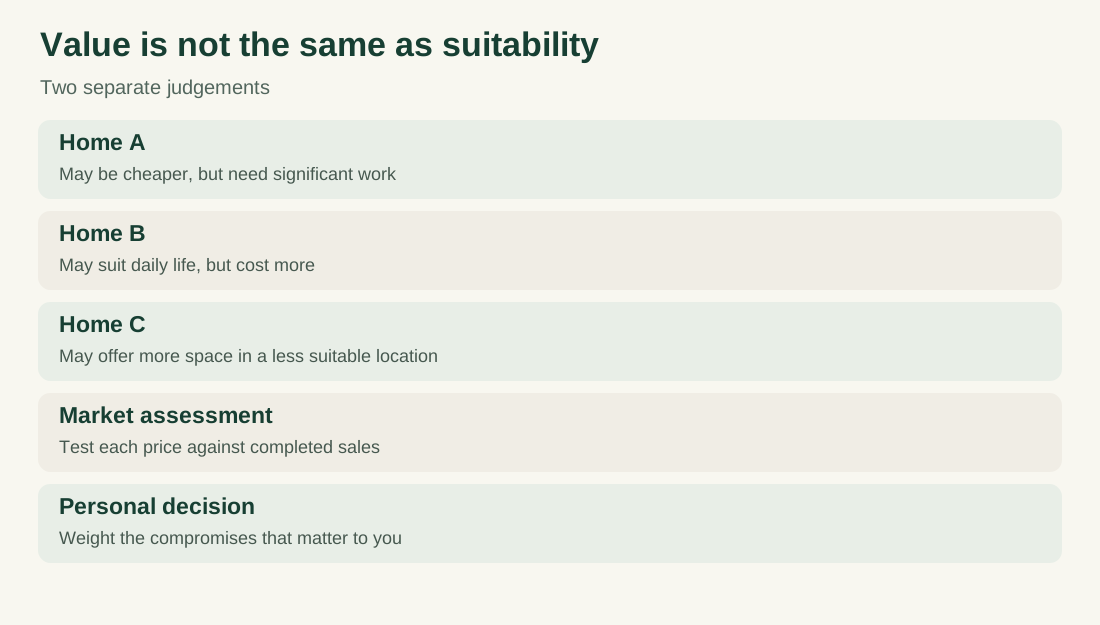
Home A: May be cheaper, but need significant work. Home B: May suit daily life, but cost more. Home C: May offer more space in a less suitable location. Market assessment: Test each price against completed sales. Personal decision: Weight the compromises that matter to you.
If you are moving to an unfamiliar location, buying in a new area explains what to investigate beyond the property itself.
A useful final comparison
Choose a short list of five or six criteria, not a spreadsheet with dozens of equally weighted rows. Give the most weight to things that would genuinely affect your life or your finances. Record why you gave each property its assessment.
If two homes remain close, revisit them at different times of day where practical. Pay attention to noise, light, access and the surrounding streets. Ask yourself which shortcomings you could address and which you would have to live with.
Before making an offer, use the checks to make before offering to identify the unanswered questions. You can read about PMD's buyer report for a home you are considering.
The aim is not to discover a mathematically perfect house. It is to make a choice you can explain after the excitement of the viewing has passed.
Sources
- HM Land Registry, About the Price Paid Data: Describes completed sale price records and their limitations