
Buying and offers
Before making an offer: the checks worth doing
The viewing went well and you can imagine living there. Before offering, separate what you know from what you have assumed. Some questions can be answered by the agent now, while others need a surveyor, conveyancer or lender later.
This is an estimate from comparable sales, not a RICS or mortgage valuation, and not a survey.

First decide what you can afford, not what you might persuade the seller to accept
An asking price is an invitation to negotiate, not a statement about your borrowing capacity. Before you make an offer, establish your available deposit, the likely transaction costs and the monthly payments you can realistically sustain. If you need a mortgage, discuss your position with a lender or qualified mortgage adviser. An agreement in principle is useful evidence of initial borrowing potential, but it is not a mortgage offer for that property.
Leave room for the costs you already know about and for costs that may emerge later. A buyer who stretches to the last pound of an initial budget has less flexibility if the survey identifies work or the lender values the property differently.
Put the asking price alongside completed sales
Look at properties that have actually sold, not only those advertised nearby. The strongest comparisons tend to share location, type, approximate size, condition and relevant features. Note when each sale completed. A transaction from a different market period may need more careful interpretation than a recent one.
A large detached home and a smaller semi-detached house in the same village do not become comparable merely because they share a postcode. Equally, a similar house on the other side of a busy road may not attract identical demand.
HM Land Registry's Price Paid Data records many completed transactions in England and Wales, but there can be a delay before a sale appears. It also cannot tell you everything about condition at the point of sale. For the detailed pricing decision, use how to decide what to offer.
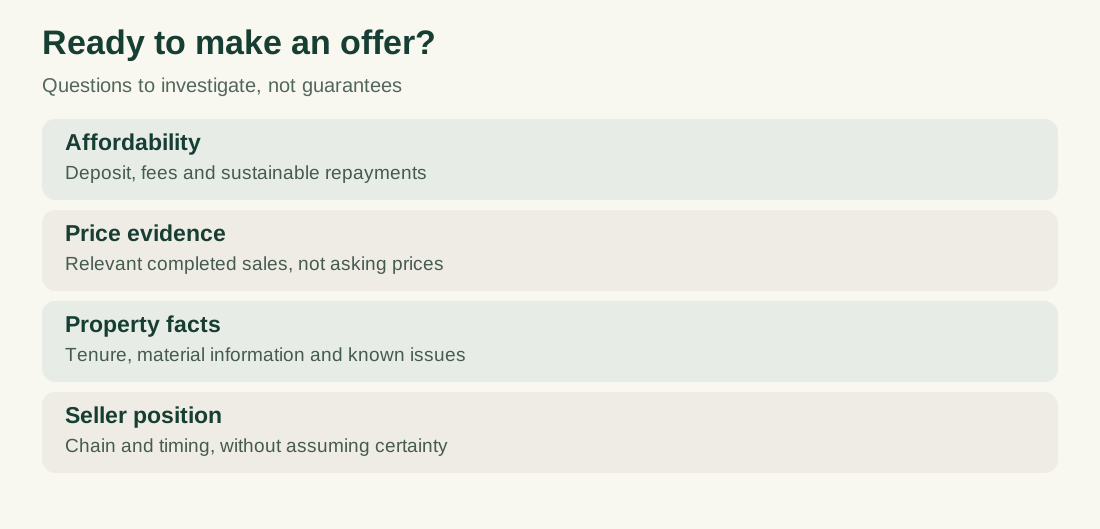
Affordability: Deposit, fees and sustainable repayments. Price evidence: Relevant completed sales, not asking prices. Property facts: Tenure, material information and known issues. Seller position: Chain and timing, without assuming certainty.
Ask for information that could change the decision
Before offering, ask the estate agent to confirm the tenure, the seller's intended timescale and any material information already available about the property. Questions about known alterations, rights of access, parking, boundaries, flooding or ongoing neighbour issues may be important depending on the home. Ask for the answer in writing where possible.
A confident verbal answer is not the same as documentary evidence. Some matters cannot be resolved until your conveyancer examines the title and replies to enquiries. Make a list of what remains to be verified rather than treating the absence of an immediate answer as proof that no issue exists.
If the property is leasehold, ask about the remaining lease term, service charges, ground rent and planned major works. The precise legal and lending implications depend on the documents and the lender, so get specialist advice rather than assuming a general rule applies.
Distinguish a viewing observation from a professional check
You may notice a stain on a ceiling, an uneven floor or condensation around a window. Record what you saw and ask whether the seller has an explanation. Do not diagnose the cause yourself or rely on a seller's reassurance instead of appropriate inspection.
A surveyor can advise on the building's condition within the scope of their inspection. A conveyancer deals with legal title and enquiries. Your lender assesses whether it will lend on the property. These are different tasks, and none is replaced by an online estimate. For questions to ask while you are physically at the property, see the house-viewing questions guide.
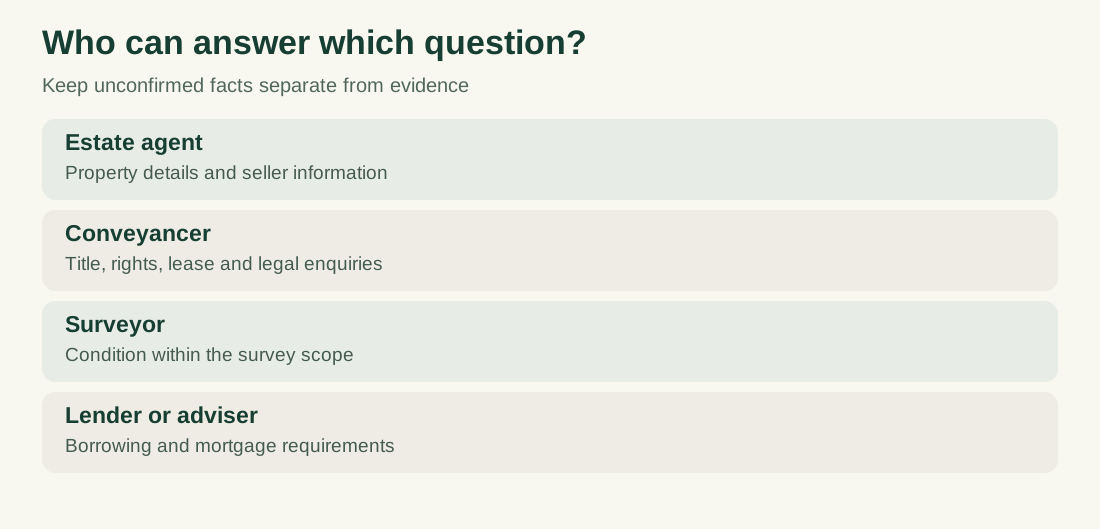
Estate agent: Property details and seller information. Conveyancer: Title, rights, lease and legal enquiries. Surveyor: Condition within the survey scope. Lender or adviser: Borrowing and mortgage requirements.
Understand the seller's circumstances without assuming too much
Ask whether the seller is buying onward, has an agreed purchase or has a preferred moving date. Their answer may help you frame a realistic timetable. It does not prove the chain is secure, and it should not be treated as a promise of completion.
If the agent says there is another offer, you can ask about the process and timing for submitting yours. You may not be entitled to details of a competing buyer's finances or identity. Avoid allowing urgency to replace your own checks.
Decide what can wait until after the offer
In England and Wales, an accepted offer generally does not make the property purchase legally binding before exchange of contracts. That does not mean the period is risk-free: you may incur survey, mortgage and legal costs even if the transaction fails. Scotland follows a different process, so take jurisdiction-specific advice.
You do not need to complete conveyancing before offering. You do need to know which unanswered questions are material enough to affect your decision and what professional checks you will commission if the offer is accepted.
You can read about PMD's buyer report for a home you are considering. It is a property report on the price, not a completed buyer due-diligence service, a survey or legal advice.
A sensible offer begins with a clear affordability limit, credible price comparisons and a written list of questions that still require answers. The offer amount comes next, not first.
Sources
- HM Land Registry, About the Price Paid Data: Explains recorded completed sale price information and limitations
- RICS, Home surveys: Explains the purpose and scope of residential property surveys, URL to verify before publishing