
Property valuations
Which type of property valuation do you need?
Different property decisions need different kinds of assessment. An online estimate, estate agent appraisal, lender valuation and survey each answer a different question. This guide explains what each can tell you, where its limits lie and how to choose the right starting point.
This is an estimate from comparable sales, not a RICS or mortgage valuation, and not a survey.
Choose the assessment that matches your decision
A seller deciding an asking price, a buyer applying for a mortgage and a homeowner concerned about a structural crack do not need the same kind of assessment. The word valuation is used for several services, but their purposes and evidence are different.
Start with the question you need answered. Do you want an indication of a likely selling price, a lender's assessment for mortgage security, a formal valuation for a particular legal or financial purpose, or an inspection of the property's condition? The answer determines which professional or report to use.
An automated property estimate can help you examine recent transactions and market context. It cannot inspect the building, settle legal questions or replace an assessment required by a lender or another organisation.
An online estimate is a starting point for market research
Online estimates commonly use recorded property details and comparable sales. Their usefulness depends on how much is known about the home and how relevant the available transactions are.
A typical property in an area with many similar recent sales may have more supporting evidence than an unusual home with substantial alterations. A system may not know about a new extension, a change in condition or a feature that buyers particularly value. That is why the reasoning and assumptions matter as much as the number.
Use an online estimate to prepare questions, explore a potential range and test whether an asking price appears consistent with the evidence. See how accurate online house valuations can be for a closer look at the limitations.
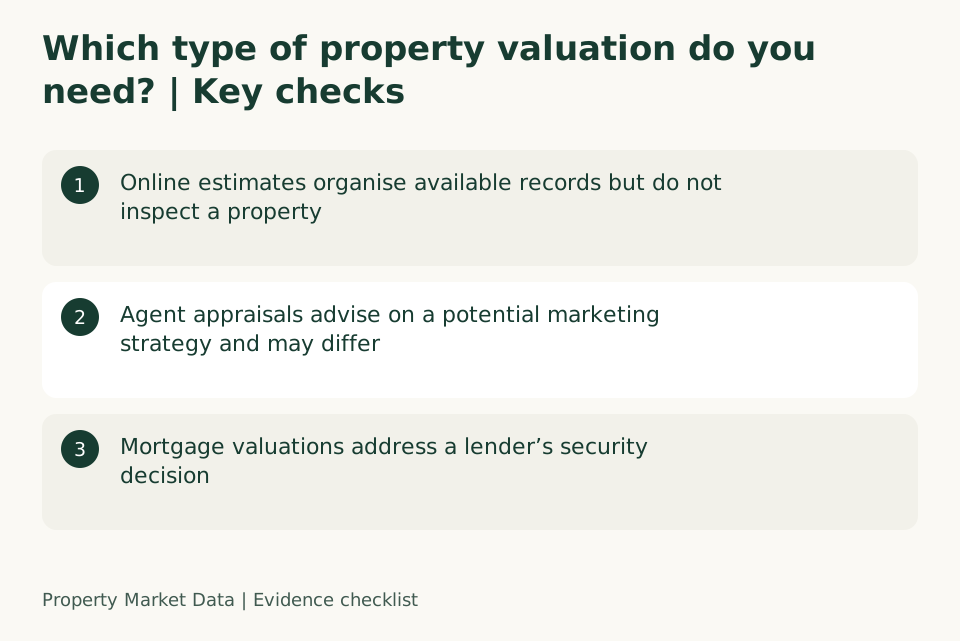
Online estimates organise available records but do not inspect a property; Agent appraisals advise on a potential marketing strategy and may differ; Mortgage valuations address a lender’s security decision
An estate agent appraisal helps plan a sale
An estate agent's market appraisal usually considers how the home could be positioned and marketed, as well as the local demand they expect to encounter. The agent may have viewed the property and may know about current competing listings or buyer enquiries.
An appraisal is still a judgement about a possible sale, not a completed transaction. Ask the agent to separate their estimate of an achievable price from their recommended asking price. Request recent comparable sales and an explanation of why the chosen properties are relevant.
If several agents disagree, ask what assumptions produce the differences. Is one allowing for a longer marketing period? Does another believe the condition or location will attract a narrower buyer pool? A higher appraisal is not automatically a better outcome.
A lender's valuation answers a lending question
When a mortgage is involved, the lender may arrange an assessment to decide whether the property offers acceptable security for the proposed loan. The assessment is for the lender's purpose, even where the applicant pays a fee.
A lender's figure can differ from the asking price or the agreed purchase price. It does not necessarily establish the only possible market price. If a lender assesses the property below the agreed amount, discuss the financing implications with your mortgage adviser or lender before deciding how to respond.
See what a mortgage down valuation means for the buyer's next steps.
A survey looks at condition, not simply price
A survey is intended to provide information about the property's condition and potential defects. The scope depends on the type of survey and the surveyor's instructions.
Do not assume that a lender assessment includes a thorough inspection for your benefit. Equally, do not assume that an automated report can identify damp, structural movement, roof defects or other issues that may require physical inspection.
A buyer may need both an assessment of price and a separate inspection of condition. These answer different questions and can affect different decisions.
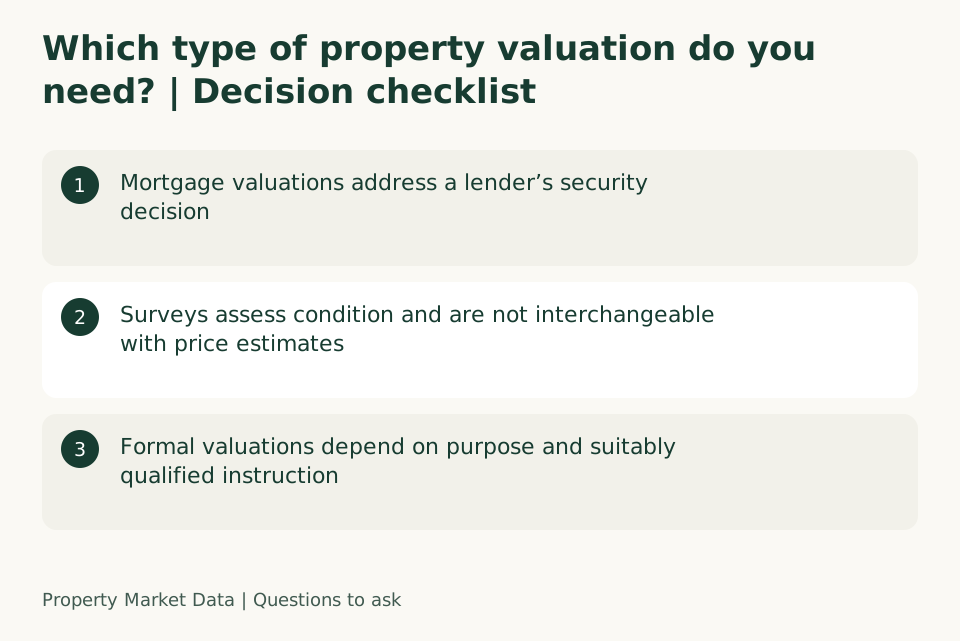
Mortgage valuations address a lender’s security decision; Surveys assess condition and are not interchangeable with price estimates; Formal valuations depend on purpose and suitably qualified instruction
Formal valuations have defined purposes
A formal valuation may be required for taxation, court proceedings, probate, accounting or another specified purpose. The appropriate basis, date, evidence and professional requirements depend on that purpose.
If an organisation requires a particular type of valuation, check its instructions before commissioning anything. A consumer market estimate or an estate agent appraisal may not satisfy that requirement. For legal, tax or lending decisions, use the relevant professional guidance.
Match the report to the decision you are making
| Your question | Sensible starting point | Important limitation |
|---|---|---|
| What might my home sell for? | Market evidence and an estate agent appraisal | Neither predicts a completed sale |
| Does this asking price make sense? | Comparable sales and property details | Similar properties can still differ materially |
| Will my lender accept the price? | The lender's required assessment | The lender decides its own lending position |
| What condition is the property in? | A suitable survey | A price estimate does not inspect the building |
| Do I need a figure for a formal purpose? | Confirm the required valuation basis | A general online estimate may not be acceptable |
A sample Property Intelligence Report shows the kind of comparable evidence and assumptions available through PMD. For a home you are considering selling, the seller report can provide a separate evidence-led starting point.
Next step: Write down exactly which decision the figure must support. Then choose the report or professional assessment that is designed for that purpose.
Sources
- HM Land Registry, Price Paid Data: Explains the nature and limits of recorded completed sale prices
- HM Land Registry, House Price Index: Provides background on published house price statistics