
Choosing an estate agent
When is a second property market opinion worth paying for?
Conflicting valuations can leave you wondering who to believe. A second property market opinion may help with the evidence behind a price, but it cannot answer every question. The important first step is choosing the kind of review that matches your decision.
This is an estimate from comparable sales, not a RICS or mortgage valuation, and not a survey.
When another opinion helps, and when it does not
A homeowner receives three different price recommendations. A buyer wonders whether an asking price reflects recent sales. Someone with an unusual property finds that online estimates disagree sharply.
These are situations in which another informed opinion may help. But 'property review' can describe very different services. Before paying for one, establish which decision you need help making and what the reviewer will actually examine.
An opinion about comparable sales is not a survey. Advice on negotiation is not a formal valuation. A review of an automated report is not the same thing as appointing a professional to inspect the property.
Identify the unresolved question
Start with a sentence that describes the decision, not the service you think you need.
For example: 'The agents disagree about whether the proposed asking price is supported by completed sales.' Or: 'I cannot tell whether the house I want to buy is priced above similar properties.'
Those questions invite a review of evidence and reasoning. A reviewer can examine which comparisons are relevant, where assumptions differ and what remains uncertain.
By contrast, 'Is the roof structurally sound?' calls for a suitable inspection. 'What figure is required for a tax or court purpose?' may require a formal valuation with a defined basis. A market commentary service cannot replace either.
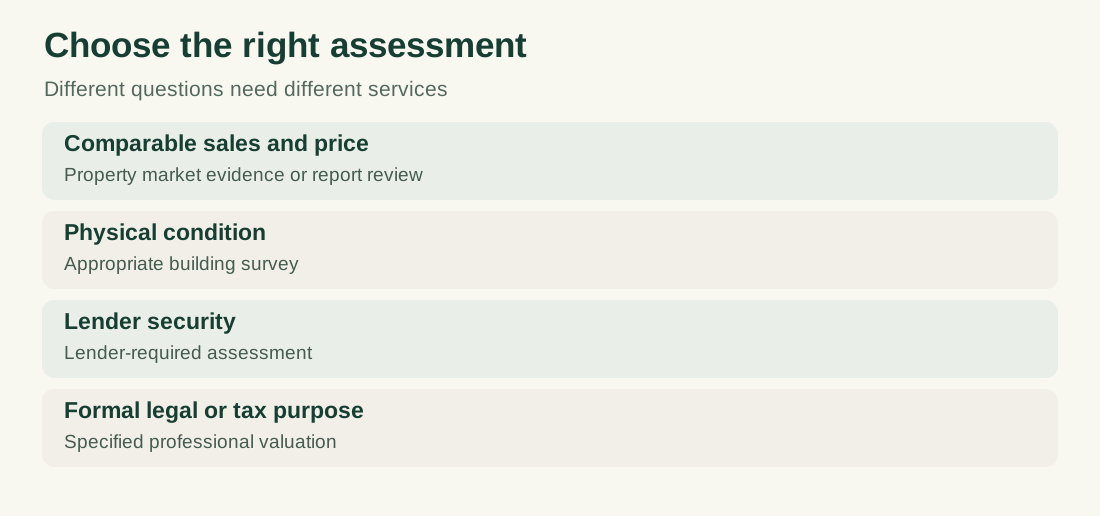
Comparable sales and price: Property market evidence or report review. Physical condition: Appropriate building survey. Lender security: Lender-required assessment. Formal legal or tax purpose: Specified professional valuation.
Check what the reviewer will actually do
Ask whether the service includes reading documents, inspecting the property, researching completed sales, considering the question you have raised and providing a written conclusion.
Find out what is excluded. Does the reviewer speak to estate agents or sellers? Will they advise on marketing proposals? Are they assessing a property's physical condition? Do they provide a formal valuation?
Do not infer any of those services from phrases such as 'expert opinion' or 'second opinion'. A useful written scope should tell you exactly what you will receive and which questions it is designed to answer.
For the distinction between market estimates, appraisals and formal assessments, see which type of property valuation you need.
Independence is a question to investigate
A reviewer can be knowledgeable and still have commercial relationships that matter to your decision. Ask who owns the service, whether it works with estate agents and whether any referral or commercial arrangement could affect how you interpret the advice.
That does not automatically make the analysis wrong. It does mean the relationship should be disclosed, rather than hidden behind a broad claim of independence.
Ask also about relevant experience and the evidence the reviewer relies on. If the property is unusual, find out how they deal with sparse comparable sales instead of pretending the estimate is more precise than it is. Valuing unusual homes explains why these cases need particular care.
Know what PMD's human review covers
PMD's human review is a written review of the customer's own Property Intelligence Report. A member of the team reads that report with the customer's specific question in mind and provides a property market opinion and negotiation support.
It does not include property inspection, a survey, a formal valuation, legal or financial advice, comparison of estate agents or their proposals, presentation or marketing advice, or contacting a seller or estate agent.
PMD is a trading name and service of The Ivybridge Collection Ltd, whose registered nature of business is real estate agencies, and we also sell marketing subscriptions to estate agents. That context is relevant when considering the perspective offered. The service should not be described as wholly independent of the agency market.
If you need the service just described, see the written human review. If you first need the underlying property evidence, a Property Intelligence Report provides an automated estimate using available comparable sales and property information.
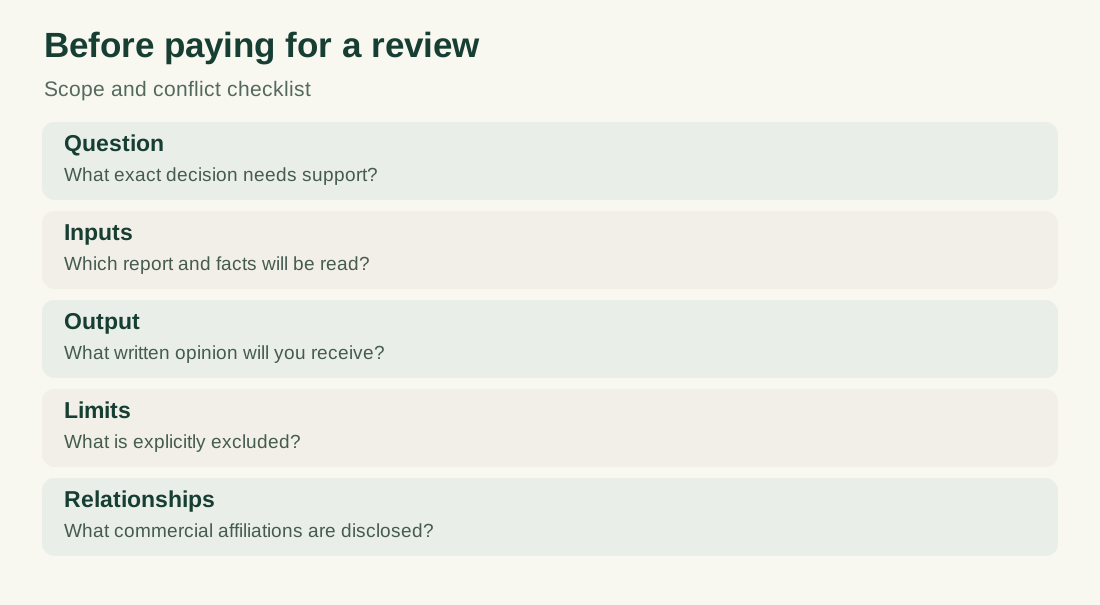
Question: What exact decision needs support?. Inputs: Which report and facts will be read?. Output: What written opinion will you receive?. Limits: What is explicitly excluded?. Relationships: What commercial affiliations are disclosed?.
What a useful written opinion should leave you with
A useful review need not remove every uncertainty. Sometimes the most valuable conclusion is that the evidence is weak or that an important property fact has not been confirmed.
Look for an explanation of which evidence matters, why competing interpretations differ and what information would materially change the assessment. Be cautious about confident conclusions that do not show their reasoning.
If your problem is conflicting estate agent appraisals, why estate agent valuations differ will help you ask the agents better questions. That is distinct from asking PMD to select an agent for you.
Decide whether the review matches the risk
A relatively straightforward pricing question may be answered by examining a report and a few relevant completed sales. A property with unusual construction, potential defects or legal complications may require specialist input that a written market opinion cannot supply.
There is no virtue in paying for the wrong kind of reassurance. Choose the assessment that can actually answer the question.
Before commissioning anything, write down the question, the documents the reviewer will use, what you will receive and what the service excludes. If those four things are clear, you can judge whether it is worth the cost.
Sources
- HM Land Registry, About the Price Paid Data: Describes recorded completed property transactions and data coverage