
Choosing an estate agent
Why do estate agent valuations differ?
Three agents can recommend three different prices for the same home. The difference may come from their comparable sales, assumptions about buyers or the marketing strategy they propose. This guide shows how to challenge the evidence and compare their reasoning.
This is an estimate from comparable sales, not a RICS or mortgage valuation, and not a survey.
Why two agents can value the same home differently
Two estate agents can inspect the same home and recommend different asking prices without either having a complete picture of what the market will pay. An appraisal involves judgement about comparable sales, current competition, likely buyer interest and the strategy chosen for the seller.
The first question is whether the agents actually disagree about likely selling value, or whether they agree broadly on value but recommend different marketing approaches. Those are different disagreements and need different answers.
Ask each agent to explain both their estimated achievable range and their suggested asking price. If they cannot distinguish the two, it is difficult to compare their recommendations properly.
Compare the completed sales behind each recommendation
Ask which completed transactions the agent considers most relevant. Check property type, size, condition, tenure, location and date. A sale on the same street may be less useful than a similar property a little further away.
Ask what adjustments the agent has made for differences between your home and each comparable. If one agent uses a larger, recently renovated house while another uses a smaller property needing work, their starting evidence may explain much of the difference.
Recorded sold prices can be checked using HM Land Registry data. Those transactions are historical facts, but interpreting them for today's market still involves judgement.
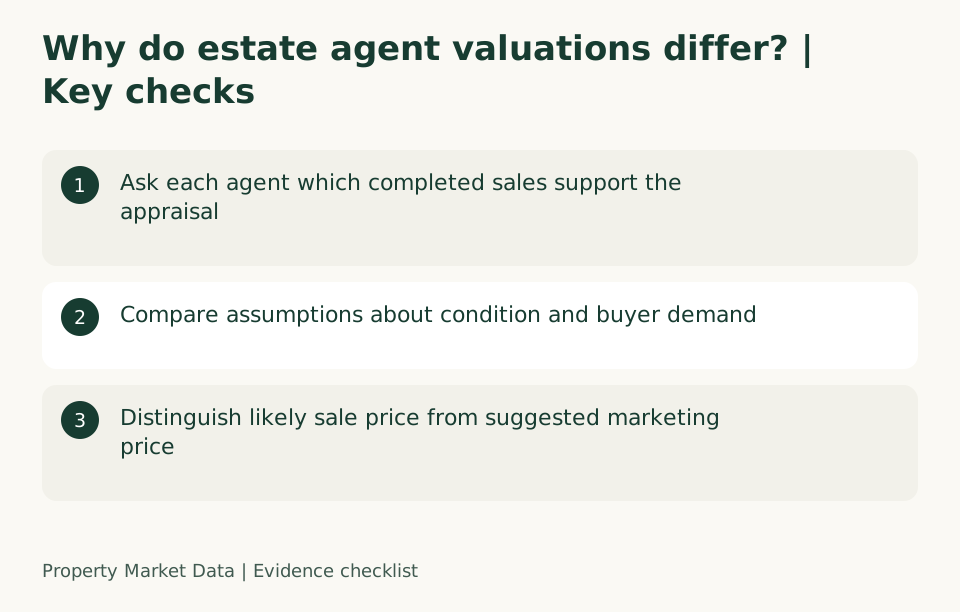
Ask each agent which completed sales support the appraisal; Compare assumptions about condition and buyer demand; Distinguish likely sale price from suggested marketing price
Ask what each agent assumes about the market
Agents may have different views about how many buyers are actively searching for your type of property. One may be influenced by recent viewings and offers; another may emphasise completed sales and current competing listings.
Ask them to separate observable facts from predictions. How many genuinely comparable properties are currently available? How long have they been advertised? Which recent sales support the proposed level?
A confident presentation is not itself evidence. Equally, an agent who gives a cautious estimate is not necessarily more accurate. The explanation matters more than the tone.
Distinguish an asking strategy from a valuation
An agent might recommend advertising above their central estimate to allow time to test demand. Another might recommend a more competitive opening price to attract attention sooner.
Neither strategy ensures a particular result. Ask what the agent expects to learn in the first few weeks, what buyer feedback would matter and what circumstances would trigger a change.
A useful question is: If the property attracts viewings but no offers, what would you investigate before recommending a price reduction? This tests whether the agent has a reasoned plan rather than a single opening number.
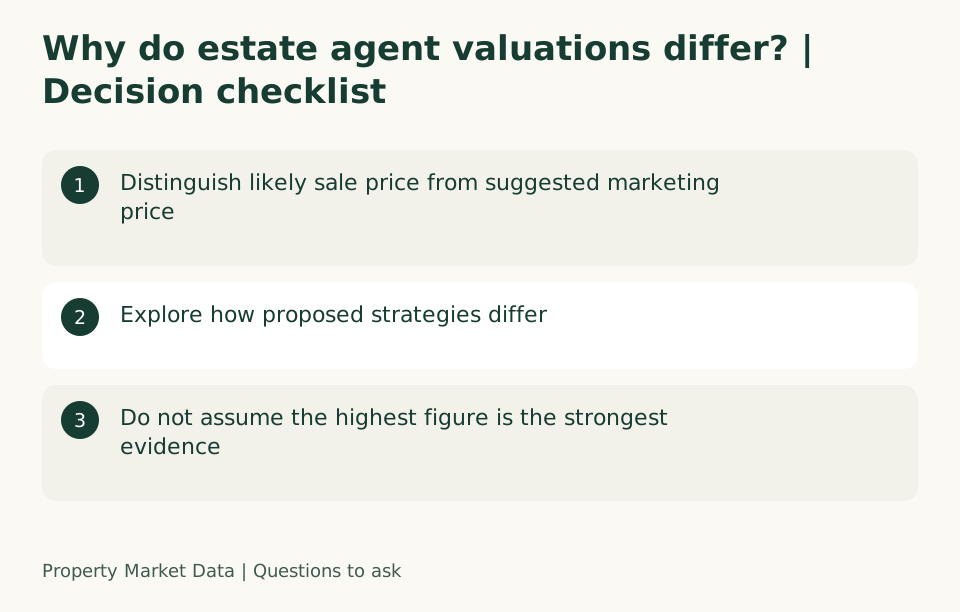
Distinguish likely sale price from suggested marketing price; Explore how proposed strategies differ; Do not assume the highest figure is the strongest evidence
Do not choose an agent by the highest figure alone
An attractive valuation can feel reassuring, especially when the home has been improved or holds personal significance. But choosing the highest appraisal without examining its basis may create unrealistic expectations.
Compare the service as well as the number. Who conducts viewings? How will offers be qualified? What will the agent report each week? What marketing is included and what will it cost? These questions matter to the overall instruction decision, although a PMD human review does not evaluate competing agents.
For a structured comparison of the agency service itself, see how to compare estate agents. For more questions to ask at the appraisal, see questions for an estate agent valuation.
A practical way to reconcile conflicting opinions
Create a short table with a row for each agent. Record the suggested asking price, estimated achievable range, strongest comparable sales, assumptions about condition and demand, and proposed review point.
Then identify where the disagreement lies. If the agents use different comparable sales, examine their relevance. If they use similar evidence but recommend different asking prices, compare their marketing logic. If important facts about the property are missing, correct those before deciding.
Illustrative example. One agent recommends a higher asking price because a nearby larger house sold well. Another recommends a lower figure based on a smaller but more similar property. Rather than averaging their suggestions, the seller should investigate the differences in size, condition and buyer appeal.
You can use a Property Intelligence Report to examine available sales evidence separately from the agents' recommendations. If you already have a report, a written human review can provide a team member's property market opinion and negotiation support in response to your question. It does not compare agents, advise on marketing or presentation, or contact anyone on your behalf.
Next step: Ask every agent for the two completed sales that most strongly support their appraisal and an explanation of why those sales are comparable.
Sources
- HM Land Registry, Price Paid Data: Explains the nature and limits of recorded completed sale prices
- HM Land Registry, House Price Index: Provides background on published house price statistics