
Choosing an estate agent
How to compare three estate agents before choosing one
Three estate agents may recommend different prices, fees and marketing plans. The right choice is rarely the one with the most flattering valuation. Here is how to compare their evidence, inspect the work they actually deliver and establish who will be accountable for your sale.
This is an estimate from comparable sales, not a RICS or mortgage valuation, and not a survey.
Three agents, three presentations, one decision
When you invite three estate agents to value your home, the appointments can feel like auditions. One agent brings a glossy brochure. Another has impressive local figures. The third seems to understand your house immediately.
All of that may be relevant. None of it tells you, on its own, who will do the job well.
You are choosing a business to represent a valuable asset, manage enquiries, negotiate with buyers and keep a transaction moving when complications arise. The proposed asking price matters, but it is only one part of that decision.
A useful comparison asks three separate questions: Is their pricing advice credible? What exactly will they do? Who will be accountable for doing it?
First, ask each agent to explain the price
Do not start by ranking the three valuations from highest to lowest. Ask each agent to distinguish the price they believe a buyer might pay from the figure they recommend putting on the advert.
An agent might believe a home could achieve one amount but recommend launching above it to test interest. Another might prefer a more competitive asking price. These are different strategies, even if both agents broadly agree about the home's value.
Ask for the completed sales behind the recommendation. Look at the properties, not just the prices. Was the comparison larger? Better presented? On a quieter road? Sold recently enough to be informative?
If one agent offers a notably higher figure, ask what evidence supports the difference. A thoughtful answer is more reassuring than a promise to achieve the asking price.
Why estate agent valuations differ explores that particular problem in more detail.
Look at the work, not the marketing vocabulary
Most agents will promise excellent photography, major property portals and attentive service. Those words are easy to say. Ask to see examples of the finished work.
Open two or three of their current listings that resemble your home. Are the first photographs compelling? Does the description explain the property accurately? Is the floor plan legible? Does the presentation give a buyer a reason to arrange a viewing?
Then ask what happens before launch. Who advises on preparing rooms? Who decides the order of photographs? Who writes and approves the description? What happens if the first photographs are not good enough?
A proposal that says 'professional marketing' without identifying the actual work leaves too much to interpretation. What an estate agent marketing proposal should include examines the deliverables in greater detail.
Find out who will actually sell your home
The person who visits to win your instruction may not be the person who conducts viewings or negotiates offers.
Ask who will handle the enquiries, whether viewings are accompanied, how prospective buyers are qualified and who will negotiate on your behalf. Find out who takes responsibility when a buyer has a mortgage problem, a chain breaks or the legal work stalls.
This is not an argument that one staffing model is always better. A well-organised team can provide excellent continuity. A director-led approach can offer clear accountability. What matters is whether you know who is responsible and can reach them when needed.
Ask each agent to describe the last difficult sale they managed, without revealing private client information. Listen for a clear account of the issue, the action taken and what was within their control. Be wary of anyone who suggests every transaction proceeds smoothly.
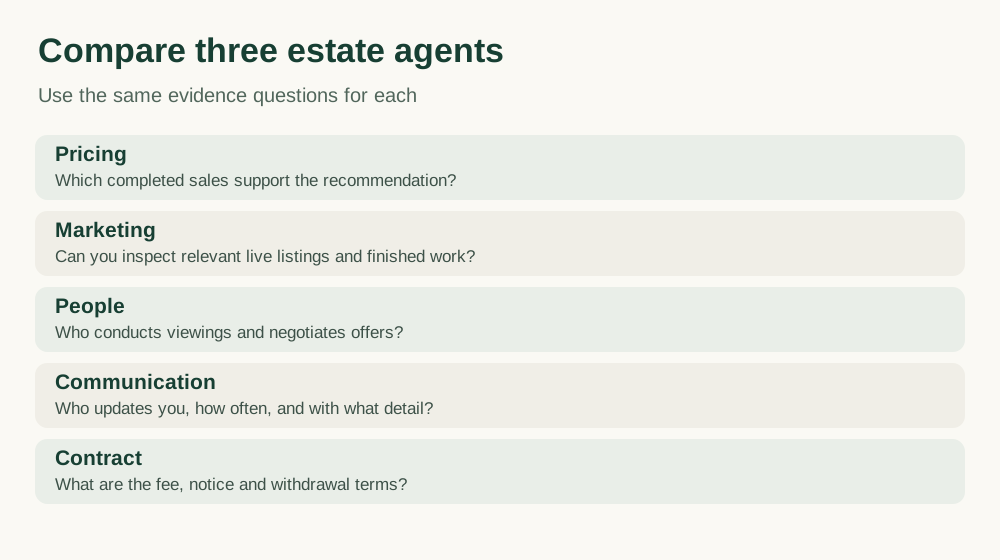
Compare pricing evidence, listing quality, people and responsibilities, communication and contract terms across all three agents.
Read the contract alongside the fee
A lower percentage does not automatically mean a better deal. Nor does a higher fee prove that an agent will provide a better service.
Request the terms in writing. Check the fee basis, VAT treatment, minimum charges, withdrawal terms, sole agency period, notice requirements and any circumstances in which a fee could become payable after you have moved to another agent.
Pay particular attention to how the contract defines an introduced buyer and when a commission liability arises. If you are unsure what a clause means, ask for an explanation in writing before signing and seek appropriate legal advice where necessary.
Compare the full cost and the work included, not a headline percentage in isolation. Comparing estate agent fees and service addresses that calculation separately.
Give the agents the same questions
You cannot make a fair comparison if one agent has been asked detailed questions and another has only given a presentation. Send each the same short request for clarification.
| Question | Agent A | Agent B | Agent C |
|---|---|---|---|
| What completed sales support your advice? | Record answer | Record answer | Record answer |
| What asking strategy do you recommend, and why? | Record answer | Record answer | Record answer |
| Who handles viewings and negotiations? | Record answer | Record answer | Record answer |
| What work is included before launch? | Record answer | Record answer | Record answer |
| How often will I receive a meaningful update? | Record answer | Record answer | Record answer |
| What are the full fees and exit terms? | Record answer | Record answer | Record answer |
Do not turn the table into a contest for the most impressive promises. Use it to expose unanswered questions.
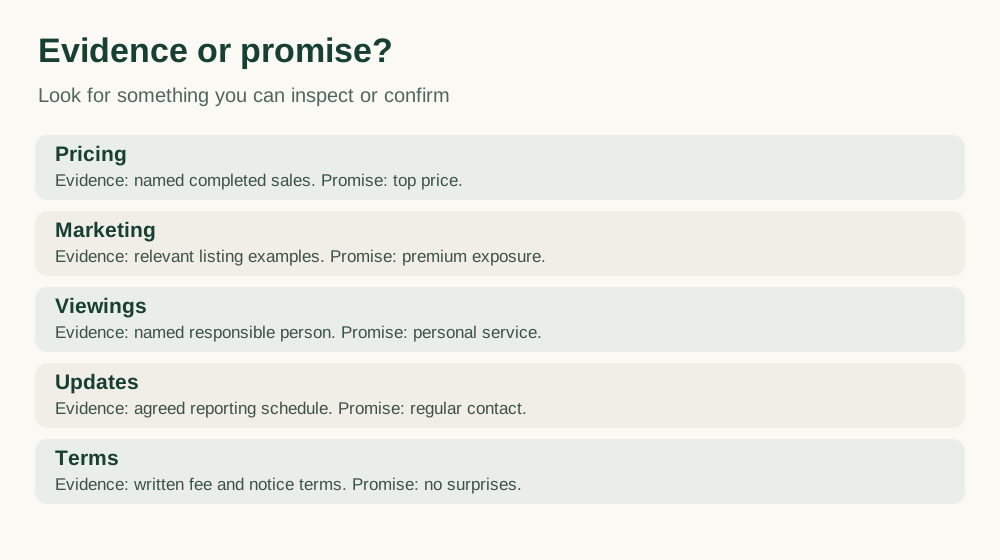
A convincing claim is backed by a named example or written commitment. A general promise is not equivalent evidence.
A simple scoring method, with one important safeguard
You may find it helpful to score each agent against pricing evidence, quality of presentation, personal accountability, communication and contract terms. Decide which matters most to you before looking at the scores.
Illustrative example. A seller with a complicated onward purchase may place particular weight on sales progression and communication. Someone selling an unusual country property may place more weight on the agent's ability to explain its distinctive features and reach appropriate buyers.
There is no universal weighting. A neat total can create false confidence if you have scored promises rather than demonstrated work. Write one sentence explaining each score, and leave it blank if you have not seen enough evidence.
You should also ask yourself which agent you would trust to deliver unwelcome news. The ability to have a difficult conversation about price, buyer feedback or delays can be more valuable than an impressive valuation appointment.
Make your choice on evidence and fit
Before deciding, ask each agent to confirm their proposed asking strategy, marketing deliverables, named contact, reporting arrangements, fee and contract terms in writing.
If you want a separate view of the comparable sales supporting your home's price, a Property Intelligence Report may help you examine the evidence. It is not an assessment of which estate agent you should appoint.
PMD also provides a written human review of a customer's report focused on the customer's specific property market question and negotiation support. That service does not compare estate agents or their proposals, advise on presentation or marketing, or contact an agent on your behalf. PMD is a trading name and service of The Ivybridge Collection Ltd, whose registered nature of business is real estate agencies, and we also sell marketing subscriptions to estate agents. Consider that context when judging its perspective.
Choose the agent whose reasoning you understand, whose work you have seen and whose responsibilities are clear. You are not buying the most flattering number. You are appointing someone to handle a sale.
Sources
- HM Land Registry, Price Paid Data: Explains the nature and limits of recorded completed sale prices
- HM Land Registry, House Price Index: Provides background on published house price statistics