
Choosing an estate agent
How to compare estate agent fees and what they include
Estate agent commission quotes are easy to compare until you look at what is included. Two similar percentages can cover different work and different contractual obligations. This guide shows how to calculate the cost and establish what each agent is actually offering.
This is an estimate from comparable sales, not a RICS or mortgage valuation, and not a survey.
The cheapest percentage is not necessarily the cheapest decision
Two agents quote different commission rates. It is tempting to subtract one from the other and choose the lower figure. But a fee is only meaningful when you know what triggers it, what is included and who will actually deliver the service.
Ask for a written quotation with VAT clearly stated. Then compare the work covered by that quotation. Photography, floor plans, accompanied viewings, negotiations and sales progression can be organised differently from firm to firm.
This does not mean a more expensive agent must be better. It means the percentages are not comparable until you know what you are buying.
Work out the amount payable, including VAT
Percentage commissions are commonly calculated against the eventual sale price, but the exact basis is set by the agreement. Check whether the quoted percentage includes VAT and whether a minimum fee applies.
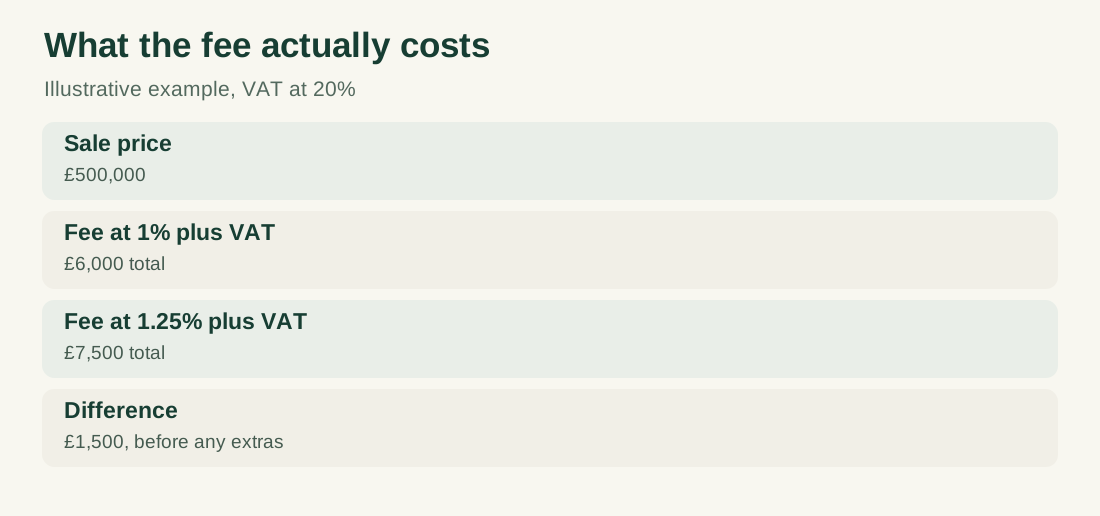
Illustrative example. On a completed sale at £500,000, a fee of 1% plus VAT at 20% would amount to £6,000. A fee of 1.25% plus VAT at 20% would amount to £7,500. The difference is £1,500. This calculation assumes those are the agreed rates and that no other fees apply.
That arithmetic tells you the cost difference. It tells you nothing about which agent would achieve a better outcome. Nobody can establish that from a commission quote alone.
Ask whether additional payments are due for premium portal listings, photographs, video, floor plans, advertising or withdrawing the property. Check whether any payment is due before completion and what happens if the sale does not proceed.
 Illustrative example
Sale price: £500,000. Fee at 1% plus VAT: £6,000 total. Fee at 1.25% plus VAT: £7,500 total. Difference: £1,500, before any extras.
Ask for the service in writing
A brochure that promises comprehensive marketing is not a service specification. Ask who does the work and what you can expect to receive.
For example, does the fee include professional photography, an accurate floor plan and a considered property description? Who approves the advert before publication? Are viewings accompanied? Who follows up with viewers and reports their comments? Who negotiates offers? Who follows the transaction after an offer is accepted?
The answers should be specific enough that you could recognise whether the promised work had been done. For more on assessing the proposed marketing itself, see what to look for in an estate agent marketing proposal.
An agent may offer a leaner service at a lower price and deliver it very well. Another may provide a more involved service that suits a complicated property. The question is whether the scope matches your needs.
Look beyond the launch
Many proposals devote pages to photography and property portals. Fewer explain the routine work that follows.
Ask how often you will receive a meaningful update, who qualifies potential buyers, how offers are presented and who handles delays between agreement and completion. A difficult chain can require more attention than the launch campaign.
If the person who wins the instruction will not handle the transaction, establish who will. This is not a criticism of team-based agencies. It is a question of accountability.
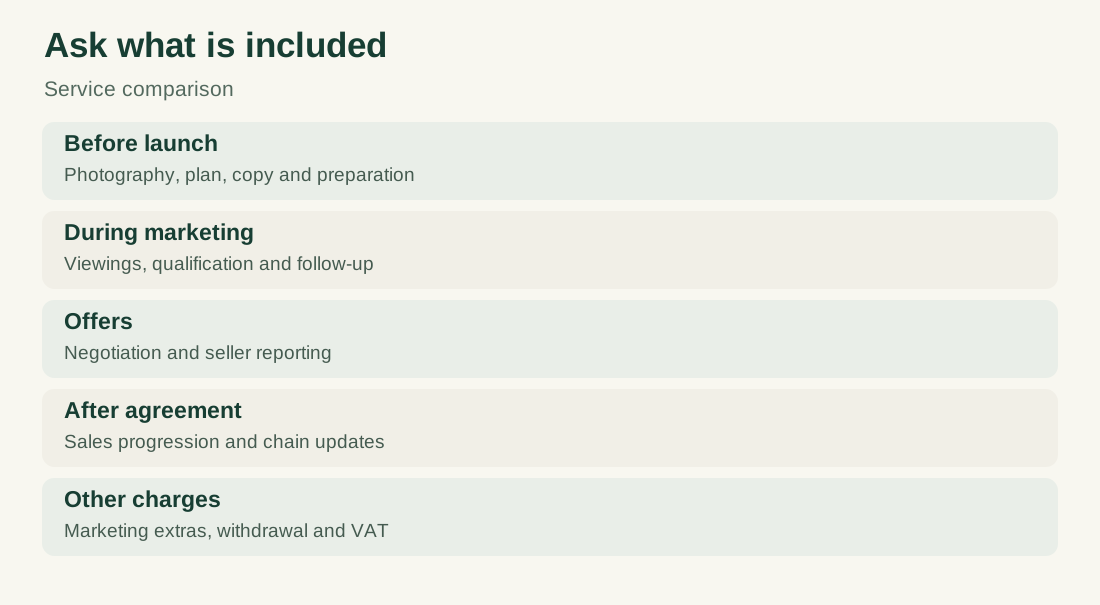
Before launch: Photography, plan, copy and preparation. During marketing: Viewings, qualification and follow-up. Offers: Negotiation and seller reporting. After agreement: Sales progression and chain updates. Other charges: Marketing extras, withdrawal and VAT.
Understand when commission becomes due
Fee comparisons also depend on the contract. A sole agency agreement and a sole selling rights agreement can create different liabilities. The agreement should explain the circumstances in which a fee is payable, including what happens if a buyer is introduced during the instruction but completion occurs later.
Do not assume that giving notice immediately removes every potential commission liability. Nor should you assume that a withdrawn instruction always creates a fee. The written terms matter.
For the clauses to examine, use the estate agency agreement checklist. If a clause is unclear, ask the agent to explain it in writing and obtain legal advice where needed.
A fair comparison takes two columns
Make one column for the total potential cost and another for the work and responsibilities included. If an item is unclear, mark it as unanswered rather than guessing.
Consider the type of property and the help you need. Someone with a straightforward, readily comparable home may value a different service from a seller managing an unusual property, a chain or a strict moving deadline.
The wider choice of agent is covered in how to compare estate agents. A Property Intelligence Report can provide separate market evidence for your home's pricing discussion, but it cannot tell you which agency fee represents the right commercial choice.
PMD is a trading name and service of The Ivybridge Collection Ltd, whose registered nature of business is real estate agencies, and we also sell marketing subscriptions to estate agents. Its written human review service concerns a customer's Property Intelligence Report and specific property market question, not a comparison of agents' fees or contracts.
Ask every agent for a written total-fee example, a list of included services and the exact payment trigger. Only then are you comparing like with like.
Sources
- HM Land Registry, About the Price Paid Data: Describes recorded completed property transactions and data coverage
- The Property Ombudsman, Codes of Practice: Consumer-facing estate agency code and agreement standards, subject to current version check
- HMRC, VAT rates: Standard VAT rate for the explicitly illustrative fee calculation