
Choosing an estate agent
What to check before signing an estate agency agreement
An estate agency agreement sets out more than the commission percentage. It may affect when you can leave, whether a buyer introduced earlier creates a fee liability and what happens if you instruct another firm. Read these clauses before signing.
This is an estimate from comparable sales, not a RICS or mortgage valuation, and not a survey.
Read the agreement before the photography is booked
The valuation meeting may have gone well. The agent seems enthusiastic and you are ready to put the house on the market. That is precisely when it is worth slowing down enough to read the agreement.
An estate agency agreement does more than record a fee. It sets out the agency arrangement, the seller's obligations, when commission becomes payable and how the instruction ends. Some terms may still matter after you have stopped marketing with that agent.
This is a practical checklist of questions to ask, not an interpretation of any particular contract. If the wording is unclear or the consequences are significant, obtain legal advice before signing.
Identify the agency arrangement
Find the clause describing the instruction. Is it sole agency, sole selling rights or another arrangement? Do not assume the phrases mean the same thing.
The important question is when the agent can claim a fee. Under some arrangements, a fee may be payable in circumstances where another party finds the buyer. Ask the agent to explain, in writing, exactly which circumstances would trigger payment.
If you are considering instructing more than one agent, check whether the agreement permits it and whether another fee could become payable. Never rely on an informal assurance that an arrangement is 'standard'.
Check the term, notice and exit provisions
Look for the minimum instruction period, any continuing period and the notice you must give to end the agreement. Note the method of serving notice and when it takes effect.
Illustrative example. Suppose a contract has an initial instruction period followed by a notice requirement. A seller who asks to leave before the initial period ends may not be free to appoint another agent immediately. The actual answer depends on the agreement's wording.
Write down the dates once the terms are agreed. If the contract renews or continues unless notice is served, understand how that operates.
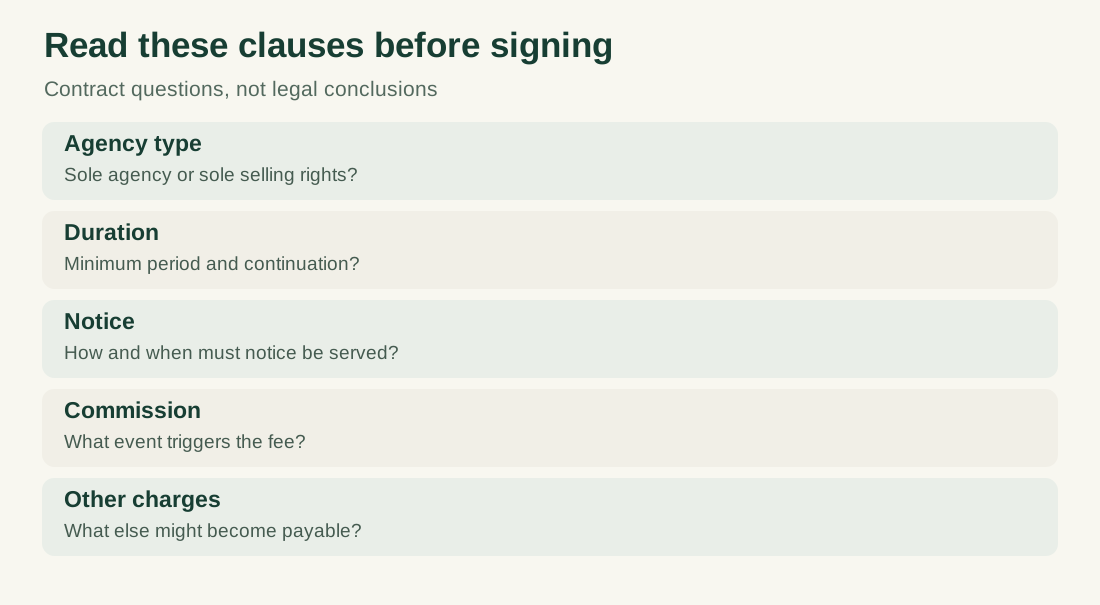
Agency type: Sole agency or sole selling rights?. Duration: Minimum period and continuation?. Notice: How and when must notice be served?. Commission: What event triggers the fee?. Other charges: What else might become payable?.
Understand the commission trigger
Locate the clause that describes when commission is earned or payable. Check whether the wording refers to introduction, exchange, completion or another event. These distinctions matter.
Ask what happens if a buyer first sees the property through this agent but purchases after the instruction ends. Ask whether the agent keeps a list of introduced applicants and how potential overlapping claims will be handled.
If you later move agents, keep written records of notice, introductions and communications. For the practical transition, see what to consider when changing estate agents.
Identify charges beyond the main commission
Check for marketing contributions, photography charges, withdrawal fees, cancellation terms, minimum fees and VAT treatment. If an item is described as optional, make sure the contract says how you authorise it.
Ask whether the agency can incur additional expenditure without your approval. If it can, what is the limit? If it cannot, make that clear before marketing starts.
A separate guide, how to compare estate agent fees and services, covers the commercial comparison. Here the task is to understand the obligation you are agreeing to.
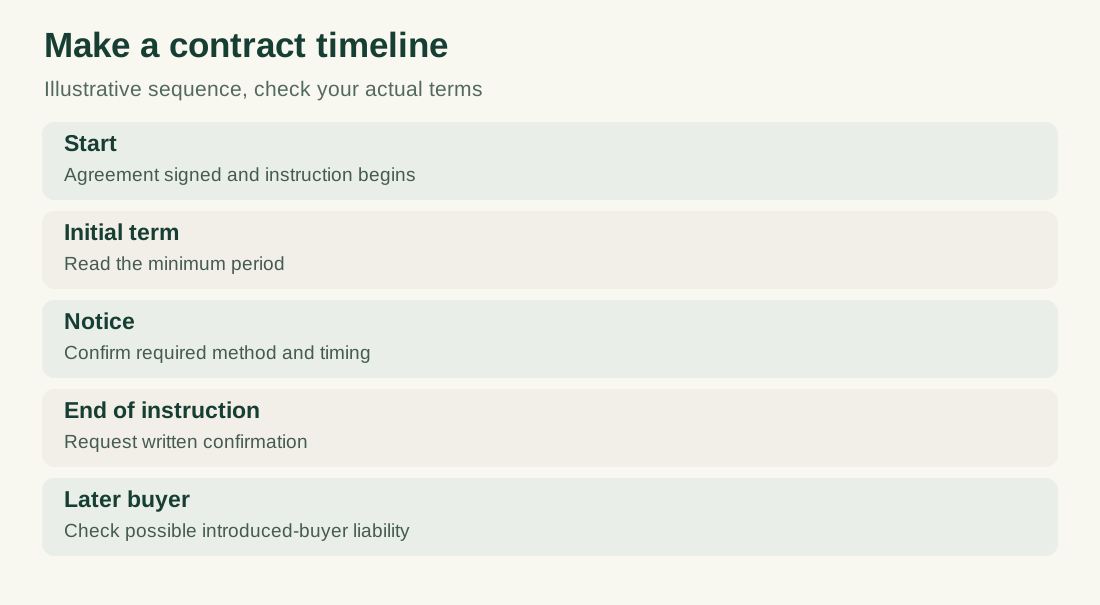 Illustrative example
Start: Agreement signed and instruction begins. Initial term: Read the minimum period. Notice: Confirm required method and timing. End of instruction: Request written confirmation. Later buyer: Check possible introduced-buyer liability.
Ask how complaints and disputes are handled
Find the firm's complaints procedure and the redress scheme details. Estate agents carrying out residential estate agency work must belong to an approved redress scheme. Check the current scheme information and the process for escalating a complaint if the firm's response does not resolve it.
The Property Ombudsman's Code of Practice contains standards relevant to agency agreements and how agents explain their terms. The code is not a substitute for reading your own contract, and scheme membership and applicable rules should be checked for the agent concerned.
Do not sign because you feel hurried. Ask for the agreement in advance, mark clauses you do not understand and request written answers.
Keep a short record of what you agreed
Before signing, make sure you can answer these questions:
- What kind of agency instruction is this?
- How and when could a commission become payable?
- What is the minimum term and how do I give notice?
- Could a buyer introduced now create a fee liability later?
- What other charges might I incur?
- Who is responsible for the work and where are the complaints details?
If you are still choosing a firm, the agent comparison guide helps assess the service. PMD's Property Intelligence Report provides property pricing evidence; it does not review estate agency contracts. PMD is a trading name and service of The Ivybridge Collection Ltd, whose registered nature of business is real estate agencies, and we also sell marketing subscriptions to estate agents.
Keep the signed agreement and every subsequent variation together. The easiest contract dispute to manage is one where the wording and correspondence can be found.
Sources
- HM Land Registry, About the Price Paid Data: Describes recorded completed property transactions and data coverage
- The Property Ombudsman, Codes of Practice: Consumer-facing estate agency code and agreement standards, subject to current version check