
Property valuations
How to Value an Unusual Home With Few Comparable Sales
Unusual homes rarely come with an obvious price comparison. A barn conversion, listed house or equestrian property may attract a specialist buyer while differing sharply from nearby sales. Here is how to build a defensible view without disguising uncertainty behind an exact figure.
This is an estimate from comparable sales, not a RICS or mortgage valuation, and not a survey.
The house that defeats the postcode average
A converted chapel, a moated farmhouse or a contemporary home built into a hillside may have no convincing twin among recent local sales. That does not mean its value is unknowable. It means a conventional comparison needs more judgement and a clearer explanation of uncertainty.
The first mistake is to take the average price of a postcode and add a premium for character. The average may largely reflect conventional houses with entirely different accommodation, land, condition and buyer appeal. A distinctive home requires evidence that has been selected for a reason, not simply because it is close.
Decide which features really define the property
Start with the fundamentals: location, usable floor area, layout, construction, condition, access, outside space and legal constraints. Then identify the unusual features that materially influence how people can live there.
A listed house with small rooms and restrictions on alterations may appeal to a different buyer from a similarly sized modern house. An equestrian property may attract interest because of paddocks and facilities, but the acreage, access, drainage and lawful use need examining. A converted barn may have striking volume without the number of conventional bedrooms buyers expect at its price.
Not every distinctive feature adds value to every buyer. The question is whether comparable purchasers have paid for it, and what compromises accompany it.
Widen the evidence search with discipline
When there are no close local comparisons, expand one dimension at a time. First look further back in time for a similar type of home. Then consider a wider geography with a comparable market and buyer profile. Finally, use less similar properties nearby to establish the general price context.
Record the compromise in every comparison. A sale three years ago might be architecturally similar but require adjustment for market conditions. A recent sale twenty miles away might be physically similar but occupy a different local market. A nearby sale may be relevant for location but not for the home's specialist appeal.
HM Land Registry's Price Paid Data can establish recorded transaction prices in England and Wales. It cannot explain the state of the building, the contents of the sale or the reasoning behind the price. Using sold house prices explains how to interrogate those records.
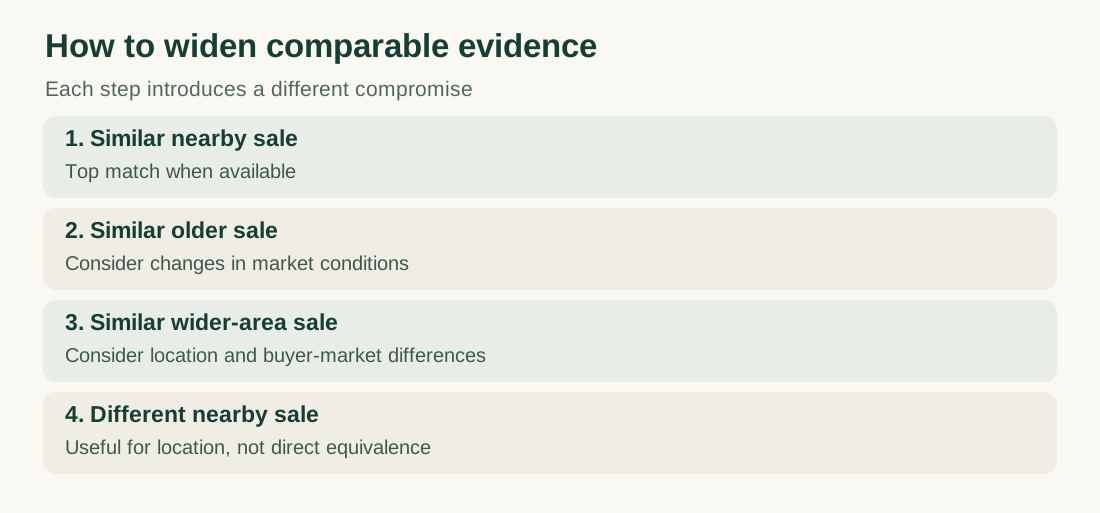
1. Similar nearby sale: Top match when available. 2. Similar older sale: Consider changes in market conditions. 3. Similar wider-area sale: Consider location and buyer-market differences. 4. Different nearby sale: Useful for location, not direct equivalence.
Do not turn differences into invented percentages
It is easy to say a view adds 10%, a listed status subtracts 5% or a paddock adds a fixed amount. Such figures sound systematic but may have no credible basis for the property in question.
A better approach is to compare the advantages and disadvantages explicitly. Ask which features the reference property shares, which are absent and whether any actual transactions help establish the importance of the difference.
Illustrative example. A seller owns a five-bedroom former rectory with a substantial garden. The nearest recent five-bedroom sale is a modern estate house. A former rectory sold farther away, but it had been fully renovated. Neither transaction gives a direct answer. Together they may help bound the discussion, provided the location and condition differences are stated rather than concealed.
A wider provisional range can be more useful than a precise figure with weak support.
Consider the number of plausible buyers
Unusual properties may appeal intensely to a relatively small group. That can make the relationship between asking price and selling time less predictable.
Ask what a buyer at the proposed price could purchase instead. Would they choose a more conventional home with easier maintenance? Is the specialist feature genuinely scarce? Are finance, insurance or future alterations likely to be more complicated?
This is not an argument to undervalue character. It is a reason to assess the real alternative choices facing the people most likely to buy.
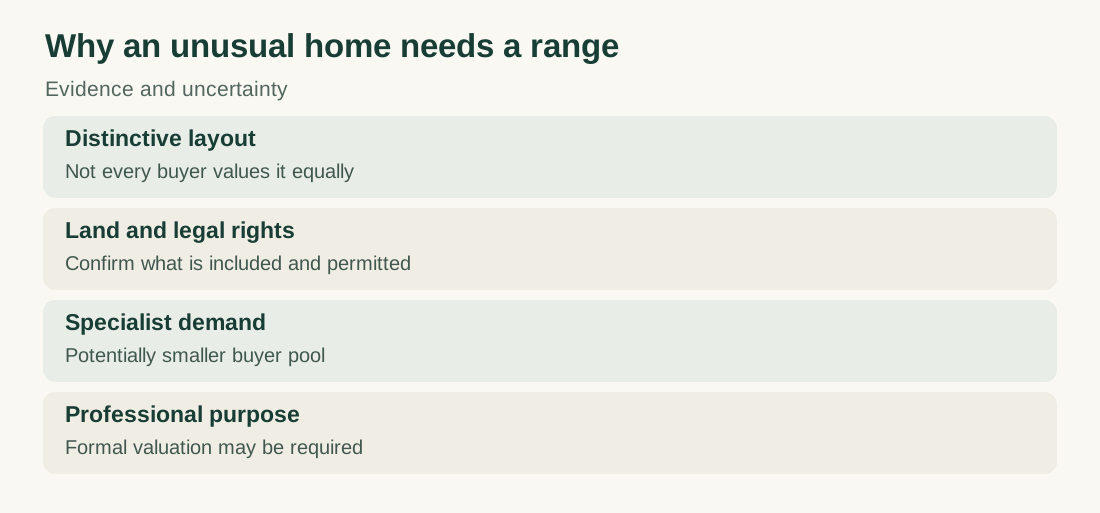
Distinctive layout: Not every buyer values it equally. Land and legal rights: Confirm what is included and permitted. Specialist demand: Potentially smaller buyer pool. Professional purpose: Formal valuation may be required.
Know when a specialist assessment is required
For marketing decisions, an experienced estate agent with relevant transactions can provide an appraisal and explain a recommended asking strategy. A PMD Property Intelligence Report may organise available comparable sales and assumptions, but sparse evidence should remain visibly sparse.
For secured lending, taxation, litigation, probate or another formal purpose, you may need a suitably qualified professional valuation on the appropriate basis. An automated estimate or informal market opinion is not a substitute.
Where construction, listed-building obligations, land rights or condition are uncertain, seek the appropriate surveyor or legal professional. A property can be distinctive in several ways, and different specialists answer different questions.
See the different types of property valuation and how condition affects value for those distinctions.
Agree the price and the review mechanism together
A carefully reasoned asking price is only the beginning. Discuss what evidence would make you revise it: a new comparable sale, qualified buyer feedback, a change in competing listings or an absence of serious enquiries.
Ask the agent to explain not only the figure but the range of plausible outcomes and the intended review points. Be sceptical of any claim that a distinctive property has one objectively certain marketing price.
PMD is a trading name and service of The Ivybridge Collection Ltd, whose registered nature of business is real estate agencies, and we also sell marketing subscriptions to estate agents. Its written human review concerns a customer's own Property Intelligence Report and specific market question, not a formal valuation or a review of agents' proposals.
For an unusual home, a good valuation discussion makes the uncertainty understandable. You should leave knowing which sales matter, why each is imperfect and what could change the conclusion.
Sources
- HM Land Registry, Price Paid Data: Explains the nature and limits of recorded completed sale prices
- HM Land Registry, House Price Index: Provides background on published house price statistics