
Property valuations
How Does Property Condition Affect House Value?
Two homes with the same floor plan can sell for different amounts because buyers see different levels of work, risk and inconvenience ahead. But it is a mistake to subtract a renovation quote pound for pound from a comparable sale price. Condition affects demand in more complicated ways.
This is an estimate from comparable sales, not a RICS or mortgage valuation, and not a survey.
Buyers react to the work they can see and the risk they cannot
A tired kitchen, peeling paint and an ageing roof can all affect the price a buyer is willing to offer, but not in the same way. Cosmetic work is often easier to assess. Possible structural or hidden defects introduce uncertainty about both cost and disruption.
Condition also interacts with the market. A buyer looking for a finished family home may reject a renovation project, while another buyer may actively seek the opportunity. The likely selling price depends partly on how many suitable buyers remain interested at a given figure.
Separate presentation, maintenance and defects
A cluttered room may photograph poorly without changing the building's underlying condition. Worn decoration may be relatively straightforward to refresh. Damp, roof movement or a failing heating system can call for specialist assessment.
Do not describe every visible mark as a serious defect, but do not dismiss material concerns as cosmetic either. If you are unsure what a problem means, obtain an appropriate professional opinion. An estate agent's price appraisal is not a building survey.
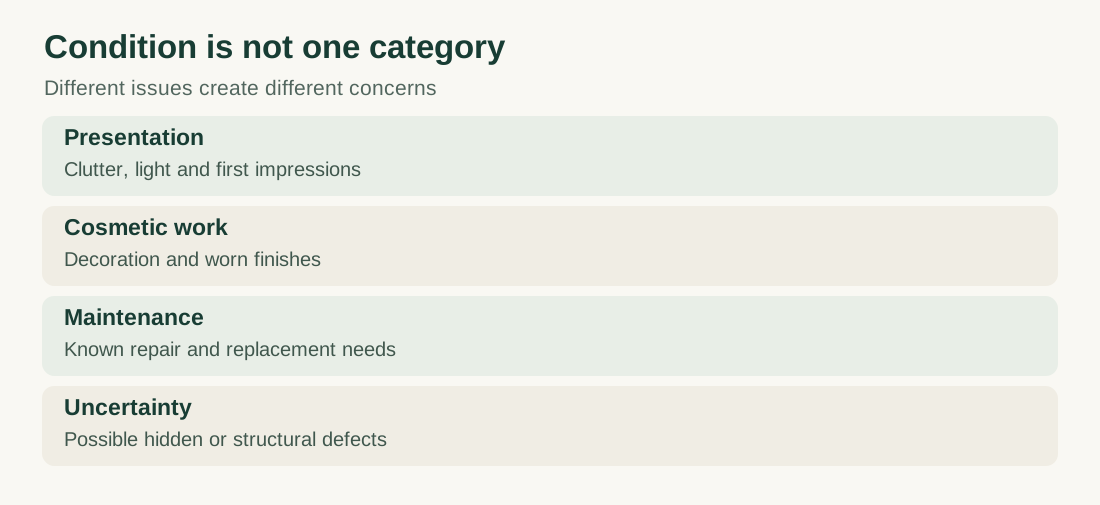
Presentation: Clutter, light and first impressions. Cosmetic work: Decoration and worn finishes. Maintenance: Known repair and replacement needs. Uncertainty: Possible hidden or structural defects.
A clear account of known repairs and relevant documentation can help buyers understand the property. Concealing a material issue risks creating a larger problem later during enquiries or a survey.
Renovation cost is not the same as lost value
Illustrative example. A buyer receives a quotation of £25,000 to modernise a kitchen and bathroom. It would be a mistake to conclude that the house is therefore worth exactly £25,000 less than a renovated comparable. Some buyers may value the opportunity to choose their own finishes. Others may demand a larger allowance for inconvenience, time and uncertainty.
The quotation may also include improvements beyond what is necessary to make the property functional. Compare the home's current condition with the condition of the sold comparables, rather than subtracting every desired upgrade from their prices.
If you are deciding whether to undertake work before marketing, see renovate before selling or sell as it is. The right answer depends on cost, time, likely demand and the risks of the project.
Understand how uncertainty changes an offer
A buyer who knows the roof needs a specific repair can obtain estimates and make a reasoned decision. A buyer who sees unexplained staining but cannot establish its cause may be more cautious, or may walk away altogether.
Survey findings can therefore affect negotiations even when the repair itself is relatively modest. A seller who has investigated the issue and kept relevant reports may be able to give buyers more confidence, though reports have limits and should not be presented as guarantees.
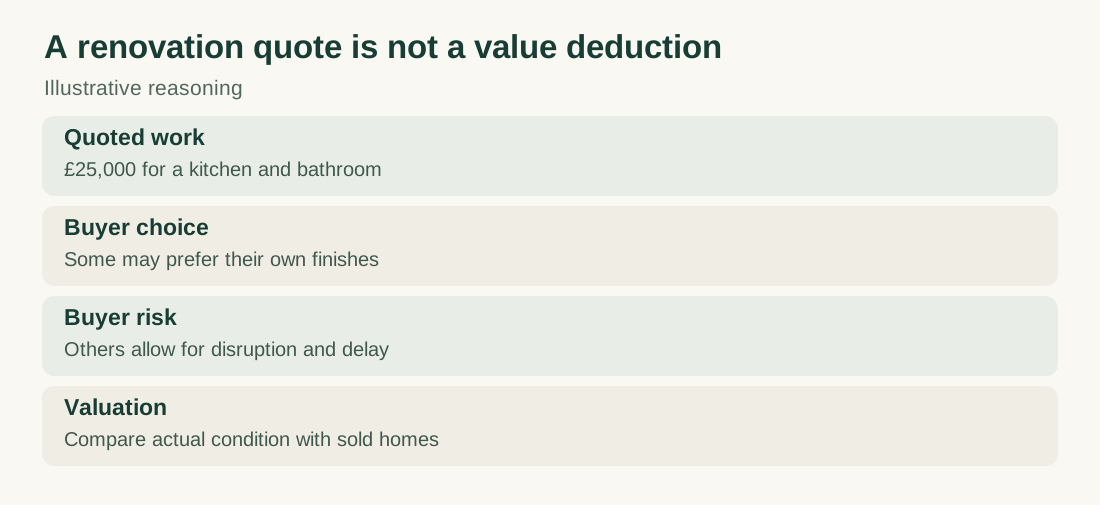 Illustrative example
Quoted work: £25,000 for a kitchen and bathroom. Buyer choice: Some may prefer their own finishes. Buyer risk: Others allow for disruption and delay. Valuation: Compare actual condition with sold homes.
The negotiation after a survey is discussed separately in renegotiating after a house survey. That process is not a mechanical deduction of the surveyor's estimated repair costs from the offer price.
Consider whether improvements broaden the buyer pool
Clean, well-maintained accommodation can make a home easier for more people to imagine living in. Essential repairs may also remove a reason for buyers or lenders to hesitate.
Yet expensive, highly personal upgrades can be difficult to recover in the sale price. A new luxury kitchen may appeal to some buyers while leaving others indifferent. The most sensible pre-sale work is often work that makes the property clear, usable and honestly presented, not work designed to chase a guaranteed return.
For practical preparation, see home presentation before selling. That guide is about communicating the home well, not claiming that styling repairs structural problems.
Adjust comparable sales with care
When using completed sales, identify whether each comparable was in better, similar or worse condition. Explain the significance of major differences without inventing precise adjustment percentages unsupported by evidence.
PMD's Property Intelligence Report uses available property information and comparable sales to explore pricing assumptions. It cannot inspect hidden defects, replace a survey or guarantee that an improvement will increase the sale price. PMD is a trading name and service of The Ivybridge Collection Ltd, whose registered nature of business is real estate agencies, and we also sell marketing subscriptions to estate agents.
The most useful question is not 'How much have I spent on this house?' It is 'What will a buyer understand about its condition, and what uncertainty are they being asked to accept?'
Sources
- HM Land Registry, About the Price Paid Data: Explains recorded completed sales, coverage and limitations