
Selling your home
Renovate Before Selling or Sell As It Is?
A new kitchen or major refurbishment might make your home more attractive, but the cost is real while the eventual selling-price benefit is uncertain. Before starting work, decide whether the project solves a specific barrier to sale and whether you can afford the time, disruption and risk.
This is an estimate from comparable sales, not a RICS or mortgage valuation, and not a survey.
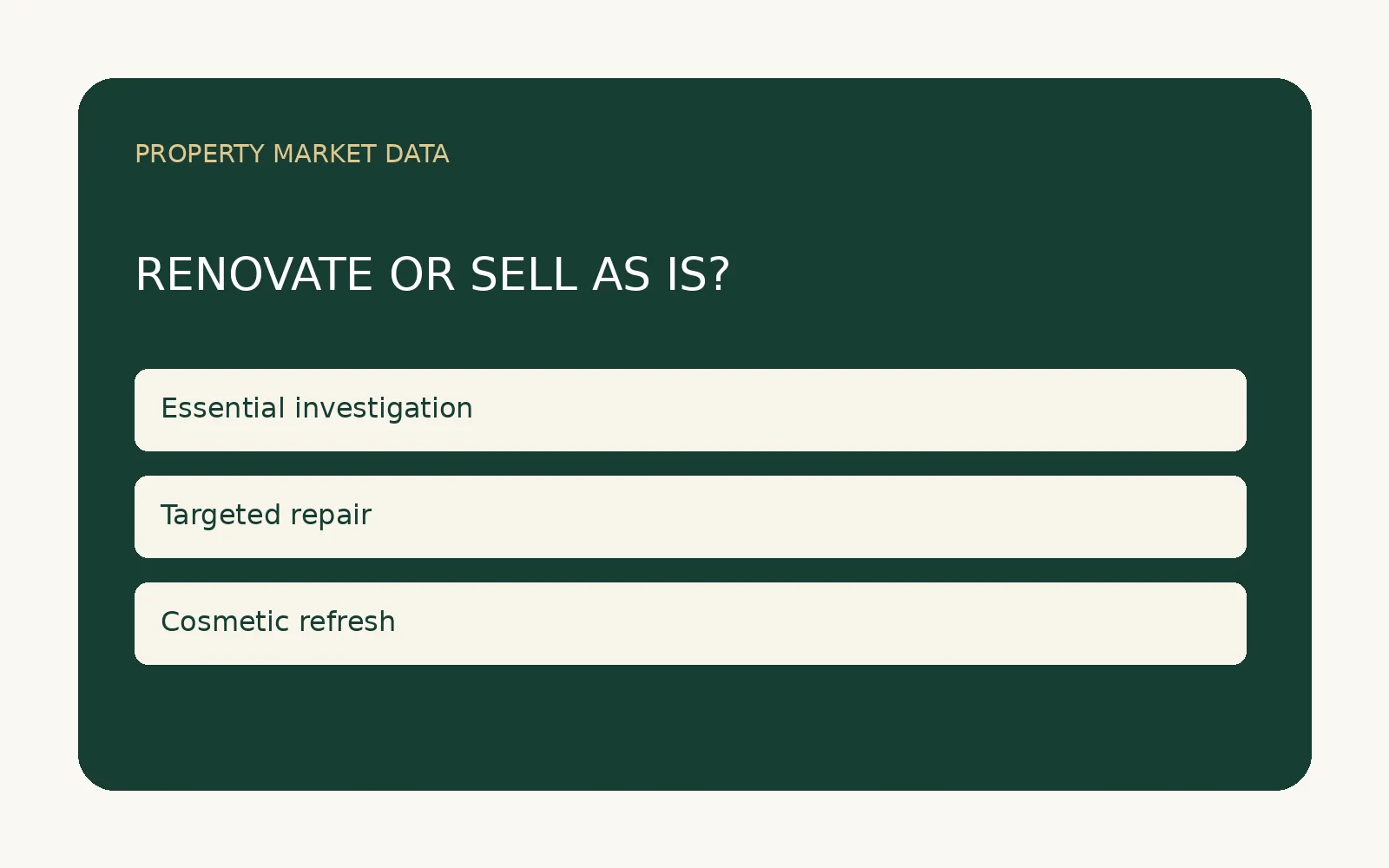
A renovation is an investment decision with an uncertain result
Sellers sometimes assume that a home must be brought up to a particular standard before it can go on the market. Others believe every pound spent on improvements will return more than a pound at sale. Neither assumption is safe.
Buyers may value a finished home, but they may also prefer to choose their own kitchen, bathroom or layout. The right choice depends on the property's current condition, likely buyers, competing homes and your circumstances.
Start with a narrower question: which specific problem would the work solve?
Separate necessary repairs from discretionary upgrades
An unsafe electrical issue, active leak or serious maintenance defect is different from a serviceable but unfashionable kitchen. Some problems need professional investigation regardless of your selling plans. Others may be priced into the transaction and left for the buyer to address.
Get suitable advice for significant defects and make accurate disclosures. Do not assume that painting over a problem removes the obligation to explain it. Nor should you undertake specialist repairs without understanding their cause and scope.
Cosmetic work can be worthwhile when it is inexpensive and helps buyers assess the property. For lower-cost preparation, see how to present your home before selling.
Calculate more than the builder's quotation
A renovation budget should include professional fees where relevant, contingencies, VAT, materials, temporary accommodation if necessary and the carrying costs of owning the property while work is done.
Ask what happens if the project overruns or hidden defects emerge. The additional months may affect mortgage costs, utilities, council tax and your onward move. Those costs matter even if the final work is attractive.

Essential investigation: Safety, leaks and serious defects. Targeted repair: Fix specific issues with known costs. Cosmetic refresh: Improve presentation without major works. Full renovation: Allow for delay, overrun and uncertainty.
Ask whether the market will recognise the improvement
Compare completed sales of homes in different conditions, keeping location, size and layout as consistent as possible. This is difficult because no two houses are identical. A renovated property may also have a better plot or other advantages that explain part of its sale price.
Avoid using a national 'return on renovation' percentage as a promise for your property. The local ceiling price, buyer budget and quality of the work can all affect the outcome.
For the valuation implications of physical condition, see property condition and market value. For large additions, see whether extensions add value.
Compare three realistic routes
Illustrative example. A seller is considering a dated kitchen. One option is to clean, repair and market the home as it stands. A second is to replace damaged worktops and refresh the room. A third is a complete refit that takes several weeks and carries a higher risk of extra costs.
The third option may photograph well, but it is not necessarily the most profitable. The decision depends on the budget, the evidence of buyer demand and whether the finished price is likely to justify the investment.
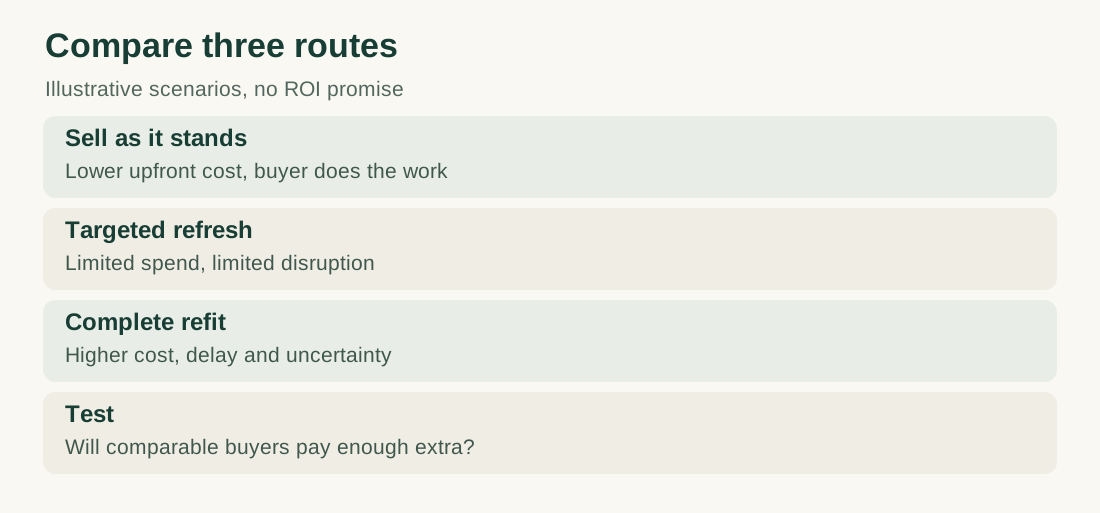 Illustrative example
Sell as it stands: Lower upfront cost, buyer does the work. Targeted refresh: Limited spend, limited disruption. Complete refit: Higher cost, delay and uncertainty. Test: Will comparable buyers pay enough extra?.
Timing can change the right choice
If you need to move quickly, a lengthy project may create more risk than it removes. If you are not under time pressure and the home has a clear defect that limits its audience, targeted work may be reasonable.
Ask your agent what buyers are likely to object to and what competing homes offer. Ask a suitable contractor for realistic costs and timing. Keep those opinions separate: the agent cannot guarantee a builder's schedule, and the builder cannot guarantee the eventual selling price.
Some buyers actively seek homes they can improve. A property marketed honestly as requiring modernisation can appeal to that audience if the asking price reflects the work and risk involved.
Decide using a range, not a promised profit
Set out the likely costs, potential delays and a range of possible sale outcomes for each route. Include the possibility that the improvement does not increase the sale price enough to recover its cost.
If the proposed work is structural, involves planning or building regulations, or could affect guarantees and insurance, seek the relevant professional guidance before proceeding.
PMD's Property Intelligence Report can help with comparable-sales evidence and pricing assumptions, but it does not calculate a guaranteed renovation return or provide a building survey. PMD's human review service does not offer presentation or renovation advice. PMD is a trading name and service of The Ivybridge Collection Ltd, whose registered nature of business is real estate agencies, and we also sell marketing subscriptions to estate agents.
Before authorising a project, write down the defect or buyer concern it addresses, the full estimated cost, the likely delay and the evidence that buyers will pay for the result. If the case depends on an assumed profit, reconsider it.
Sources
- HM Land Registry, About the Price Paid Data: Scope and limitations of recorded completed sale prices