
Property valuations
How Much Value Does an Extension Add to a House?
An extension may transform how a house works, but it does not automatically increase the sale price by its construction cost. The value depends on the finished layout, local demand, quality of work and comparable sales. This guide explains how to assess the difference.
This is an estimate from comparable sales, not a RICS or mortgage valuation, and not a survey.
An extension can create space without creating equal value
A homeowner spends heavily on an extension and expects the sale price to rise by the same amount. Another adds a bedroom and assumes the house must move into the next price bracket. Neither assumption is reliable.
An extension changes a property's accommodation. Its effect on market value depends on how useful that accommodation is, how well it works with the existing house and what buyers can purchase nearby.
The cost of building and the value created are different questions.
Start with the problem the extension solves
An extra room may be valuable because the house previously lacked a workable family kitchen, accessible ground-floor bedroom or sufficient living space. A large extension can also make the ground floor feel unbalanced if it sacrifices too much garden or leaves awkward circulation.
Think about how a buyer would use the resulting home. Is there enough natural light? Does the kitchen connect to the garden? Is storage practical? Has parking become inadequate for the enlarged accommodation?
The headline increase in square metres does not capture these details. Price per square foot and house valuation explains why area alone is an incomplete measure.
Compare the finished home with genuine alternatives
Find completed sales of properties with a similar final layout, condition and location. If possible, compare both extended and unextended examples in the same local market.
Do not assume that the difference between two asking prices measures the value of an extension. The homes may differ in plot, finish, age, parking or sellers' expectations, and neither asking price is necessarily the eventual sale price.
Illustrative example. A three-bedroom house has a small kitchen. The owners consider a rear extension that would create a generous kitchen-dining space but not another bedroom. Nearby completed sales suggest buyers value open-plan family space, yet the available examples also have larger gardens. The evidence may support some additional value, but it cannot isolate a precise extension premium.
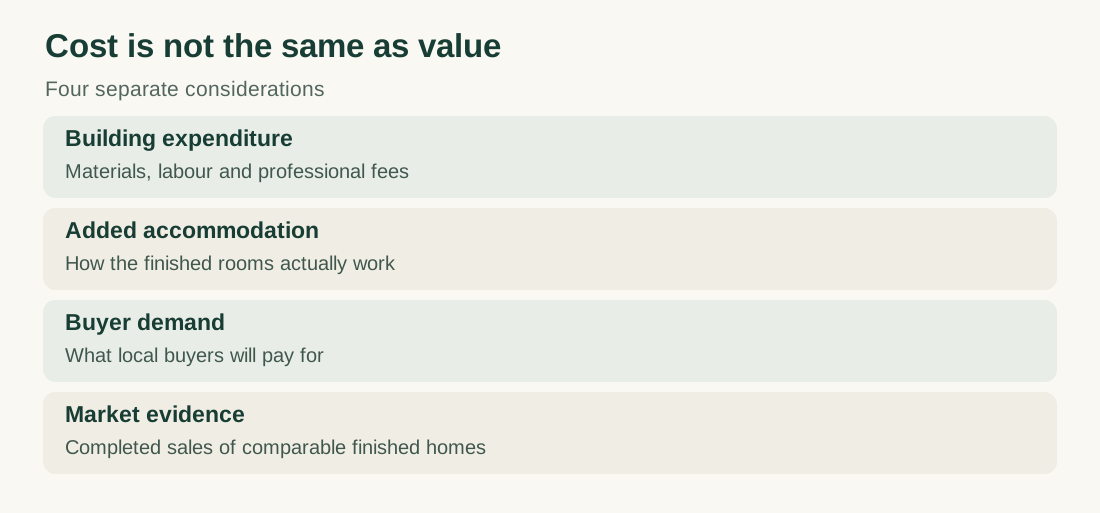
Building expenditure: Materials, labour and professional fees. Added accommodation: How the finished rooms actually work. Buyer demand: What local buyers will pay for. Market evidence: Completed sales of comparable finished homes.
More bedrooms do not always mean a higher category
Adding a fourth bedroom may attract households who would not consider a three-bedroom home. But if the fourth room is very small, the remaining bathrooms are inadequate or the living accommodation feels cramped, the label may overstate the improvement.
A loft conversion might add an attractive room while creating a steep stair or reducing storage. A garage conversion may provide living space while removing parking or practical storage that local buyers value.
Ask whether the overall house now makes sense for the buyer group it is intended to attract. A property should be judged as a whole, not as a list of rooms.
Account for permissions, certificates and construction quality
Before relying on an extension as a selling feature, gather the relevant planning, building regulations and completion documentation where applicable. Permitted development rights are subject to conditions and do not eliminate every regulatory requirement.
If work was completed by a previous owner, do not assume that the absence of paperwork proves the work is unlawful or that it is automatically acceptable. Your conveyancer and relevant building professional can advise on the particular circumstances.
A visually attractive extension may still have issues with insulation, drainage, structural design or workmanship. A survey may identify concerns that affect a buyer's decision or lender's position.
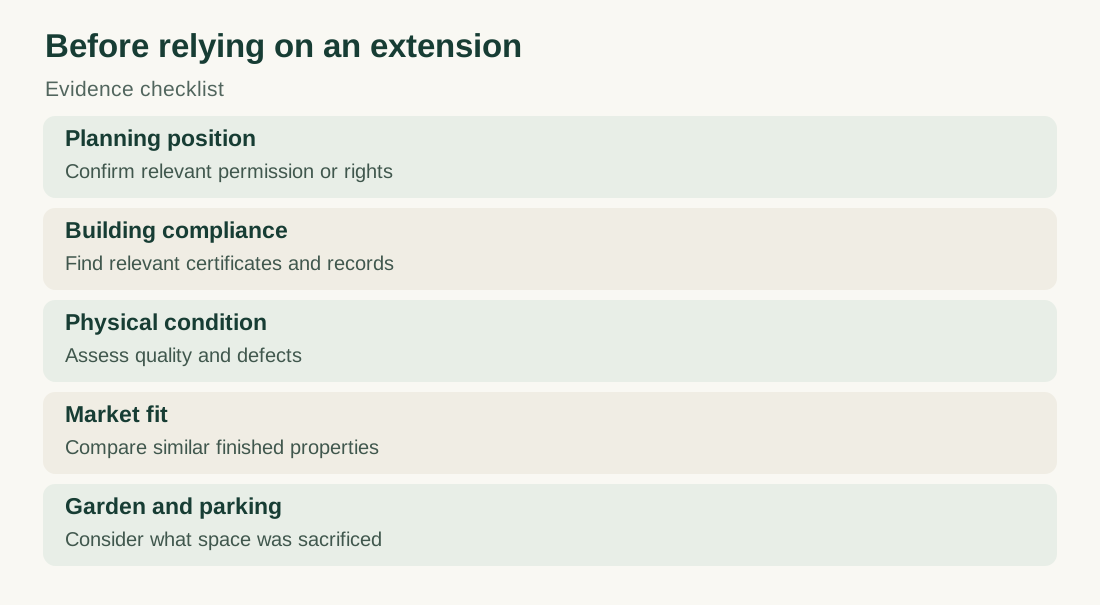
Planning position: Confirm relevant permission or rights. Building compliance: Find relevant certificates and records. Physical condition: Assess quality and defects. Market fit: Compare similar finished properties. Garden and parking: Consider what space was sacrificed.
Decide whether to build before selling
If you are considering extending primarily to improve the sale price, compare the likely increase in value with the full cost and risk of the work. Include design fees, permissions, contingencies, finance costs, disruption and the time before the property can be marketed.
You may discover that buyers would prefer to choose their own finishes or that the local market has a ceiling for this property type. In those circumstances, selling with the potential to extend may be more sensible than undertaking the work.
There is no universal return-on-investment percentage for extensions. Renovate before selling or sell as it is provides a framework for deciding whether to undertake improvements.
Value the home that exists today
If an extension is merely possible, distinguish potential from permission. A buyer may pay something for a credible opportunity, but an unapproved sketch is not equivalent to finished, compliant accommodation.
If the extension is complete, assess its quality and usefulness alongside the other property features. PMD's Property Intelligence Report can provide comparable-sales context and a pricing range, but it cannot certify construction work or guarantee an extension premium.
PMD is a trading name and service of The Ivybridge Collection Ltd, whose registered nature of business is real estate agencies, and we also sell marketing subscriptions to estate agents. Its human review is limited to a written opinion on a customer's own Property Intelligence Report and specific property market question.
Before attributing a price increase to an extension, ask which comparable buyers have paid for a similar finished home. The answer is more useful than either the builder's invoice or the number of square metres added.
Sources
- HM Land Registry, Price Paid Data: Explains the nature and limits of recorded completed sale prices
- HM Land Registry, House Price Index: Provides background on published house price statistics