
Selling your home
How to Present Your Home Before Selling
Preparing a property for sale does not require turning it into a show home. The aim is to help buyers understand the space, notice its strengths and assess its condition without avoidable distractions. Start with maintenance and accurate presentation before spending money on decoration or hired furniture.
This is an estimate from comparable sales, not a RICS or mortgage valuation, and not a survey.
Make the property easy to understand
A buyer should be able to walk into a room and recognise what it is for, how large it feels and how it connects with the rest of the home. That can be difficult when furniture blocks circulation, every surface is crowded or a spare room has become a storage space.
Presentation is not about making every property look the same. A character house can retain its personality, and a family home does not need to pretend nobody lives there. The priority is to remove avoidable obstacles to understanding the accommodation.
Start by walking through the property as if you had never seen it. Which rooms feel confusing? Where do you have to step around furniture? Which windows are blocked?
Deal with obvious maintenance before styling
Loose handles, failed bulbs, dripping taps and neglected exterior paintwork can create an impression that other issues may have been ignored. Make a practical list of defects and distinguish simple maintenance from problems requiring a qualified professional.
Do not conceal damp, damage, structural concerns or other material information behind furniture, paint or photography. A cosmetic fix is not a substitute for investigation. Your estate agent and conveyancer can advise on disclosure obligations within their respective roles.
For how condition may influence pricing, see the relationship between property condition and value.
Give each room a clear purpose
In the sitting room, arrange seating so buyers can see the principal windows, fireplace or outlook without navigating an obstacle course. In bedrooms, make sure the bed size and circulation space are easy to judge. In a study, a desk and chair may communicate the use of the room more clearly than a collection of boxes.
The kitchen and bathrooms should be clean, with surfaces sufficiently clear to show their practical working space. That does not require removing every sign of daily life. It means helping viewers focus on the fixtures and layout rather than the owner's possessions.
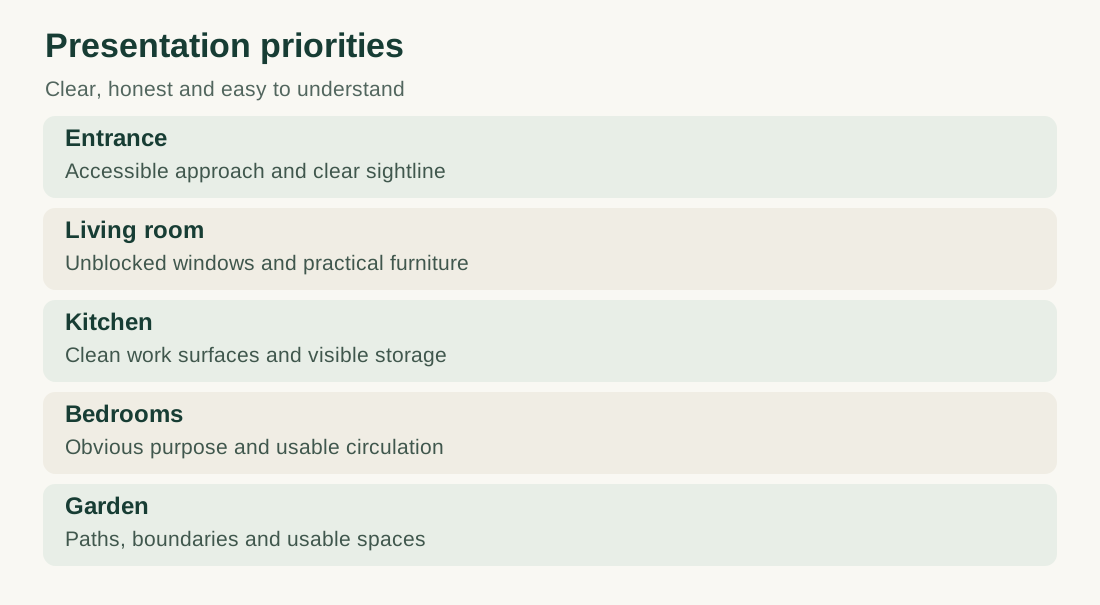
Entrance: Accessible approach and clear sightline. Living room: Unblocked windows and practical furniture. Kitchen: Clean work surfaces and visible storage. Bedrooms: Obvious purpose and usable circulation. Garden: Paths, boundaries and usable spaces.
Think about light, temperature and smell
Clean windows, open blinds where appropriate and working lights can make spaces easier to assess. If a room is naturally darker, use honest photography and appropriate lighting rather than editing the images until they misrepresent it.
Ventilate rooms and address the source of persistent odours. Strong fragrances can make buyers wonder whether something is being masked. Keep the property at a comfortable temperature for appointments where practical.
Pets, cooking and family routines are normal parts of a home. Plan viewings around them thoughtfully rather than trying to create an artificial atmosphere.
Do not forget the approach and outside space
The first impression begins before the front door. Clear the path, make the entrance accessible and check that bins, vehicles or overgrown plants are not obscuring the approach unnecessarily.
In gardens, cut back growth that hides boundaries or paths, make seating areas understandable and show how the outside space connects to the house. A modest garden can be appealing when its shape and use are clear. An extensive garden need not be manicured into something that would be difficult to maintain.
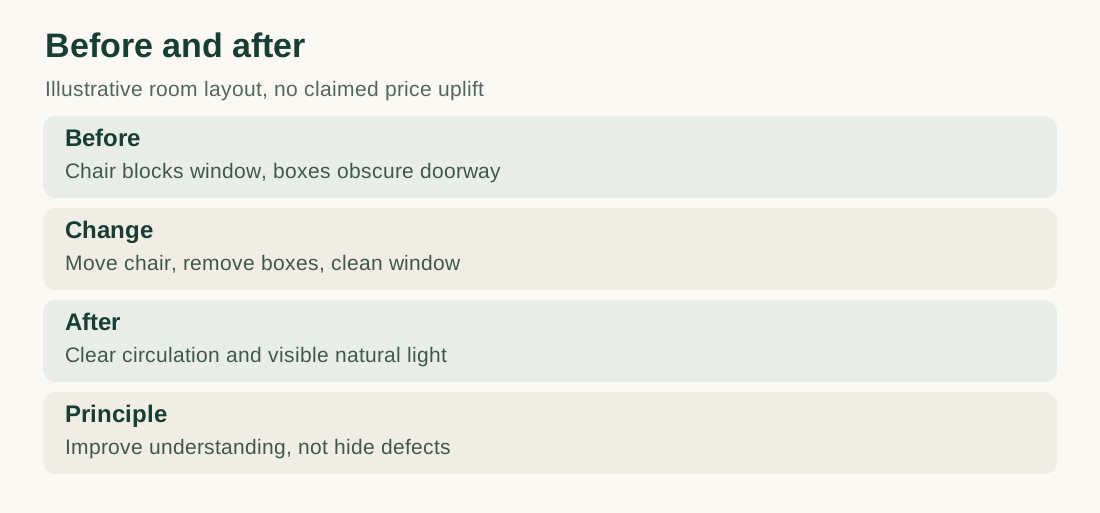 Illustrative example
Before: Chair blocks window, boxes obscure doorway. Change: Move chair, remove boxes, clean window. After: Clear circulation and visible natural light. Principle: Improve understanding, not hide defects.
Prepare for the camera and the viewing separately
Photography needs clear sightlines, accurate room representation and an agreed list of features to capture. A viewing also requires access, sensible timing and the ability for buyers to open doors and inspect spaces appropriately.
Ask your agent who will direct the photography and whether you can check factual accuracy before the listing goes live. The wider marketing proposal is covered in how to assess an estate agent's marketing plan.
Illustrative example. Moving a large chair away from a window might improve both the photograph and the experience of walking through a room. Replacing an entire furniture suite, however, may be unnecessary and could cost more than any demonstrable benefit. No general uplift percentage can establish the return on that expenditure.
Spend selectively
Start with cleaning, minor repairs, decluttering and garden maintenance. Only then consider repainting or professional styling if the property genuinely needs it and the cost is proportionate. Ask your agent to explain which buyer objection the spending is intended to address.
For decisions involving substantial work, see whether to renovate before selling or sell as it is. PMD's Property Intelligence Report concerns property market evidence; its human review service does not provide styling or presentation advice. PMD is a trading name and service of The Ivybridge Collection Ltd, whose registered nature of business is real estate agencies, and we also sell marketing subscriptions to estate agents.
Before the photographs are taken, stand in the doorway of every room. If a buyer can see its purpose, dimensions and important features clearly, you have achieved more than any decorative formula can promise.
Sources
- HM Land Registry, About the Price Paid Data: Scope and limitations of recorded completed sale prices