
Selling your home
What Should Your Property Photos and Listing Show?
A property listing has two jobs: help the right buyer recognise why the home is worth viewing and give them a truthful basis for deciding. Beautiful photographs cannot compensate for missing rooms, confusing dimensions or misleading claims. Review the advert as someone who has never visited your home.
This is an estimate from comparable sales, not a RICS or mortgage valuation, and not a survey.
Imagine seeing the house for the first time
You know where the sunny room is and how the garden connects to the kitchen. An online buyer does not. Your listing has to explain the layout, atmosphere and practical features without relying on memories or personal knowledge.
Review it on a phone as well as a large screen. Can you understand the house from the first few images and the floor plan? If the answer is no, buyers may not reach the stage of booking a viewing.
Choose a lead image that tells the truth
The opening photograph should show a genuine strength of the property. For some homes that is the front elevation; for others it may be a significant living space or the setting. Avoid choosing a striking image that leaves the buyer unsure what is for sale.
Look for straight vertical lines, balanced light and a clear sense of scale. Overly wide lenses can distort room proportions. Heavy digital alteration may create expectations the actual property cannot meet. Images should represent the property accurately, including material features and limitations.
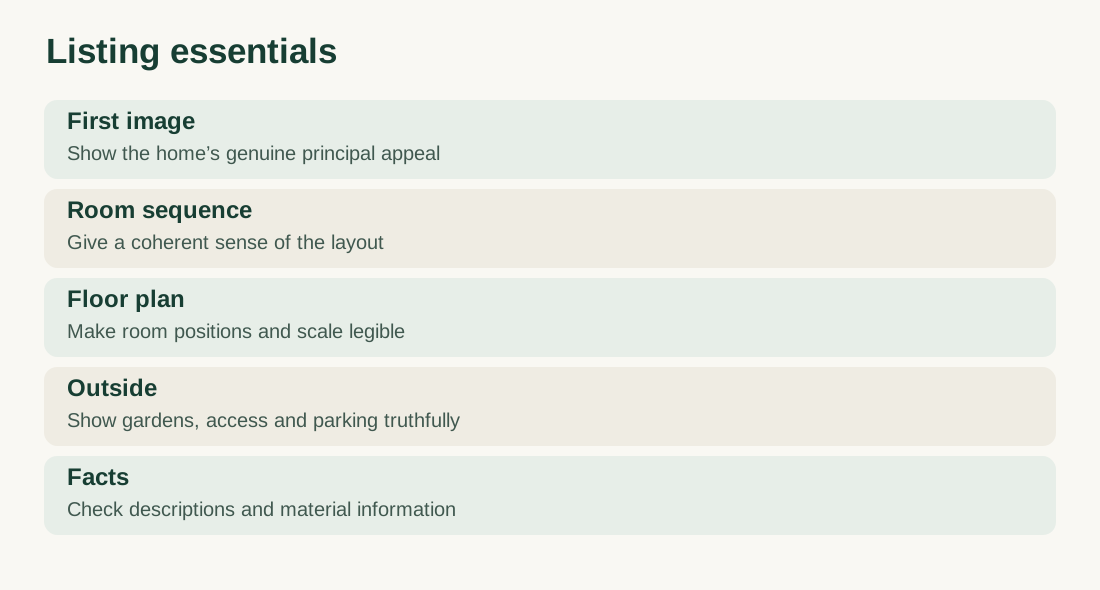
First image: Show the home’s genuine principal appeal. Room sequence: Give a coherent sense of the layout. Floor plan: Make room positions and scale legible. Outside: Show gardens, access and parking truthfully. Facts: Check descriptions and material information.
Give buyers a complete tour
Check that important rooms are represented, not only the photogenic ones. The kitchen, main reception rooms, bedrooms, bathrooms, outside space and parking should be understandable. A small utility room may matter to the right buyer more than a second photograph of the same sitting room.
A floor plan should be legible and consistent with the written accommodation. If measurements are approximate, say so. If a room is described as a bedroom, make sure the description does not conceal relevant limitations. Do not assume an outbuilding is suitable for residential use without checking its status.
Verify the factual claims
Descriptions should distinguish verified information from marketing language. Check tenure, council tax band, parking rights, listed status, extensions, heating arrangements and any known material information. The agent should investigate and disclose relevant information in accordance with applicable consumer protection requirements.
Do not describe a room, annexe or plot in a way that suggests permissions or rights which have not been established. If there is uncertainty, tell the agent and obtain the appropriate documents rather than inventing a confident answer.
Presentation should support accuracy
Tidying surfaces, cleaning windows and arranging furniture can make spaces easier to understand. They should not conceal defects. If a room is virtually staged or an image materially altered, its nature should be clear so buyers are not misled.
For practical preparation, see how to present a home before selling. A beautiful listing that creates disappointment on arrival can be less helpful than one that sets fair expectations.
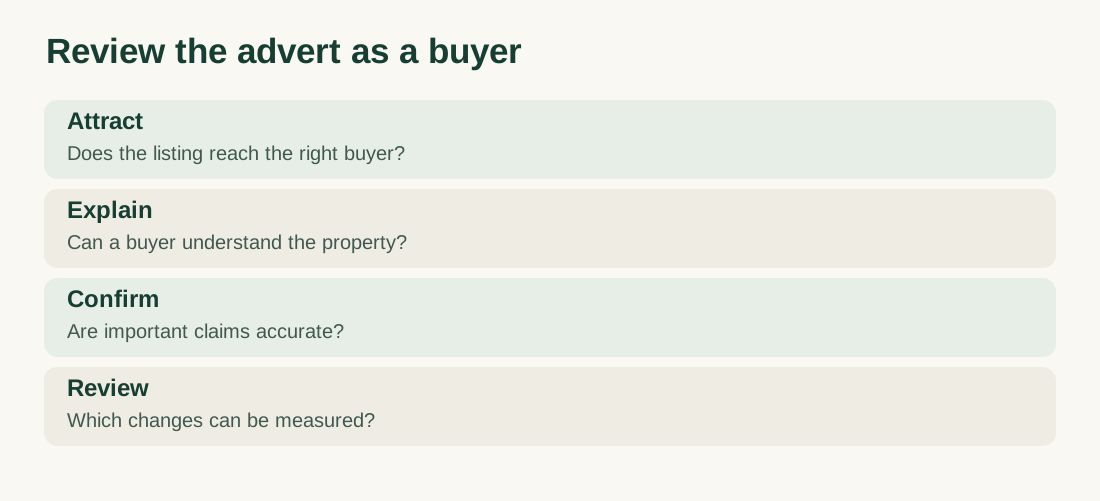
Attract: Does the listing reach the right buyer?. Explain: Can a buyer understand the property?. Confirm: Are important claims accurate?. Review: Which changes can be measured?.
Measure the response before changing everything
Ask the agent about listing views, enquiries, brochure requests and qualified viewing appointments where reliable figures are available. These measures are not identical. A large audience with few viewings may suggest a mismatch between what the advert promises and what buyers seek, but price and market demand also matter.
If an advert is underperforming, change a clearly identified weakness and review the result. Replacing every photograph and changing the asking price on the same day makes it harder to understand which change mattered.
If your home is not attracting viewings, examine the whole proposition rather than blaming the photographs alone.
PMD's Property Intelligence Report can provide market pricing evidence. It is not a photography or marketing audit, and PMD's human review does not provide presentation advice. PMD is a trading name and service of The Ivybridge Collection Ltd, whose registered nature of business is real estate agencies, and we also sell marketing subscriptions to estate agents.
Before launch, ask someone who does not know the property to describe its layout and main appeal using only the advert. Their confusion can reveal gaps that familiarity has hidden.
Sources
- HM Land Registry, About the Price Paid Data: Explains the scope of completed property transaction records
- National Trading Standards, Material information in property listings: Guidance on information in property advertisements, check current rules