
Selling your home
Your House Is Getting No Viewings: What to Check
A house can be on the market without generating a single appointment. Before assuming the asking price is wrong, find out whether buyers are seeing the listing, opening it, enquiring and being offered suitable viewing times. Each stage calls for a different response.
This is an estimate from comparable sales, not a RICS or mortgage valuation, and not a survey.
First establish where interest is disappearing
A property can be advertised online yet receive no viewings for several quite different reasons. Perhaps it barely appears in the searches that relevant buyers make. Perhaps people see it but choose not to open the advert. Perhaps they open it but decide the photographs, layout or price do not merit a visit. Or perhaps enquiries are coming in but appointments are not being arranged.
Those situations should not be treated as one problem. Ask your estate agent to show what is happening at each stage, rather than simply reporting that the market is quiet.
Is the property appearing in the right searches?
Check the live listing yourself. Is the location correct? Is the property type accurate? Are the bedroom count, asking price and key features correctly entered? An incorrect category or map position may cause relevant buyers to miss it.
Try searching as a buyer with a realistic budget, location and property requirements. Bear in mind that portals use different filters and results ordering. One search on one device is not proof of how every buyer sees the property.
Ask the agent for whatever portal exposure data is available, with dates and a comparison to relevant properties where possible. Do not confuse an impression, a listing view and a direct enquiry. They represent different levels of engagement.
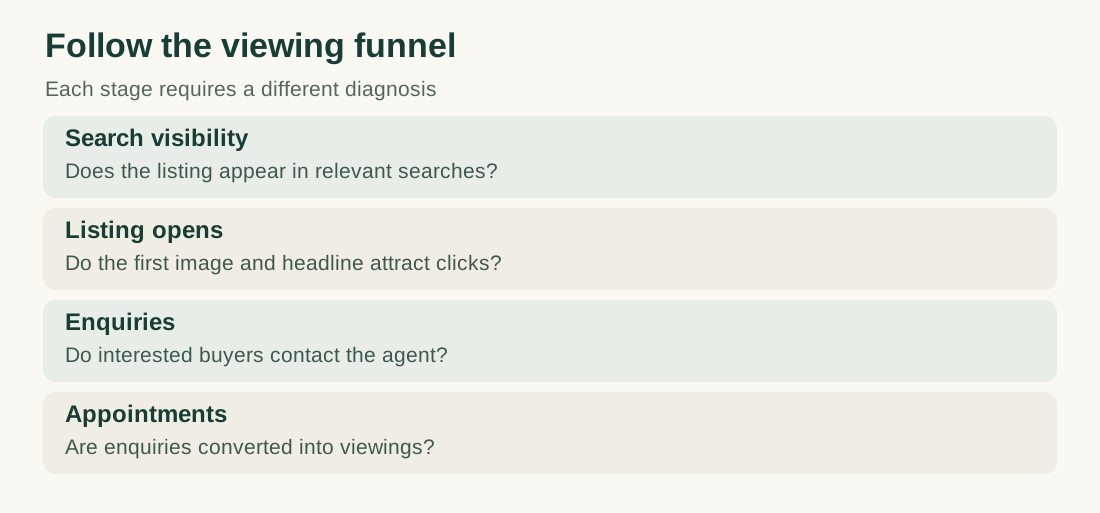
Search visibility: Does the listing appear in relevant searches?. Listing opens: Do the first image and headline attract clicks?. Enquiries: Do interested buyers contact the agent?. Appointments: Are enquiries converted into viewings?.
If buyers see it but do not open it
The first photograph, headline price and basic listing information often form the first impression. Look at your home among the competing results, not in isolation. Does the lead image show the strongest relevant feature? Is the house clearly identifiable? Does the listing appear well presented beside similarly priced alternatives?
Check whether the property description explains its accommodation and appeal without exaggerated claims. A missing floor plan, confusing room labels or photographs taken before essential preparation can create unnecessary doubt.
Ask your agent what they would change in the advert and why. Replacing photographs may be sensible if the existing images misrepresent the space, but it is not a substitute for reviewing the price against evidence.
For a fuller discussion of the visual presentation, see how to present your home before selling.
If people open the listing but do not enquire
A buyer may like the photograph and then discover a feature that rules the property out: limited parking, a small third bedroom, a busy road or a layout that does not suit their needs. Some of these are fixed characteristics; others can be communicated more clearly.
Compare your listing with genuinely competing homes at a similar budget. Are buyers being asked to pay more without an obvious benefit? Is there a feature that appears missing because it has not been photographed or described? Are dimensions and outside space easy to understand?
Illustrative example. A house has substantial portal views but very few enquiries. Its opening photograph looks attractive, yet the floor plan reveals a layout that may not suit the likely buyer. Better photographs alone may not resolve the mismatch. The agent needs to explain who the property is aimed at and whether its price reflects that audience.
If enquiries are arriving but viewings are not
Ask how quickly enquiries are answered, who follows up and whether prospective buyers can book practical appointments. Restricted viewing windows, unanswered calls or slow replies can lose opportunities. That is a service problem, not necessarily a valuation problem.
Request a simple record of enquiries and outcomes, respecting buyers' personal information. Were people uncontactable, unsuitable, unavailable or simply never called back? Ask whether qualified buyers were offered alternatives when their first appointment choice was impossible.
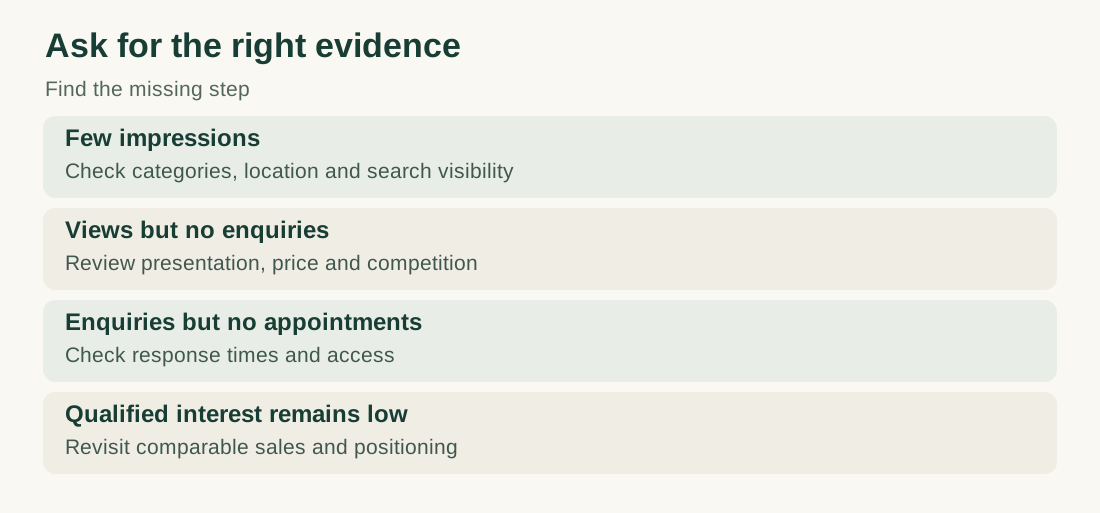
Few impressions: Check categories, location and search visibility. Views but no enquiries: Review presentation, price and competition. Enquiries but no appointments: Check response times and access. Qualified interest remains low: Revisit comparable sales and positioning.
When should price enter the discussion?
Price belongs in the diagnosis from the beginning, but a reduction should follow evidence rather than panic. Review recent completed comparable sales and the asking prices of current alternatives. Consider condition, size, location and features rather than relying on a broad postcode average.
If the listing is correctly targeted, presented competently and handled promptly but still fails to generate qualified interest, a price review may be warranted. When to reduce your asking price sets out how to make that decision.
For regular reporting, use what an estate agent weekly update should include. PMD's Property Intelligence Report can provide separate comparable-sales evidence for a pricing discussion; it cannot diagnose your agent's actual enquiry handling without their records. PMD is a trading name and service of The Ivybridge Collection Ltd, whose registered nature of business is real estate agencies, and we also sell marketing subscriptions to estate agents.
Ask your agent to identify the exact point where the buyer journey is breaking down and propose one measurable correction. A useful next step is more specific than 'wait another fortnight'.
Sources
- HM Land Registry, About the Price Paid Data: Scope and limitations of recorded completed sale prices