
Selling your home
When Should You Reduce Your House Price?
A price reduction can renew interest, but it also publicly signals that the original strategy has changed. There is no universal number of weeks to wait or percentage to cut. A better decision starts with evidence about what buyers have seen, how they have responded and which alternatives they can purchase.
This is an estimate from comparable sales, not a RICS or mortgage valuation, and not a survey.
A price reduction should solve an identified problem
If your home has not sold, a lower asking price may seem like the only lever left. Sometimes it is the right one. But first ask whether the property is reaching relevant buyers, whether they are booking viewings and what they say afterwards.
A house with almost no exposure needs a different response from one that has attracted numerous qualified viewers who consistently choose cheaper alternatives. Price may contribute to both situations, but the supporting evidence differs.
For the first diagnosis, see why a house gets no viewings. If appointments are happening without offers, see how to interpret viewings without offers.
Rebuild the comparison rather than defending the original number
Ask your agent to update the comparable-sales evidence. Look at completed transactions involving similar property types, sizes, locations and conditions. Separate these from current listings, which show sellers' expectations rather than completed results.
Consider what has changed since launch. Have competing homes reduced their prices? Have new properties appeared? Has a genuinely comparable sale completed? Have you discovered an issue that buyers are factoring into their decisions?
Do not treat an automated estimate or a postcode average as a precise answer. They can provide context, but unusual features and limited sales evidence create uncertainty.
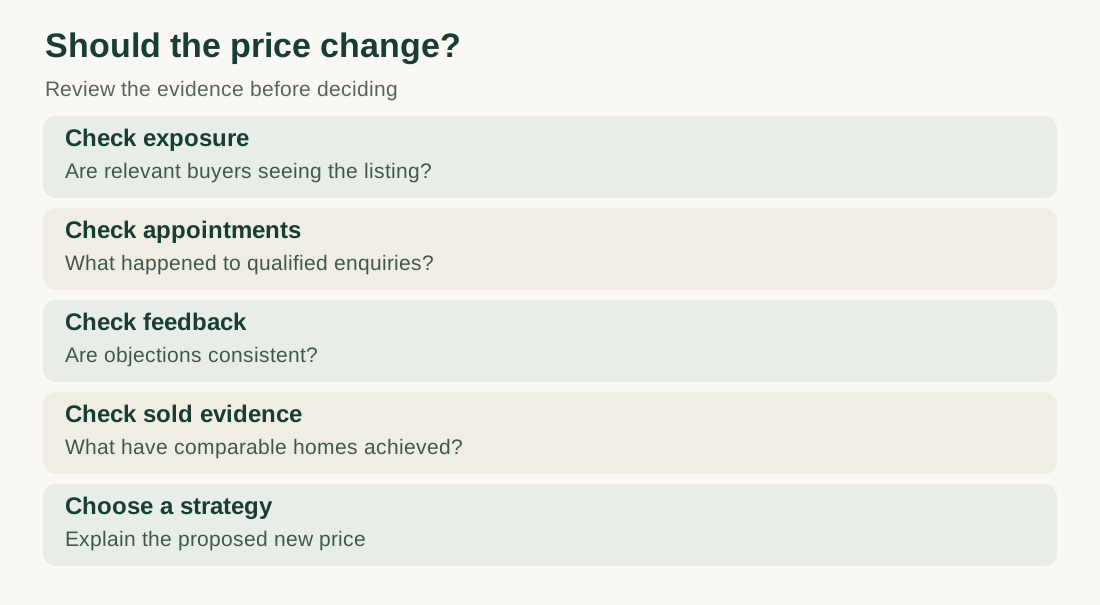
Check exposure: Are relevant buyers seeing the listing?. Check appointments: What happened to qualified enquiries?. Check feedback: Are objections consistent?. Check sold evidence: What have comparable homes achieved?. Choose a strategy: Explain the proposed new price.
How much should you reduce by?
There is no defensible standard reduction percentage for every property. A new asking price should relate to the likely selling range, competing choices and the buyers you are trying to reach.
Illustrative example. A home initially listed at £650,000 might be considered at £625,000 or £600,000 during a review. Those figures are not recommendations. The decision depends on whether recent comparable sales and buyer feedback support either position, and how the new figure changes the home's competition in relevant searches.
Ask the agent to show what competing properties a buyer would see at each proposed figure. Search-band boundaries may matter, but portal filters vary, so a neat threshold should not override the underlying evidence.
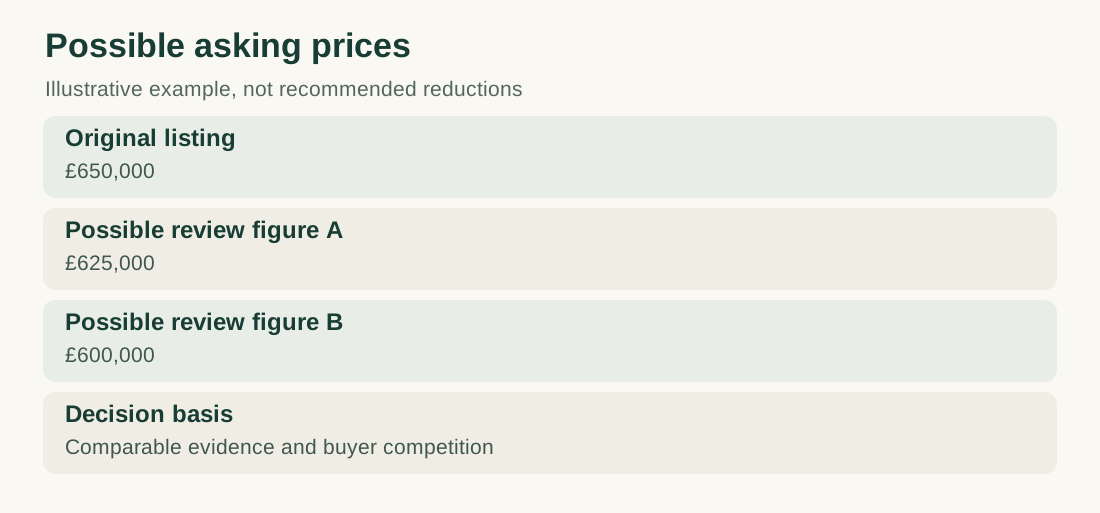 Illustrative example
Original listing: £650,000. Possible review figure A: £625,000. Possible review figure B: £600,000. Decision basis: Comparable evidence and buyer competition.
Beware a sequence of small, unexplained cuts
Repeated minor reductions can leave a listing looking stale without materially changing the group of buyers who consider it. A larger adjustment can also be wasteful if the underlying problem is inaccurate photographs or a serious issue that has not been investigated.
Rather than choosing between 'small' and 'large' in the abstract, ask which revised price is supported by the market evidence and what the change is intended to achieve. Then agree how its effect will be measured.
If the property has already had several changes, review the entire history. What happened to enquiries and viewings after each one? Were the marketing materials improved at the same time? Without that context, it is hard to tell what made the difference.
Set a review plan that can actually be tested
Before changing the figure, write down the current evidence, the new asking price, any accompanying marketing changes and the date on which results will be reviewed. Ask for reporting on qualified enquiries, viewings, feedback and offers rather than raw portal views alone.
A reduction is not a promise of a sale. The market may remain slow or the home may appeal to a small audience. Good advice should acknowledge that possibility.
For the initial strategy, read how to set your asking price. PMD's Property Intelligence Report offers comparable-sales analysis and pricing scenarios, not a guaranteed sale price. PMD is a trading name and service of The Ivybridge Collection Ltd, whose registered nature of business is real estate agencies, and we also sell marketing subscriptions to estate agents.
Ask your agent to complete this sentence: 'We propose this new asking price because the evidence shows ___, and we will judge the response by ___.' If the blanks cannot be filled, the reduction is not yet a strategy.
Sources
- HM Land Registry, About the Price Paid Data: Scope and limitations of recorded completed sale prices