
Selling your home
How to Set the Asking Price for Your House
The asking price is the first public statement your home makes to buyers. Set it too ambitiously and you may lose early interest; set it without enough evidence and you may regret the result. A sound launch price comes from understanding the likely selling range, your competition and the strategy you intend to follow.
This is an estimate from comparable sales, not a RICS or mortgage valuation, and not a survey.
Your asking price is a strategy, not a valuation certificate
An estate agent may recommend a figure, an online estimate may show another and a neighbour may remember a higher sale nearby. None of these should be copied straight into your listing without examining what they mean.
The asking price is the figure you invite buyers to respond to. The likely selling range is your evidence-led assessment of what the market might pay. The eventual sale price is only known once a transaction completes.
Those numbers can differ without anyone necessarily acting dishonestly. The problem arises when the asking price has no clear relationship to the evidence or no plan for responding to buyer behaviour.
Establish a defensible selling range
Begin with recent completed sales of genuinely comparable homes. Consider location, property type, approximate size, plot, condition, parking and unusual features. Adjust your judgement for material differences rather than applying an arbitrary percentage.
HM Land Registry's Price Paid Data provides completed transaction prices in England and Wales, but does not explain every property difference or give a live estimate of today's demand. Use current competing listings as a separate source of information about buyer choice.
If two estate agents reach different figures, ask each to identify the completed sales and assumptions behind the recommendation. Why estate agent valuations differ explains how to interrogate those figures.
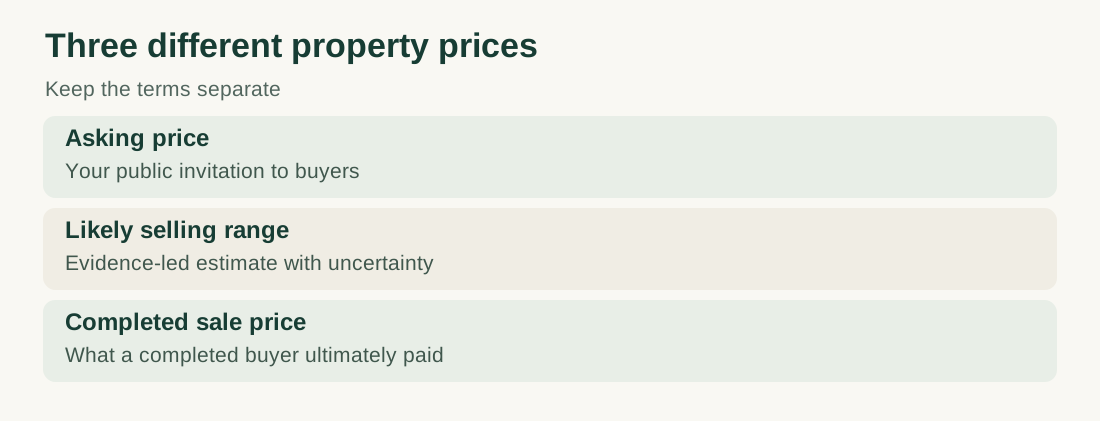
Asking price: Your public invitation to buyers. Likely selling range: Evidence-led estimate with uncertainty. Completed sale price: What a completed buyer ultimately paid.
Decide what the launch needs to achieve
A seller with a fixed relocation deadline may prefer a strategy designed to attract qualified interest promptly. A seller who can wait may be comfortable testing a more ambitious figure, provided they understand the risks and agree when to review it.
There is no reliable rule that every home should be listed a fixed percentage above its expected selling price. Buyers compare alternatives, search by budget and respond to the entire presentation.
Discuss the price bands buyers are likely to search on the relevant portals. A small price difference may affect whether a listing appears within particular saved searches, although search filters and user behaviour vary.
Look at the competition as a buyer would
Open the listings a plausible buyer would see alongside yours. Compare the first photograph, floor area, location, condition, outdoor space and asking price.
Ask a difficult question: if you had the buyer's budget, why would you choose your home over the alternatives? The answer might be location, accommodation or quality. It should not simply be that you know your home is special.
Do not confuse the asking prices of competing properties with evidence that those properties will sell at those figures. Some may have been listed for months without a buyer.
Agree what evidence will trigger a review
A price review should not depend only on frustration after an arbitrary number of days. Before launch, agree with your agent what will be measured and when you will discuss it.
Useful signals include qualified enquiries, viewing requests, completed viewings, recurring objections, offers and newly completed comparable sales. Each signal answers a different question.
Illustrative example. A property launches at £625,000. After a planned review period it has attracted online attention but almost no qualified viewings. That pattern may prompt a review of price, presentation and buyer targeting. It does not prove that a particular reduction will produce a sale.
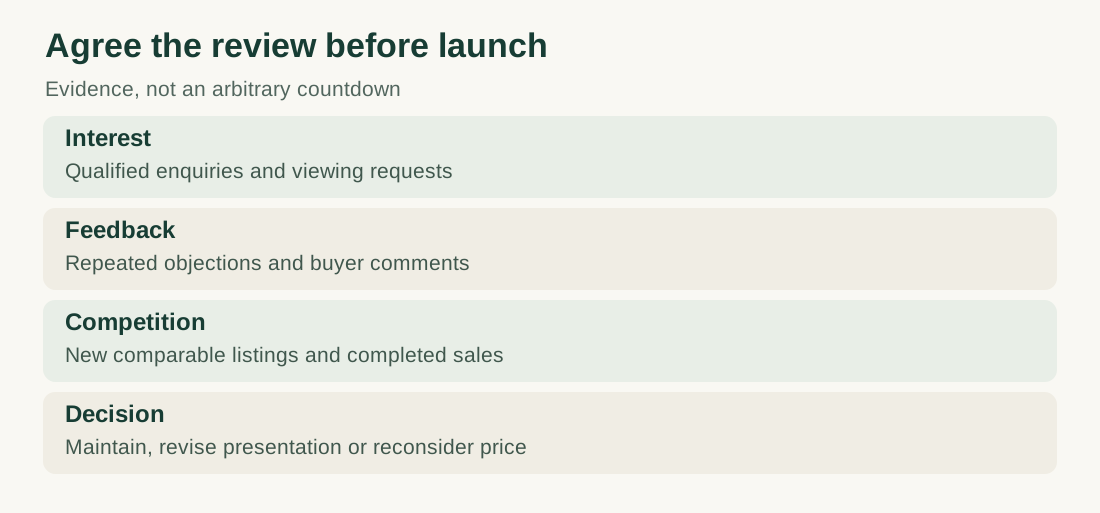
Interest: Qualified enquiries and viewing requests. Feedback: Repeated objections and buyer comments. Competition: New comparable listings and completed sales. Decision: Maintain, revise presentation or reconsider price.
Resist a high figure without a credible plan
A high appraisal can feel reassuring. Ask whether it reflects completed evidence, an optimistic assumption or a deliberate test of the market.
If the agent proposes starting above the likely selling range, ask what would justify that premium and how quickly the plan would change if buyers do not respond. A high asking price can be a conscious choice, but it should not be presented as a certainty.
For more on the distinction between asking price and market value, see asking price, market value and sale price. For the subsequent decision, see when to reduce a house price.
Use the right tool for the right question
PMD's Property Intelligence Report can help you examine comparable sales, assumptions and pricing scenarios for your property. It is a source of market evidence, not a guarantee of the price you will achieve.
PMD is a trading name and service of The Ivybridge Collection Ltd, whose registered nature of business is real estate agencies, and we also sell marketing subscriptions to estate agents. Its human review service concerns a customer's own Property Intelligence Report and specific market question, not an assessment of competing agents' marketing proposals.
Before you approve the listing, ask your agent to write down the likely selling range, the reason for the chosen asking price and the evidence that would lead you both to reconsider it. That makes the launch a decision you can manage rather than a number you hope will work.
Sources
- HM Land Registry, About the Price Paid Data: Explains completed sale price records and their coverage