
Selling your home
How Long Does It Take to Sell a House?
A seller might find a buyer quickly and still wait months to move. Another property may spend longer on the market but proceed smoothly once an offer is accepted. These are different stages with different risks. Planning them separately is more useful than relying on a single average number of days.
This is an estimate from comparable sales, not a RICS or mortgage valuation, and not a survey.

There is no single clock for a house sale
A property can spend weeks looking for a buyer, then months moving through legal work. Combining those periods into one national average hides the reasons for delay. It also creates unrealistic expectations when an agent quotes the time needed to find an offer as though it were the time needed to move out.
Plan around stages. Ask which are underway, which depend on other people and what could hold up the next step.
Before an offer: the marketing period
Preparation, photography, floor plans and accurate property details take time. Once the property launches, the volume of qualified enquiries depends on price, presentation, location, competition and the buyers currently looking.
A home attracting no viewings needs a different response from one attracting viewings but no offers. See the guide to homes with few viewings and what to do when viewings do not become offers. Ask the agent to report activity and feedback rather than promising a sale by a particular date.
After an offer: a different set of dependencies
Once an offer is agreed, solicitors or conveyancers investigate title, carry out enquiries and coordinate contracts. The buyer may arrange a survey and mortgage. Other transactions in the chain can affect the timetable, even if your own paperwork is ready.
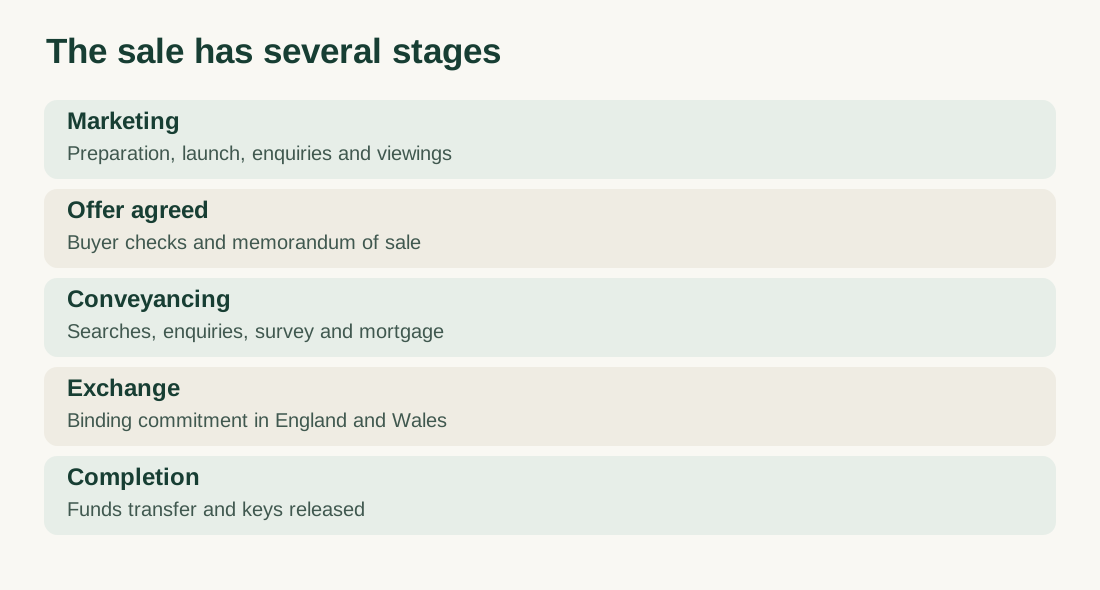
Marketing: Preparation, launch, enquiries and viewings. Offer agreed: Buyer checks and memorandum of sale. Conveyancing: Searches, enquiries, survey and mortgage. Exchange: Binding commitment in England and Wales. Completion: Funds transfer and keys released.
In England and Wales, exchange and completion are distinct milestones. Exchange normally makes the contract binding; completion is when funds are transferred and ownership changes. The process differs in Scotland, so obtain advice appropriate to the property.
A mortgage agreement in principle does not mean the buyer has a final mortgage offer. Nor does a cash buyer remove title or survey questions. These are useful distinctions when discussing an expected completion date.
Ask for a plan with dependencies
Instead of 'Can we move in eight weeks?', ask which documents and decisions must be completed before exchange. Has the seller completed the property information forms? Are there building regulations certificates or leasehold management packs to obtain? Does the buyer need to sell another home?
Illustrative example. A seller accepts an offer quickly, but the buyer's onward mortgage assessment raises a property-specific issue. The sale may slow despite strong marketing. Conversely, a home that took longer to attract an offer may move smoothly once a well-prepared chain-free buyer is found. Neither case provides a universal timetable.
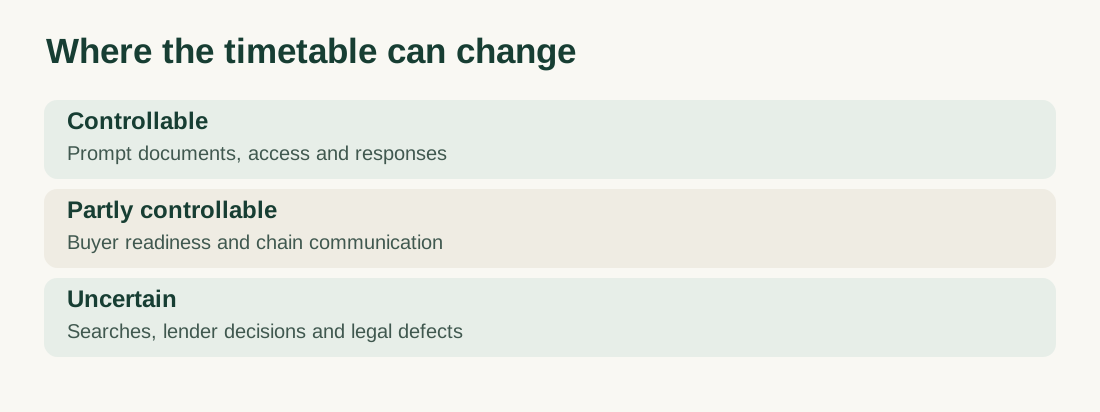
Controllable: Prompt documents, access and responses. Partly controllable: Buyer readiness and chain communication. Uncertain: Searches, lender decisions and legal defects.
Prepare without creating false certainty
Gather relevant guarantees, permissions, certificates and details of alterations early. Respond promptly to requests and tell the agent and conveyancer about important dates. If you are buying onward, understand what happens if the chain is delayed.
Avoid booking non-refundable removals or committing to an irreversible move on the strength of an estimated completion date. Discuss timing with your conveyancer, especially before exchange.
A weekly update should distinguish completed steps, outstanding enquiries and the person responsible for each. What an estate agent update should include gives a practical reporting framework.
Review the estimate as the facts change
An initial moving plan is useful, but it should be revised when a survey, title enquiry or chain issue changes the dependencies. Ask for reasons rather than treating every delay as evidence of poor performance.
PMD's Property Intelligence Report provides pricing evidence. It does not forecast a particular completion date or replace conveyancing advice. PMD is a trading name and service of The Ivybridge Collection Ltd, whose registered nature of business is real estate agencies, and we also sell marketing subscriptions to estate agents.
Keep the moving date provisional
If you need to arrange schooling, work or temporary accommodation, build a fallback plan around the possibility of delay. Agree with your conveyancer which milestones make a date more dependable and which commitments should wait until contracts are exchanged.
A realistic timetable is not a confident prediction. It is a sequence of milestones, named responsibilities and sensible contingency time.
Sources
- HM Land Registry, About the Price Paid Data: Explains the scope of completed property transaction records
- GOV.UK, Buying or selling your home: Explains the property sale and conveyancing process