
Selling your home
How to Compare Buyers When You Have Several Offers
The highest offer is not always the one most likely to complete. A buyer with a strong financial position may offer less than someone who still needs to sell a property. Neither outcome is certain. Compare the offers on the same facts and ask your agent to distinguish evidence from assurances.
This is an estimate from comparable sales, not a RICS or mortgage valuation, and not a survey.
Put every offer on the same page
Receiving several offers is encouraging, but comparing them from memory is difficult. One buyer offers more but must sell a home; another is chain-free but wants a later completion. Ask your agent to record each offer consistently so you can compare the trade-offs.
Begin with the proposed price, then add funding position, chain status, conditions and timing. Ask which details have been checked. A buyer's enthusiasm is welcome, but it is not evidence of funds.
What the price alone cannot tell you
An offer is a proposal, not completed proceeds. The seller needs to know whether the buyer can fund it and whether the transaction is likely to progress. That does not mean always choosing the lowest-risk buyer. It means recognising that price and certainty are separate considerations.
Ask about a mortgage agreement in principle, deposit arrangements and whether the buyer's own property is on the market, under offer or exchanged. Where cash is claimed, ask what evidence has been provided through appropriate processes. An agent should handle personal financial information carefully.
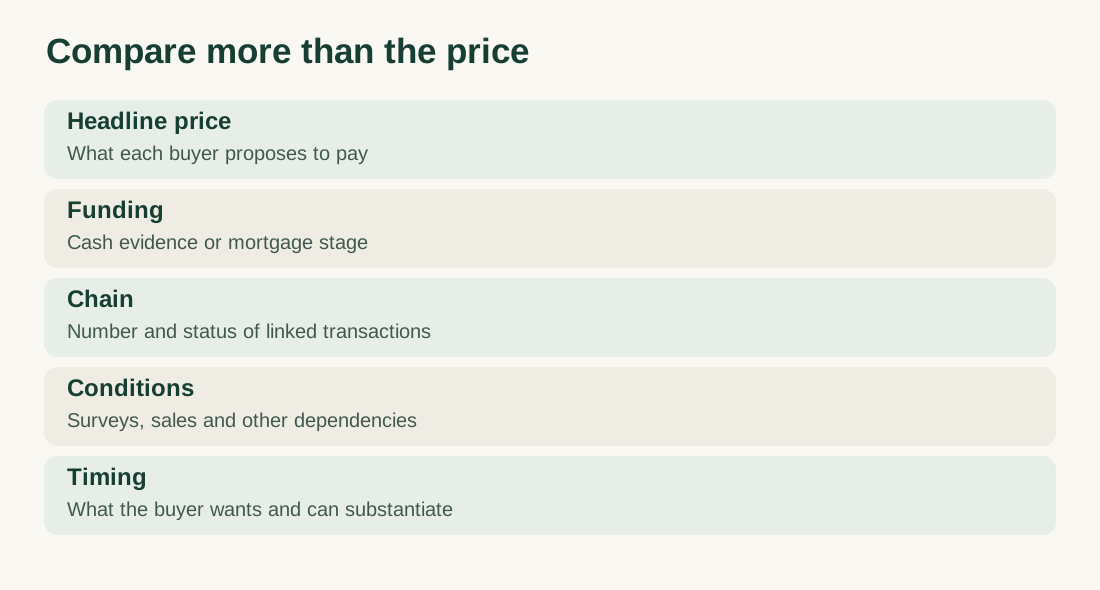
Headline price: What each buyer proposes to pay. Funding: Cash evidence or mortgage stage. Chain: Number and status of linked transactions. Conditions: Surveys, sales and other dependencies. Timing: What the buyer wants and can substantiate.
Consider the chain as a set of dependencies
'Chain-free' usually means the buyer is not relying on selling another property, but it does not mean that their mortgage, survey or legal work is complete. A short chain can still encounter a title issue. A longer chain can sometimes be well advanced.
Ask how many linked transactions there are, which are agreed and whether any parties have outstanding finance or property sales. Distinguish a confirmed fact from an agent's expectation.
For the buyer's perspective, how funding and chains affect offers explains why an apparently attractive offer may carry unresolved conditions.
Read the conditions, not just the headline
Some buyers propose a particular completion window, request items to remain or signal that they will undertake significant works. Others have a property to sell or need to clarify funding. Write down each material condition.
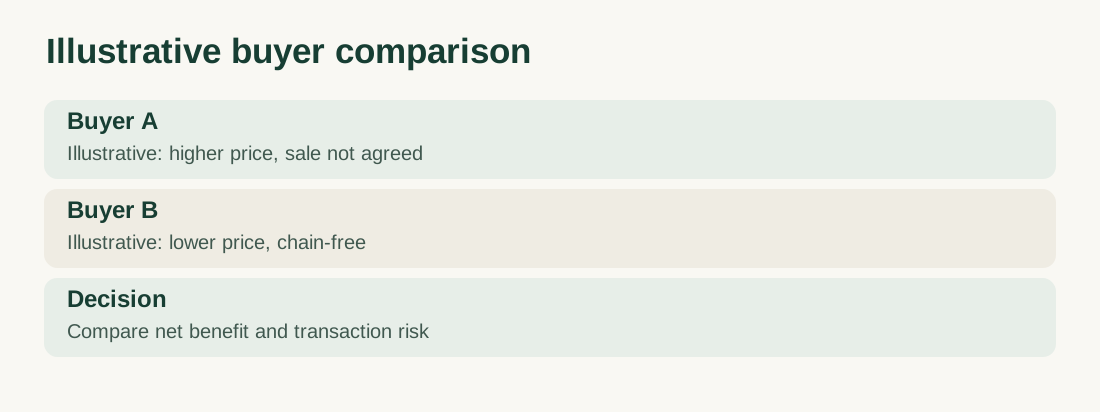
Illustrative example. Buyer A offers £615,000 but has not agreed a sale of their existing home. Buyer B offers £605,000, has no onward sale and can provide evidence of their mortgage arrangements. The £10,000 difference does not establish which offer is preferable. Your deadline, the property's market evidence and the strength of each buyer's position all matter.
 Illustrative example
Buyer A: Illustrative: higher price, sale not agreed. Buyer B: Illustrative: lower price, chain-free. Decision: Compare net benefit and transaction risk.
Ask the agent to explain their recommendation
An agent may have information from conversations with buyers, but ask them to separate what they have checked from what they infer. Have they confirmed the buyer's position? Are there warning signs about the proposed timetable? Have they presented all offers in accordance with the relevant rules?
The seller makes the decision. Avoid letting the agent's enthusiasm for a particular buyer substitute for your own assessment. If the offers are below the asking price, the guide to below-asking offers helps evaluate the price itself.
Do not mistake acceptance for completion
In England and Wales, acceptance is normally subject to contract until exchange. A buyer can withdraw or seek to renegotiate, and a seller may face difficult choices if that happens. A strong offer is one supported by a plausible route to completion, not a guarantee. Ask the agent to set out in writing what each buyer has offered and what each still needs to arrange, so that you compare the same things.
If you have an onward purchase, discuss your financial and contractual exposure with your conveyancer. If you are unsure about pricing, PMD's Property Intelligence Report may help with comparable sales, but it does not assess buyers or chains. PMD is a trading name and service of The Ivybridge Collection Ltd, whose registered nature of business is real estate agencies, and we also sell marketing subscriptions to estate agents.
Keep the comparison sheet and ask for updates when a buyer's position changes. A decision based on checked facts can be reconsidered without starting from scratch.
Sources
- HM Land Registry, About the Price Paid Data: Explains the scope of completed property transaction records
- GOV.UK, Buying or selling your home: Explains the property sale and conveyancing process