
Selling your home
Should You Accept an Offer Below Asking Price?
An offer below your asking price can feel disappointing, especially after weeks of preparation. But the gap between two figures is not enough to judge the proposal. Consider what the market evidence says, how likely this buyer is to proceed and what declining the offer would mean for your plans.
This is an estimate from comparable sales, not a RICS or mortgage valuation, and not a survey.
Start with what the offer means, not the discount
A house listed at a particular price is not automatically worth that amount. Asking prices are marketing decisions; completed prices show what buyers have paid for specific homes. A proposal below the listing figure could be sensible, opportunistic or genuinely too low. You cannot decide which from the percentage difference alone.
Ask your agent to place the offer beside the most relevant completed sales. Check property size, condition, location, plot and timing. Recent competing listings also matter, but their advertised prices are not completed evidence. The distinction between asking price and market value is useful here.
Understand the buyer before choosing a response
What does the agent actually know about the buyer's finances? Is there a mortgage agreement in principle, evidence of available funds or a property sale already agreed? If the buyer is in a chain, how far has it progressed? Has the buyer made their offer subject to a particular survey outcome or completion date?
These facts affect risk, not the home's intrinsic value. A cash buyer can still change their mind; a buyer with a mortgage can proceed efficiently. Ask the agent which facts have been checked and which are simply reported by the buyer.
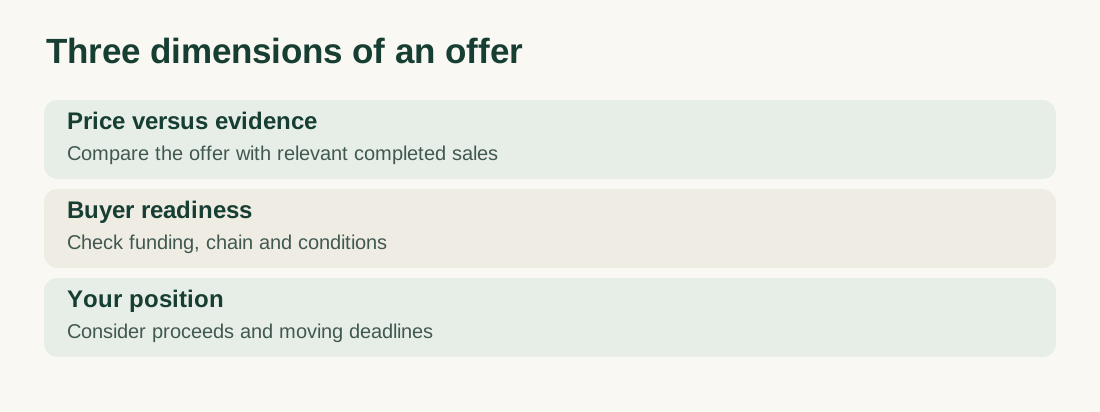
Price versus evidence: Compare the offer with relevant completed sales. Buyer readiness: Check funding, chain and conditions. Your position: Consider proceeds and moving deadlines.
Calculate the consequence for your move
Your decision may depend on what remains after mortgage redemption, selling costs and any onward purchase. Ask your conveyancer or lender for figures where necessary. A difference that looks modest as a percentage can matter greatly if it changes your ability to move.
Illustrative example. A property is marketed at £625,000 and a buyer offers £600,000. The £25,000 gap is real, but it is not automatically a £25,000 loss against market value. If comparable completed sales support a range around the offer, the asking price may have been ambitious. If strong evidence supports a materially higher figure, countering or waiting may be reasonable.
Also consider the cost of waiting, such as mortgage payments, maintenance or an onward purchase at risk. Do not count speculative future offers as money you already have.
Choose a response you can explain
You have three broad choices: accept, counter or decline. Countering can address more than price. You might discuss timescale, fixtures or the buyer's evidence of readiness, although any changes need to be clear and agreed.
If you decline, ask what specifically would make another buyer more likely to pay more. A revised listing, a change in market conditions or newly available comparable evidence may matter. Merely hoping for the full asking price is not a plan.
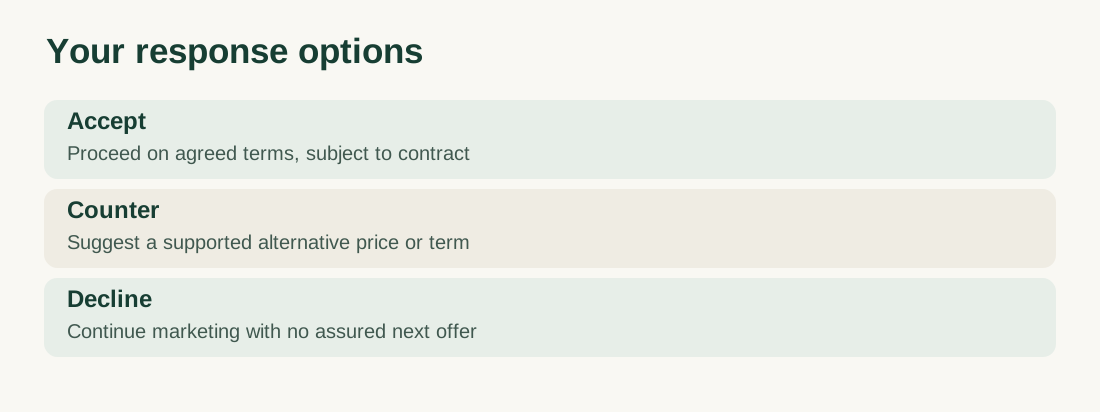
Accept: Proceed on agreed terms, subject to contract. Counter: Suggest a supported alternative price or term. Decline: Continue marketing with no assured next offer.
Keep the transaction status in perspective
In England and Wales, an accepted offer is generally subject to contract until exchange. Survey findings, legal enquiries and mortgage decisions may change the position. Do not treat a verbal promise of speed as certainty.
For competing offers, see how to compare buyers. For an asking price that may need reviewing, see when to reduce the price.
PMD's Property Intelligence Report can help you inspect comparable sales and pricing assumptions. It cannot determine a buyer's creditworthiness or promise a completed sale. PMD is a trading name and service of The Ivybridge Collection Ltd, whose registered nature of business is real estate agencies, and we also sell marketing subscriptions to estate agents.
Ask what the agent would do next
If you reject the offer, request a specific plan for finding another buyer. Will the agent contact people who viewed previously, review the listing against current alternatives or recommend a pricing discussion? Ask how the agent will report the outcome. An unexplained expectation that a better buyer will appear is not enough to weigh against an offer already received.
Write down why you accepted, countered or declined. A decision supported by comparable evidence and a clear understanding of your moving position is easier to revisit if circumstances change.
Sources
- HM Land Registry, About the Price Paid Data: Explains the scope of completed property transaction records
- GOV.UK, Buying or selling your home: Explains the property sale and conveyancing process