
Selling your home
Viewings but No Offers: How to Diagnose the Problem
Viewings are encouraging because buyers have decided the home is worth seeing. But if nobody offers, the reasons may lie in what they discover on arrival, how the home compares with alternatives or what they believe it is worth. The challenge is separating useful patterns from casual remarks.
This is an estimate from comparable sales, not a RICS or mortgage valuation, and not a survey.
A viewing is evidence of interest, not proof of value
When several buyers view a house without making an offer, it is natural to focus on the most recent visitor's comments. One disliked the kitchen, another mentioned the garden and a third said they wanted a different area. These remarks can be useful, but they do not automatically explain the lack of offers.
Begin with a record of the viewings. How many were qualified buyers? What budgets and requirements did they have? What did they know before visiting? Were they seriously considering a move, or still exploring the market?
If the home attracts almost no viewings at all, that is a different diagnosis. Start with what to check when a house is not getting viewings.
Look for repeated objections rather than isolated opinions
Ask your agent to group feedback into themes: condition, accommodation, layout, location, price and personal circumstances. Record the buyer's actual words where possible, not just the agent's interpretation.
Three people noticing a damp smell may justify investigating the cause. One visitor disliking the paint colour is much weaker evidence. Several buyers saying they can find a larger home at the same budget is a prompt to compare the competing properties.
Avoid making expensive changes in response to a single vague comment. Ask whether the objection can be verified and whether addressing it would materially change the likely buyer's decision.
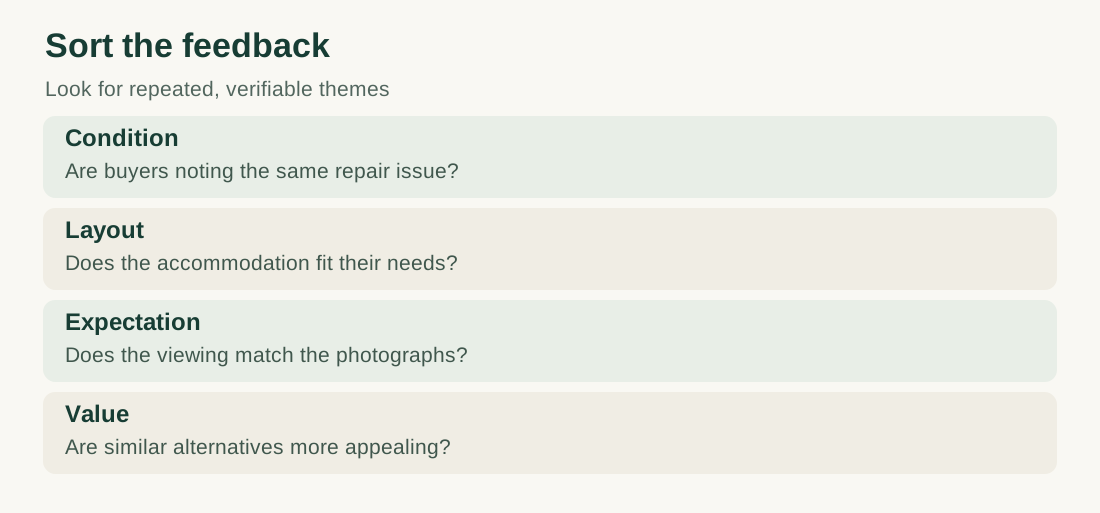
Condition: Are buyers noting the same repair issue?. Layout: Does the accommodation fit their needs?. Expectation: Does the viewing match the photographs?. Value: Are similar alternatives more appealing?.
Compare what the advert promises with the viewing experience
A listing may generate appointments because the photography suggests spacious rooms, privacy or a particular lifestyle. Buyers then arrive and discover the road is busier than expected or that a room is smaller than the images imply.
This does not mean the photographs should be deliberately unflattering. It means the presentation should be accurate. Clear floor plans, useful dimensions and photographs that show the layout can help attract better-matched buyers.
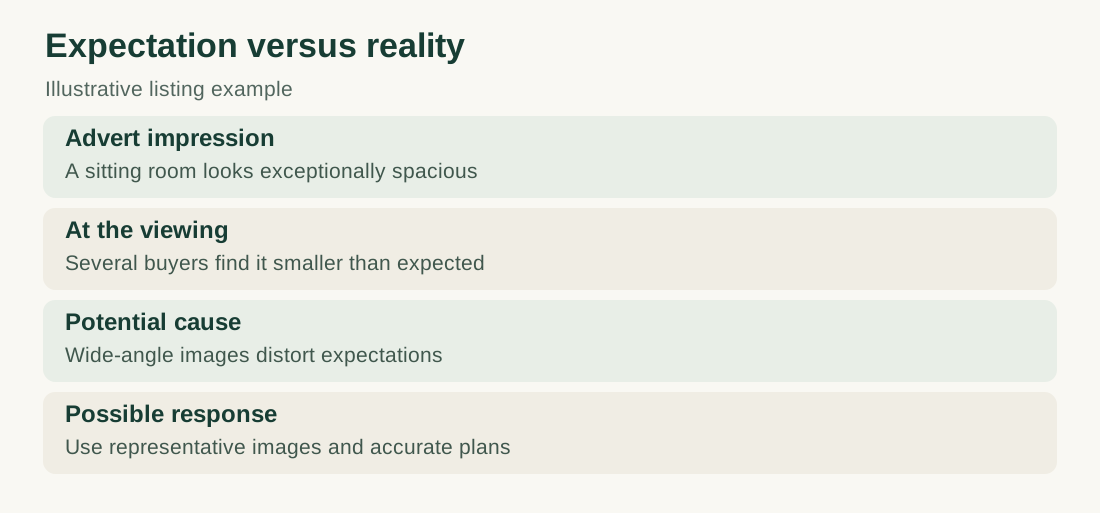
Illustrative example. A listing's wide-angle photographs make a sitting room look unusually large. Viewers repeatedly say the room feels smaller than expected. The problem may be the gap between expectation and reality, rather than the room itself. More representative photography could reduce unsuitable appointments, although it would not guarantee an offer.
 Illustrative example
Advert impression: A sitting room looks exceptionally spacious. At the viewing: Several buyers find it smaller than expected. Potential cause: Wide-angle images distort expectations. Possible response: Use representative images and accurate plans.
Ask what buyers chose instead
Where buyers are willing to share, ask which other properties they preferred and why. A comparison with an actual alternative is more informative than 'not for us'. It may reveal a different location, a better layout, less immediate work or a lower asking price.
Do not assume the agent can obtain every buyer's full reasoning. Some people simply do not respond to follow-up. Record the limits of the evidence rather than treating silence as a particular objection.
Compare the alternatives carefully. A newly refurbished home may look superior but have a smaller garden. Another may be cheaper because it is beside a busy road. You are looking for the trade-offs buyers are making.
Decide whether the response calls for preparation, information or price
A known repair issue may require investigation and honest disclosure. A poorly furnished room might benefit from simpler presentation. A misleading floor plan needs correction. If buyers consistently prefer better-value alternatives, the asking price may need review.
For low-cost preparation, see how to present your home before selling. For a price decision, see when and how to consider a price reduction. Do not jump from 'no offers' to a fixed percentage reduction without testing the comparable evidence.
Make the next viewing more informative
Ask the agent to agree a consistent, respectful follow-up process. Record what attracted each buyer, what prevented an offer and whether they would reconsider under different circumstances. The purpose is to learn, not to pressure people into making an offer.
Review the pattern after a meaningful group of viewings. The right sample size depends on the property and market, so there is no universal threshold. An unusual home may have a smaller audience and require more time to understand.
PMD's Property Intelligence Report can help assess comparable sales and pricing assumptions, but it cannot establish why particular viewers declined to offer. PMD is a trading name and service of The Ivybridge Collection Ltd, whose registered nature of business is real estate agencies, and we also sell marketing subscriptions to estate agents.
The useful question is not 'Why didn't they buy?' in the abstract. It is 'Which objections are recurring, verifiable and within our power to address?' That is where a practical sales plan begins.
Sources
- HM Land Registry, About the Price Paid Data: Scope and limitations of recorded completed sale prices