
Buying and offers
Can you renegotiate after a house survey?
A survey can turn excitement about a purchase into uncertainty. It may identify routine maintenance, serious concerns or issues that need further investigation. Before asking for a lower price, understand which findings genuinely change the cost or risk of buying.
This is an estimate from comparable sales, not a RICS or mortgage valuation, and not a survey.
Read the survey as an assessment, not a shopping list for discounts
A survey may identify items requiring attention, recommend further investigation or flag limitations in what the surveyor could inspect. That does not mean the seller must reduce the price by the estimated cost of every repair.
Older homes commonly need ongoing maintenance. The key question is whether the findings reveal a material problem you could not reasonably assess before agreeing the price, and how that changes your decision.
Ask the surveyor to clarify the significance of any important finding. What is known, what remains uncertain and which specialist should investigate further? Avoid diagnosing structural, electrical or damp problems yourself from a few lines in a report.
Separate urgency, uncertainty and routine upkeep
Make three groups. The first contains matters that may affect safety or require urgent work. The second contains concerns for which the cause or cost is not yet established. The third contains ordinary maintenance you might reasonably expect for a property of that age and condition.
This is a decision aid, not a technical classification. Your surveyor or a suitably qualified specialist should advise on the actual condition and significance of each issue.
A statement such as 'further investigation recommended' is not a repair quotation. It is a reason to obtain more information before deciding whether to proceed or change your offer.
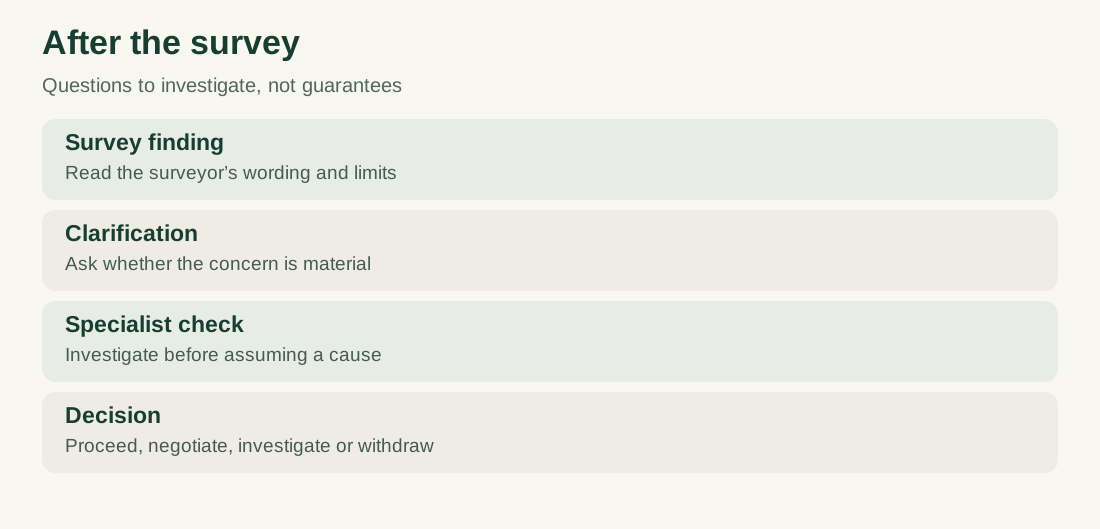
Survey finding: Read the surveyor’s wording and limits. Clarification: Ask whether the concern is material. Specialist check: Investigate before assuming a cause. Decision: Proceed, negotiate, investigate or withdraw.
Get evidence of the likely cost
For a material concern, seek appropriate specialist advice and, where possible, a written quotation that describes the proposed work. Ask what the quote includes, whether access or opening-up works are required and whether there are significant uncertainties.
Illustrative example. A surveyor notes possible roof deterioration. An informal guess from a friend suggests a modest repair, while a contractor advises that further inspection is needed before any reliable price can be given. Neither figure should be presented to the seller as a confirmed repair cost. The sensible next step is to establish the scope of the problem.
If you receive several quotes, compare their scope rather than choosing the largest number to support a negotiation. Repair costs are not necessarily identical to the effect of a defect on market value.
Decide what outcome you actually want
You might proceed at the agreed price, ask for more time to investigate, seek a reduction, request that the seller undertakes specified work or withdraw. Each route has practical consequences.
Work carried out by a seller may create questions about contractor selection, warranties and timing. A price adjustment gives you control over later work but leaves you responsible for arranging it. Your conveyancer can advise on how any agreement should be documented.
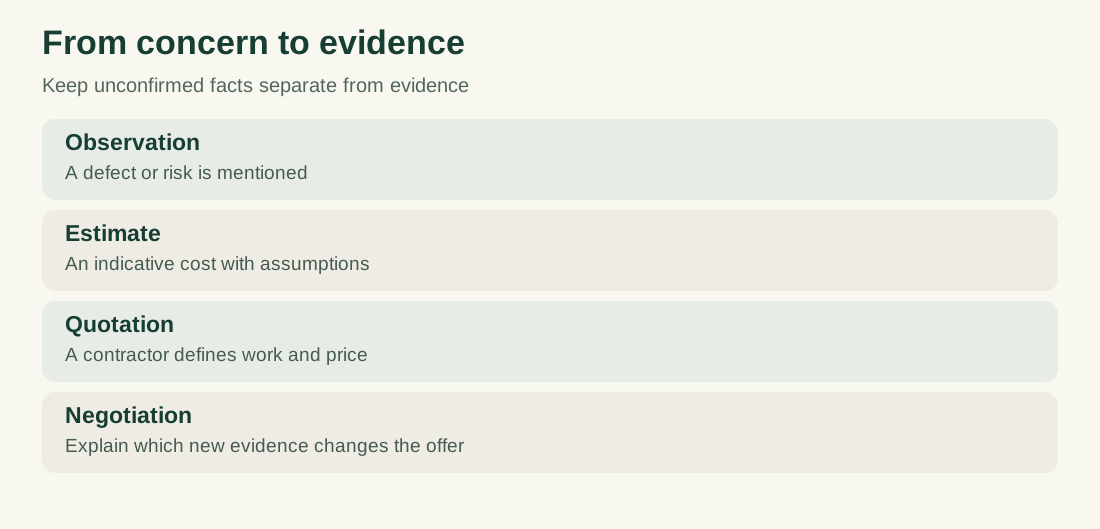
Observation: A defect or risk is mentioned. Estimate: An indicative cost with assumptions. Quotation: A contractor defines work and price. Negotiation: Explain which new evidence changes the offer.
Make a measured request through the agent
If you decide to renegotiate, identify the material findings, attach the relevant professional evidence and explain the adjustment you propose. Be specific about what has changed since the original offer.
Avoid treating the survey as a bargaining tactic or sending the seller a long list of cosmetic faults. A focused explanation is easier to evaluate than an unexplained demand for a discount.
The seller may refuse, propose a compromise or ask for more information. In England and Wales, transactions are generally not legally binding until exchange of contracts, but you can still incur costs and delay. Obtain legal advice about your particular circumstances.
Do not confuse a survey problem with a lender down valuation
A building survey considers condition within its scope. A mortgage valuation is undertaken for lending purposes. A lender might assess the property below the agreed price even where a survey has not identified a significant defect, or might raise separate concerns about condition.
Those are different conversations. See what happens after a mortgage down valuation for the financing issue and how property condition affects value for the broader relationship between condition and pricing.
If you are still deciding what checks to make before offering, the pre-offer checklist can help you avoid preventable surprises.
You can read about PMD's buyer report for a home you are considering. A property market report or written opinion cannot replace a building survey or specialist inspection.
A persuasive renegotiation is based on a genuine change in information, professionally supported costs or risks and a clear explanation of the outcome you are requesting. The purpose is to make an informed decision, not to manufacture a discount.
Sources
- HM Land Registry, About the Price Paid Data: Explains recorded completed sale price information and limitations
- RICS, Home surveys: Explains the purpose and scope of residential property surveys, URL to verify before publishing