
Buying and offers
What happens when a mortgage valuation is lower?
Your offer has been accepted, but the lender values the property below the agreed price. That does not automatically mean the home is worth one exact figure or that the purchase must fail. It does mean the proposed borrowing may need to be reconsidered.
This is an estimate from comparable sales, not a RICS or mortgage valuation, and not a survey.
A mortgage valuation answers the lender's question
A mortgage lender needs to assess whether the property offers suitable security for the amount it proposes to lend. Its valuation may differ from the agreed purchase price. That is often called a down valuation.
It is not necessarily a full building survey, and it is not a guarantee of the price another buyer would pay. Different valuation instructions, available evidence and lending policies can produce different conclusions. The lender decides how to use the assessment under its own criteria.
For the difference between valuation purposes, see the types of property valuation explained.
Work out the funding gap before reacting
The important issue is how the lender's assessment affects the loan available to you. A lower valuation can change the loan-to-value ratio and may reduce the amount the lender is willing to advance. The effect depends on your product, deposit and the lender's policy.
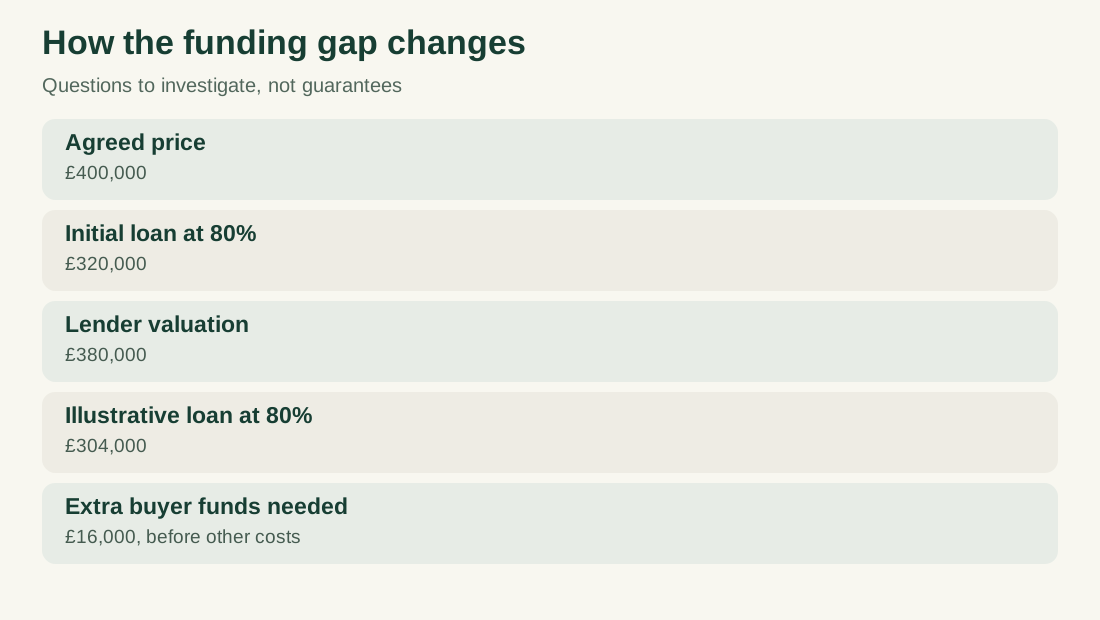
Illustrative example, not a mortgage quotation. Suppose the agreed price is £400,000, you expect to borrow 80% of that price (£320,000) and have £80,000 for the purchase. If the lender instead uses a valuation of £380,000 and applies an 80% lending limit to that figure, the illustrative maximum loan becomes £304,000. To complete at £400,000, you would need £96,000 of your own funds, before fees and other costs. That is £16,000 more than originally planned.
This example assumes the same 80% limit applies and ignores product-specific rules. Your actual lender may assess the application differently. Do not move money or make a revised offer based on the illustration alone.
 Illustrative example
Agreed price: £400,000. Initial loan at 80%: £320,000. Lender valuation: £380,000. Illustrative loan at 80%: £304,000. Extra buyer funds needed: £16,000, before other costs.
Ask what the lender has actually decided
Contact your lender or mortgage adviser. Has the lender formally reduced the amount it will offer? Is the valuation provisional? Is a different product available, and on what terms? Can you request a reconsideration and, if so, what evidence would be accepted?
A reconsideration is not an entitlement to a higher figure. The lender may require recent, relevant completed sales or correction of a factual error, and it may retain its original assessment. Ask about the process before paying for additional work.
Your conveyancer can explain how a funding problem affects the transaction timetable. Do not assume that a seller or estate agent can change the lender's decision.
Consider the options without treating them as equal
One possibility is to ask the seller to reduce the price. They may agree, decline or suggest a compromise. Another is to contribute more of your own funds, if that is genuinely affordable and acceptable to the lender. You might discuss alternative lending arrangements with a qualified mortgage adviser. Or you may decide the purchase no longer works for you.
These options have different costs and risks. A larger deposit could reduce your emergency savings. A different mortgage may change repayments, fees or eligibility. A lower purchase price depends on the seller's consent. There is no single choice that suits everyone.
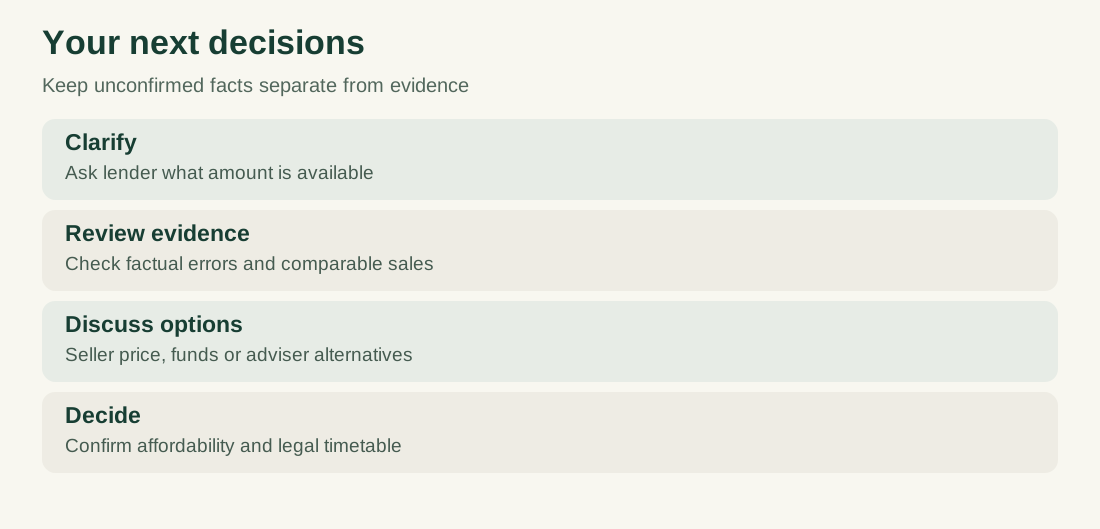
Clarify: Ask lender what amount is available. Review evidence: Check factual errors and comparable sales. Discuss options: Seller price, funds or adviser alternatives. Decide: Confirm affordability and legal timetable.
Present evidence carefully if you challenge the valuation
If you believe a factual error has affected the assessment, write down the specific error. Examples might concern property type, accommodation or a comparable sale that is materially unlike the subject home. Check facts before presenting them as corrections.
If you provide comparable transactions, identify completion dates, location, size and relevant differences. A higher asking price for another home is not evidence of a completed sale at that figure. How to decide what to offer explains how to weigh asking prices against actual sales.
The lender may still disagree. A market contains uncertainty, and an accepted offer is not itself proof of the lender's security value.
Keep condition issues in a separate file
A lender's valuation and a survey are not interchangeable. If a building survey reveals repairs that change your willingness to proceed, use the post-survey renegotiation guide. If the lender imposes conditions relating to the property's state, ask the lender and relevant professionals what those conditions require.
Do not tell the seller that a survey found defects when the only new information is a lower lending valuation. Clear distinctions make the conversation more credible.
You can read about PMD's buyer report for a home you are considering. No PMD report determines a lender's lending decision or replaces regulated mortgage advice.
The immediate task is to confirm the lender's actual position, calculate the revised funding requirement and decide what you can responsibly do next. A down valuation is a financing problem to investigate, not a verdict to accept or dismiss without evidence.
Sources
- HM Land Registry, About the Price Paid Data: Explains recorded completed sale price information and limitations
- MoneyHelper, Mortgages: Consumer guidance on mortgage decisions and home buying, URL to verify before publishing