
Property valuations
How to Use Sold House Prices to Value a Property
A sold price is one of the strongest pieces of evidence in a property discussion. It is also easy to misuse. A recorded transaction tells you what a particular buyer paid for a particular home at a particular time, not what your property would necessarily achieve today.
This is an estimate from comparable sales, not a RICS or mortgage valuation, and not a survey.
A sold price answers one precise question
When a home completes, the recorded price is evidence of what was paid for that transaction. It is not a certificate of today's market value, nor does it tell you whether the property was refurbished, sold with extra land or subject to unusual circumstances.
HM Land Registry's Price Paid Data covers many residential transactions in England and Wales. It has defined exclusions and reporting delays, so a recent completion may not yet appear. Always read the dataset's scope before assuming that a missing record means a property did not sell.
Check the date before comparing the figure
The date attached to a recorded sale is important. A price achieved during a different mortgage environment or before substantial local development may be less informative than a more recent comparable transaction.
There is no universal adjustment that reliably converts an old sale into today's price. The UK House Price Index can provide broad context about movements, but its regional or national averages are not a property-specific adjustment factor.
Illustrative example. A detached house sold for £540,000 three years ago. A neighbouring home is now offered at £620,000. Those two numbers do not establish that prices have risen by £80,000. The properties may differ, and an advertised price is not a completed sale.
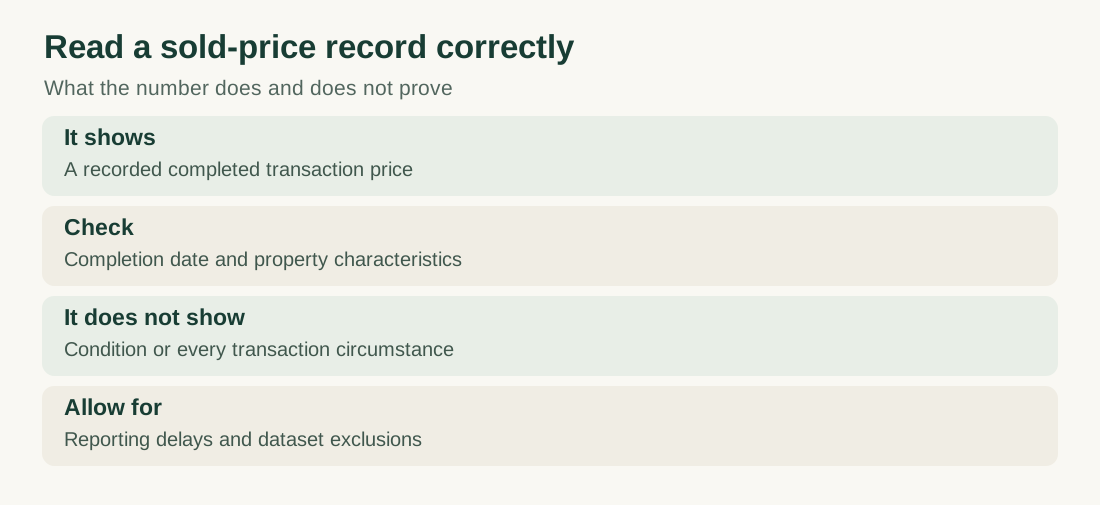
It shows: A recorded completed transaction price. Check: Completion date and property characteristics. It does not show: Condition or every transaction circumstance. Allow for: Reporting delays and dataset exclusions.
Compare homes that a buyer would regard as alternatives
Begin with property type, location, accommodation, approximate floor area, tenure and plot. Then examine the differences that matter: condition, parking, outlook, extensions and any unusual restrictions.
The closest address is not necessarily the most useful comparable. A bungalow on the next road may be a poor comparison for a three-storey townhouse, while a similar townhouse a mile away may be more useful. Equally, crossing a major road, school boundary or village edge may change buyer demand.
For a different way to cross-check size, see price per square foot and its limitations. It should support, not replace, comparison of the actual homes.
Look for what the record cannot show
A sold-price entry will not tell you the kitchen's condition, whether a loft conversion has appropriate approvals, the quality of the garden or whether a buyer accepted an unusual completion arrangement. Historical listing photographs, EPC records and other reliable documents may help, but information can be incomplete or outdated.
Be especially careful with properties that have been extended, divided or materially altered. A transaction that looks like a bargain may have included obligations or defects that are not visible in the basic price record.
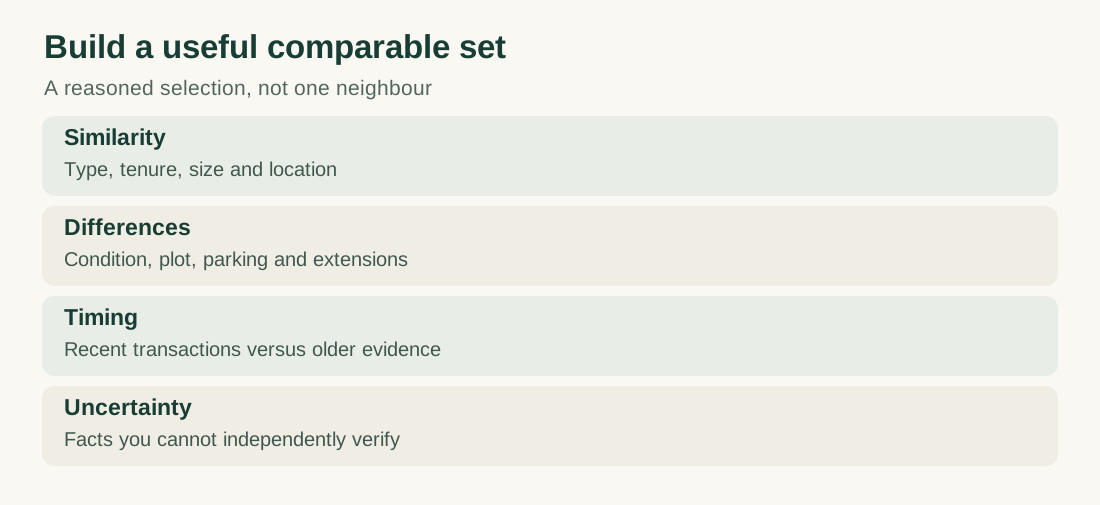
Similarity: Type, tenure, size and location. Differences: Condition, plot, parking and extensions. Timing: Recent transactions versus older evidence. Uncertainty: Facts you cannot independently verify.
Use a range, not a single convenient neighbour
Choose several relevant completed transactions if the evidence allows. Explain why each is useful and where it differs. If there are very few comparable sales, acknowledge the uncertainty instead of filling the gap with an invented adjustment percentage.
Avoid selecting only the highest nearby sale because it supports the figure you hope for. The lower results may be informative too. Look at the pattern and ask what accounts for the spread.
Property condition and value examines one of the most common sources of difference. Valuing unusual homes addresses situations where the available transactions are sparse.
Keep asking prices in a separate column
Current listings reveal the competition and the prices sellers are seeking. They are useful, but they are not proof of value. Likewise, an advertised price reduction tells you that a seller changed their expectations, not the final price a buyer paid.
PMD's Property Intelligence Report draws on available comparable sales and property information to explain an estimated range and assumptions. It is an analytical aid, not a formal valuation or a promise of sale price. PMD is a trading name and service of The Ivybridge Collection Ltd, whose registered nature of business is real estate agencies, and we also sell marketing subscriptions to estate agents.
Before relying on any sold price, write down the completion date, the property's relevant characteristics and the differences you cannot verify. That simple discipline prevents a useful record from becoming a misleading comparison.
Sources
- HM Land Registry, About the Price Paid Data: Explains recorded completed sales, coverage and limitations
- HM Land Registry, UK House Price Index: Broad historical market context, not individual property values