
Property valuations
Why Do Online Property Valuations Change?
An online estimate can rise or fall even when you have not touched your house. That does not necessarily mean your property has suddenly changed in value. Often the system has received new information or revised how it interprets the information already available. The useful question is what changed in the evidence.
This is an estimate from comparable sales, not a RICS or mortgage valuation, and not a survey.
A changing estimate does not mean your house changed overnight
An online valuation can move even if your property has been untouched for years. Automated systems use records, property attributes and statistical methods. When their inputs or methods change, the result can change too.
That does not make every revision meaningless. A new comparable sale may be highly relevant. But the size and direction of a change need to be understood before you treat it as evidence that the market has moved.
Look for newly recorded transactions
Completed property sales may appear in public records after a delay. When a nearby transaction is added, an automated model may revise its estimate, especially if there were few recent comparable sales before.
The effect depends on whether the new sale is actually similar to your home. A large detached house selling nearby may be a poor comparison for a smaller terrace, even if both share a postcode.
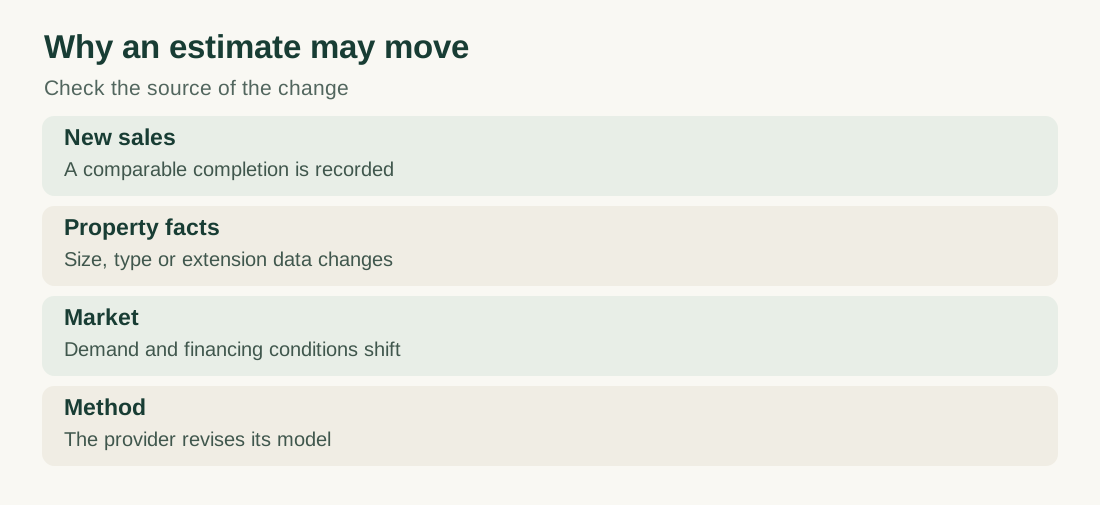
New sales: A comparable completion is recorded. Property facts: Size, type or extension data changes. Market: Demand and financing conditions shift. Method: The provider revises its model.
Ask whether the system shows the comparables it used and the dates of those transactions. If it does not, the estimate may be harder to assess. How to use sold house prices explains what a completed sale record can and cannot establish.
Check whether the property facts changed
An estimate can be affected by recorded floor area, property type, number of bedrooms, tenure or the presence of an extension. Some records are incomplete or wrong. A system may also interpret a property differently after receiving new information.
If your home has a substantial extension but the model is using an old size, the result may be misleading. Equally, entering a larger floor area without checking the measurement does not automatically make a higher estimate reliable.
Compare the facts the service displays with what you can document. Correct errors through the provider's published process where available, and keep track of which information was changed.
Distinguish a market shift from a model revision
A local market can change as mortgage conditions, supply and buyer demand change. An automated provider may update its statistical approach at the same time. Without a transparent explanation, you cannot always tell how much of a revised figure reflects market activity and how much reflects the model.
Illustrative example. An estimate rises from £480,000 to £505,000 in a month. That £25,000 change is not proof that a buyer would now pay £25,000 more. The model might have added a relevant sale, corrected the home's size or changed its assumptions. The next step is to inspect the evidence, not to assume the gain is realisable.
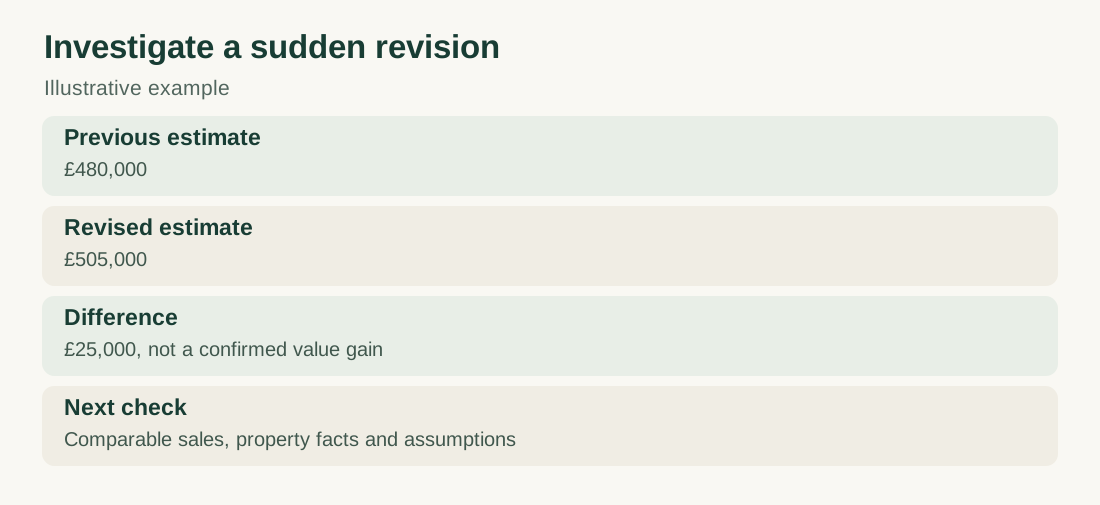 Illustrative example
Previous estimate: £480,000. Revised estimate: £505,000. Difference: £25,000, not a confirmed value gain. Next check: Comparable sales, property facts and assumptions.
Be wary of false precision
A valuation presented as a single exact number can look more certain than the evidence warrants. Homes with unusual layouts, substantial land or very few comparables are particularly difficult to estimate automatically.
A range, explanation of assumptions and clear account of missing facts are more useful than a confident number with no supporting reasoning. See valuing unusual homes for the particular difficulties involved.
Different websites may produce different estimates because they use different datasets, property facts and methods. Agreement between two websites does not necessarily mean the underlying assumptions are correct.
Decide whether the change matters to your next decision
If you are not planning to move or borrow against the property, a small fluctuation may not require action. If you are setting an asking price, deciding on an offer or reconsidering a listing, current comparable sales and an informed property-specific assessment matter much more.
A PMD Property Intelligence Report is designed to show property-specific evidence, estimated ranges and assumptions. It is not a formal valuation or a guarantee of what the home will sell for. PMD is a trading name and service of The Ivybridge Collection Ltd, whose registered nature of business is real estate agencies, and we also sell marketing subscriptions to estate agents.
When an estimate changes, record the old and new figures, check the property details and look for relevant new sales. The explanation behind the movement is more valuable than the movement itself.
Sources
- HM Land Registry, About the Price Paid Data: Explains recorded completed sales, coverage and limitations
- HM Land Registry, UK House Price Index: Broad historical market context, not individual property values