
Property valuations
How accurate are online house valuations?
An online house valuation can help you understand a property's possible value, but its usefulness depends on the evidence behind it. Similar recent sales and correct property details give you more to work with. Missing information and unusual features leave more unanswered questions. Treat the result as a starting point for your decision, rather than the answer on its own.
This is an estimate from comparable sales, not a RICS or mortgage valuation, and not a survey.
How much confidence should you place in an online estimate?
An online house valuation is useful when it gives you evidence you can examine. It is less useful when it presents a precise-looking figure without explaining the property match, the sales used or the information it cannot see.
Before you use the result to set an asking price or assess a home you want to buy, ask a practical question: what would need to be true for this estimate to make sense?
For a home with similar recent sales nearby, you may be able to check much of the reasoning. For a substantially altered or unusual property, important questions may remain. Rightmove's explanation of online valuations makes this distinction: results vary by property and area, and comparable evidence matters.
A sensible response is to test the estimate against the facts you know. Do not accept it simply because it agrees with the figure you hoped to see. Equally, a disappointing result is a reason to investigate the evidence, rather than dismiss it immediately.
Why a range is more useful than a precise-looking number
A property is not identical to every home around it. An estimated range leaves room for differences and uncertainty. It should encourage you to examine the reasoning, not simply select the highest point.
A range also needs an explanation. Ask what accounts for the spread. Is there a good set of similar sales, or does the estimate rely on broader evidence? Are the property details clear, or are there important gaps?
The diagram below shows the principle without assigning prices or an accuracy percentage. It does not represent measured performance for a particular system.
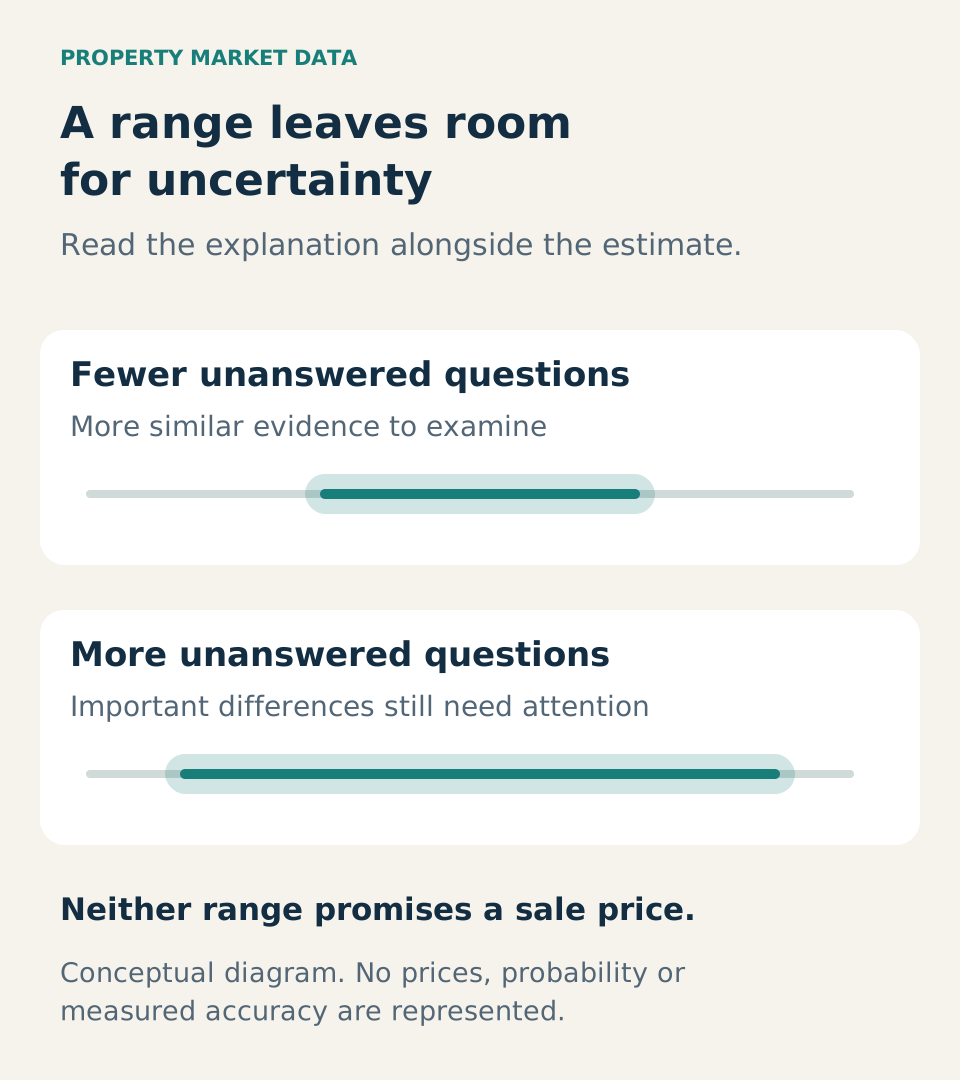
The first schematic range has fewer unanswered questions and a narrower spread. The second has more unanswered questions and a wider spread. Neither range is a measured result, a confidence score or a prediction of an achieved price.
Our recommendation is to read the estimate and its explanation together. A number on its own gives you little basis for deciding whether your own property is a suitable match.
Check the evidence in five practical steps
Use the following checklist before leaning on an estimate. You do not need to reconstruct a valuation model. You need to recognise which facts are supported and which remain uncertain.
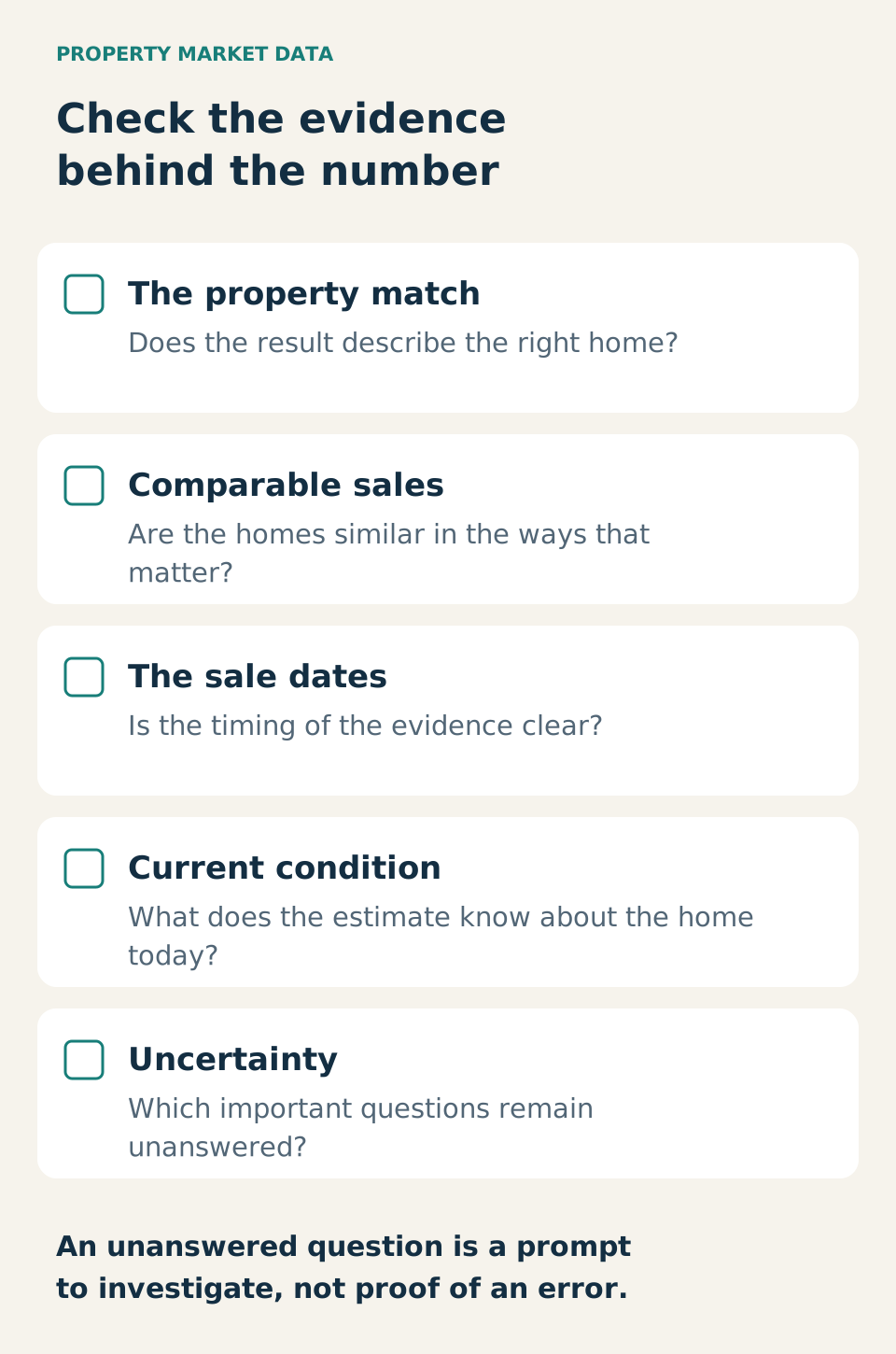
Ask whether the correct property is matched, the comparable homes are genuinely similar, the sale dates are clear, current condition is understood and uncertainty is explained. An unanswered question is a reason to investigate, not proof that the estimate is wrong.
Check that the correct home has been matched
Look at the address and the description provided. If the estimate appears to concern the wrong flat, the wrong property type or an earlier version of the home, pause before using it.
Record the discrepancy and ask the provider how that detail has been handled. Do not assume that entering a correction automatically means the underlying calculation has changed. Ask what the result actually reflects.
Look at the comparable homes
A sale deserves attention because it helps explain your property, not merely because it happened nearby.
Look for the similarities and the important differences. A useful review should let you ask why a particular transaction has been selected and what makes it relevant. The professional roadmap for automated valuation models identifies unusual features and sparse market data as reasons an estimate can carry more uncertainty.
For the separate task of selecting evidence, read how to choose comparable sales for a house valuation. This article focuses on judging the usefulness of an estimate, rather than teaching the whole comparison method.
Read the dates as carefully as the prices
HM Land Registry's Price Paid Data records completed transactions submitted for registration in England and Wales. Registration and publication happen after the sale, so recent information can be incomplete.
Check the dates shown beside the transactions. A historical sale is evidence of what happened then. Ask how the estimate relates that evidence to the decision you are making now.
Do not treat the absence of a recent recorded sale as proof that no home has sold. It may mean the record is not yet available. Nor does a recorded transaction establish the current condition of the property you are considering.
Separate current condition from recorded information
An automated model does not inspect your home. Published professional discussion of these models highlights the difficulty of accounting for condition through data alone.
If the home has changed, make a short list of the changes you want considered. Ask whether the provider has information about them and whether that information affects the estimate.
The same approach helps a buyer. Keep your observations and any professional findings separate from what the online result appears to know. A valuation estimate is not evidence that the building has been checked for defects.
Ask what remains uncertain
An explanation should help you identify gaps, rather than make them disappear behind a polished report.
Write down what you would still want to establish before acting. That might include a property detail, the relevance of a sale or the treatment of an unusual feature. Ask for clarification of those points.
One unanswered question does not prove that the estimate is wrong. It tells you where further work may be useful. Several unresolved questions should make you more cautious about treating the result as the sole basis for a decision.
What if different websites give you different values?
Do not solve the disagreement by choosing the most encouraging number or averaging the results without checking them.
Instead, compare what each provider tells you about the same home:
- What property details does it show?
- Which sales or sources does it explain?
- How clearly does it describe the date and limitations of the result?
- What questions remain unanswered?
This comparison is a practical way to organise your questions. Agreement between several numbers is not a substitute for understanding their supporting evidence.
If you cannot see enough detail to make the comparison, say so. The appropriate conclusion may be that you need more information, rather than that one website has proved another wrong.
When should you look beyond an online estimate?
A home that is difficult to compare deserves careful attention. Read how to assess an unusual home with few comparable sales if that describes your situation.
For a seller, an in-person market appraisal can add information about the actual home and its presentation. Still ask for the evidence and reasoning behind the proposed price.
If you need an assessment for a particular formal purpose, check what the organisation requesting it will accept. The separate guide which type of property valuation you need explains how to choose the appropriate assessment. An online estimate should not be assumed to meet that requirement.
Apply these checks to your own home with PMD
The checklist tells you what to question. A PMD property report brings together comparable sales, local market evidence and an explained estimate for the particular home you want to assess.
That gives you something specific to examine, rather than leaving you to compare headline numbers from different websites.
| Your question | How to use your PMD report |
|---|---|
| What supports this estimate? | Examine the comparable sales and the explanation alongside the estimated value. |
| How does the local market fit in? | Read the local market evidence alongside the property-specific information, rather than treating an area average as your home's value. |
| What still needs checking? | Compare the report with what you know about the home and record any differences or unresolved questions. |
Before choosing a report, see an example property report and read how our property data is explained. Look at the evidence you will receive and how its limitations are presented.
If you are preparing to sell, use the report to prepare questions for your valuation appointments and to examine the reasoning behind a proposed asking price.
If the harder question is what to do with conflicting advice, you can also add a written human review of your report. A member of our team reads your report with your own question in mind and tells you what they make of it. It is a property market opinion and negotiation support. It is not a survey, a valuation or legal or financial advice, and we do not contact the seller or the estate agent for you.
For a purchase, explore a buyer property report for the home you are considering. Use its evidence when assessing the asking price and deciding which questions to raise before an offer.
Keep a short record of what the report supports and what you still need to establish. PMD helps organise the evidence around your property decision. You should still investigate material gaps before acting.
Sources
- Rightmove, How do online valuations work?: Online estimates vary by property and area, typical homes with comparable evidence, ranges and the value of an in-person assessment
- HM Land Registry, Price Paid Data: Recorded completed sale prices, reporting delays and the difference between transaction evidence and current property details
- Royal Institution of Chartered Surveyors, Automated Valuation Models roadmap: Unusual property features, sparse market evidence, model uncertainty and limits of automated assessment
- Royal Institution of Chartered Surveyors, Human-algorithm relations: The difficulty of assessing current property condition through an automated model