
Buying and offers
Buying in a New Area: Research the Local Market
Moving to an unfamiliar area means making two decisions at once: whether you like the property and whether the location will work in everyday life. A county-wide price average will not answer either question. This guide shows how to build a useful picture of a neighbourhood without pretending you know it already.
This is an estimate from comparable sales, not a RICS or mortgage valuation, and not a survey.
Start with the area you would actually live in
A place name can cover several quite different housing markets. One side of a town may have period terraces near a station, another newer detached houses beside a main road. An average sale price across both tells you little about either property.
Define a search area around the streets you are genuinely considering. Mark the station, schools, workplaces, shopping and the journeys that matter to your household. This makes it easier to recognise when an attractive listing falls outside the area you would realistically choose.
Do not treat an estate agent's description of a neighbourhood as a fixed boundary. Walk it and test it yourself.
Use completed sales, not only today's listings
Property portals show what sellers hope to achieve. Completed sale records show what buyers have actually paid, although the records may be published after the transaction and cannot tell you every detail of a home's condition.
Look at a selection of completed transactions of the same property type and broadly similar size. Check the streets, plot sizes, parking, age and accommodation where you can. A recently renovated home with a large garden is not an interchangeable comparison for a tired property on a busy road.
HM Land Registry's Price Paid Data is a useful starting point for recorded transactions in England and Wales. The UK House Price Index offers broader context, but its averages are not a valuation of an individual street.
For the mechanics of comparing properties, see how to compare homes before buying.
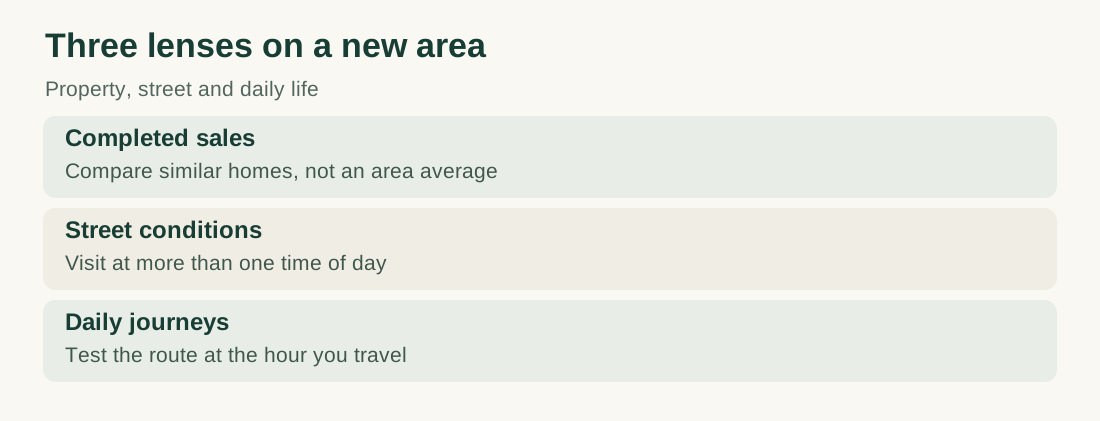
Completed sales: Compare similar homes, not an area average. Street conditions: Visit at more than one time of day. Daily journeys: Test the route at the hour you travel.
Test the commute at the time you would make it
A journey that looks short on a map may behave very differently at school drop-off time. Try the drive or public transport journey on an ordinary working day, at the hour you would actually travel.
Check the last bus or train home, parking availability, walking routes and what happens when a service is cancelled. If a child will travel independently, consider the practical route rather than distance alone.
Ask whether your requirements are daily, weekly or occasional. A longer journey to a favourite restaurant may be acceptable. A difficult daily school run can shape your entire experience of living there.
Investigate the property and the street separately
Visit the street more than once, preferably at different times. Listen for road noise, observe parking pressure and notice the use of neighbouring buildings. An appealing afternoon viewing may not reveal how the street feels early in the morning or at night.
For schools, check official admissions and catchment information rather than assuming that living nearby secures a place. For flood exposure, consult the appropriate official flood-risk service and consider professional advice where warranted. For planning activity, check the local authority's planning register. Each source answers a different question.
Avoid drawing conclusions about residents from stereotypes or a single anecdote. Focus on observable conditions and information you can verify.
Beware the apparent bargain across a boundary
Illustrative example. Two similar three-bedroom homes sit a short walk apart. One is close to a station but has limited parking; the other has a driveway but a much longer walking route. The difference in asking price might reflect those factors, condition, sellers' expectations or something else entirely.
Rather than applying a blanket 'postcode premium', list the features you would pay for and check whether completed sales support a difference. Sometimes there will be too few genuinely comparable transactions to reach a confident conclusion.
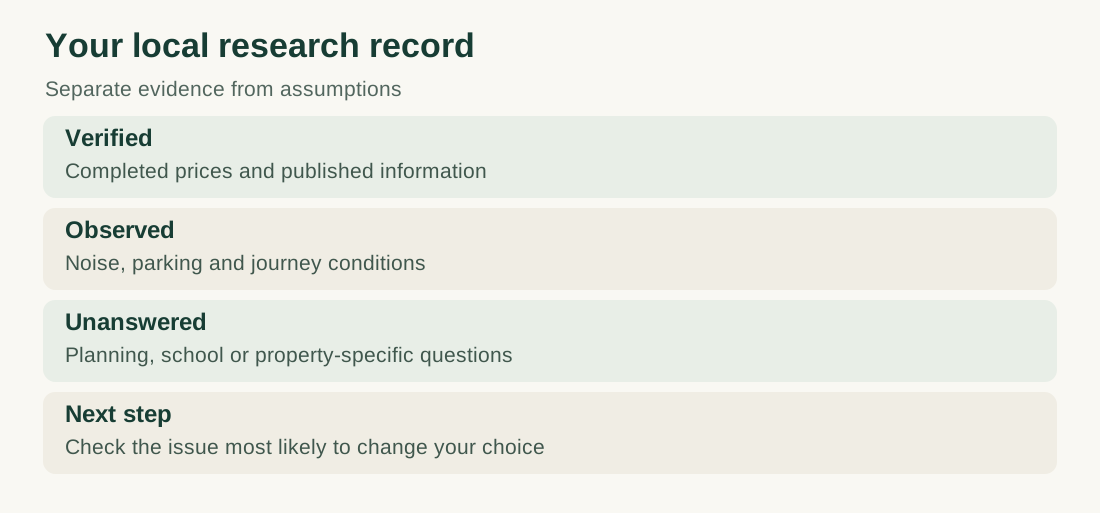
Verified: Completed prices and published information. Observed: Noise, parking and journey conditions. Unanswered: Planning, school or property-specific questions. Next step: Check the issue most likely to change your choice.
Build a decision record you can revisit
For each shortlisted area, record three things: what you have personally checked, what comes from a named source and what remains an assumption. Add the dates, because transport services, school arrangements and asking prices can change.
If a listing has caught your eye, the house viewing questions guide will help you ask about the property itself. If you are considering an offer, the pre-offer checks covers the next stage.
You can read about PMD's buyer report for a home you are considering. It does not replace local visits, a survey or legal enquiries.
A good area search ends with more than a favourite postcode. It leaves you knowing which streets suit your life, what comparable buyers have paid and which important questions still need answers.
Sources
- HM Land Registry, About the Price Paid Data: Explains completed sale price records and their coverage