
Buying and offers
What Does a House Price Reduction Mean for Buyers?
A price reduction catches your eye because the house suddenly looks better value. But a lower asking price does not tell you why the seller changed it or whether the property is now fairly priced. The history is useful only when read alongside the property and the market.
This is an estimate from comparable sales, not a RICS or mortgage valuation, and not a survey.

The old price is not a benchmark for value
A listing moves from one asking price to a lower one. The portal highlights the reduction, and it is easy to think you are being offered a discount. But the original asking price was a marketing choice, not proof of the home's value.
If the initial figure was unrealistic, the new one might simply bring the property closer to the evidence. If the original figure was reasonable, the seller may have changed their timescale or strategy. You cannot distinguish those explanations from the reduction alone.
The relevant question is what comparable buyers have paid for similar homes and how this property differs.
There are several plausible reasons for a change
An agent may have received repeated feedback that buyers preferred alternatives at the same price. A seller may need to move sooner. A competing home may have entered the market. An agreed sale might have fallen through and the seller may be repositioning the listing.
Those possibilities are not interchangeable. Nor should you assume that any one of them applies to a particular seller. Ask the agent when the price changed and whether the property has previously been under offer. Treat the answer as information to assess, not proof of the seller's private circumstances.
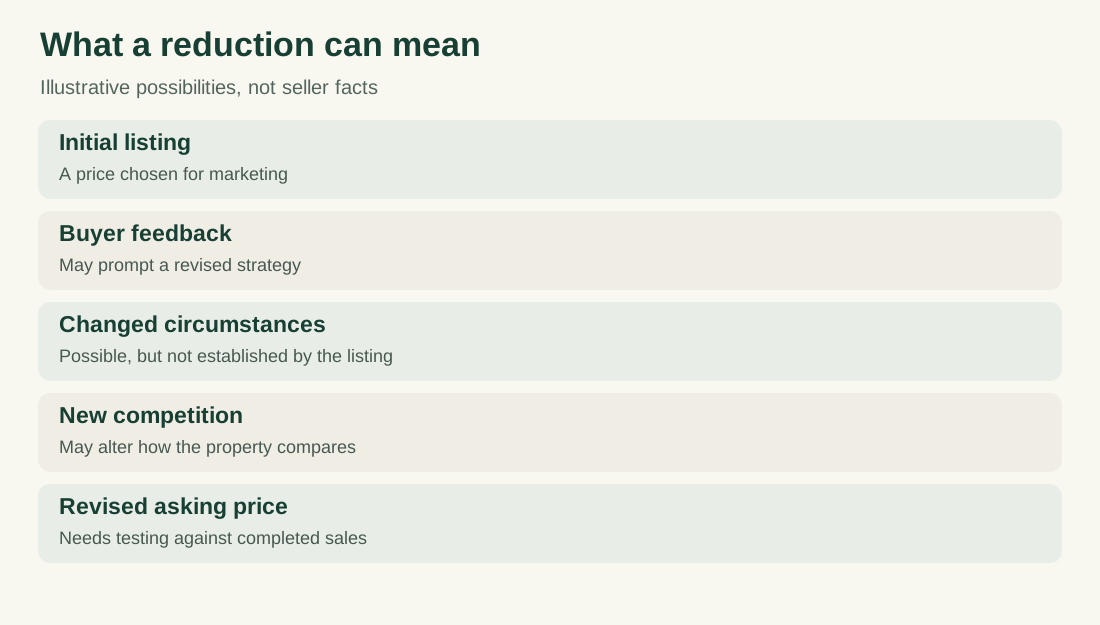 Illustrative example
Initial listing: A price chosen for marketing. Buyer feedback: May prompt a revised strategy. Changed circumstances: Possible, but not established by the listing. New competition: May alter how the property compares. Revised asking price: Needs testing against completed sales.
Look at the full listing history
Note the first date you can reliably establish, the asking prices you can confirm, any withdrawal or relaunch and changes to the description or photographs. A relaunch can make an older campaign appear recent, so ask when the property was first marketed.
Historical portal records may be incomplete. A listing might have been advertised through another agent, or removed during an agreed sale. If you cannot confirm an earlier period, mark it unknown rather than reconstructing a story from fragments.
The number of days advertised is a separate question. How time on the market should affect your offer explains why elapsed time alone is weak negotiating evidence.
Compare the revised figure with actual sales
Return to relevant completed transactions. Check type, floor area, condition, tenure and location. A reduced price can still sit above the available evidence. Equally, a property with genuinely superior features may justify more than nearby homes.
Illustrative example. A house is initially advertised at £520,000 and later reduced to £485,000. The reduction is £35,000, but it does not establish a £35,000 saving. If comparable evidence suggests a value around the new asking price, the reduction may simply reflect a revised marketing judgement.
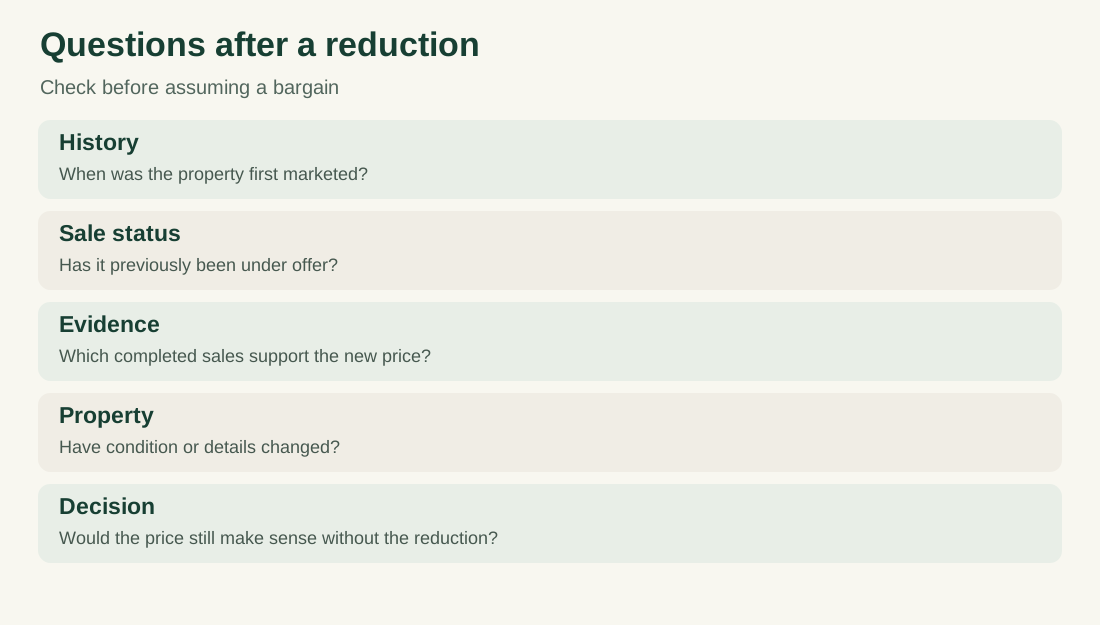
History: When was the property first marketed?. Sale status: Has it previously been under offer?. Evidence: Which completed sales support the new price?. Property: Have condition or details changed?. Decision: Would the price still make sense without the reduction?.
See how to assess whether a house is overpriced for the evidence test. The previous price should not dominate that assessment.
Ask questions that the agent can answer
You can ask when the price changed, whether the property has been under offer, what material information is available and whether the seller has given any guidance about their preferred timescale. The agent may not be able to disclose everything, and you should not infer motives from a refusal to share private information.
If the reduction followed a survey or a failed transaction, find out what can properly be disclosed and commission your own appropriate checks where necessary. A changed asking price is not a substitute for due diligence.
Decide on the home as it is priced today
A buyer should judge the current property against alternatives and completed sales, then consider their own finances and priorities. Do not feel obliged to act simply because a listing has acquired a red reduction label.
For the separate question of structuring an offer, see how much to offer on a house. You can read about PMD's buyer report for a home you are considering.
A price reduction tells you that the marketing decision changed. The evidence must tell you whether the revised price makes sense.
Sources
- HM Land Registry, About the Price Paid Data: Describes completed sale price records and their limitations