
Buying and offers
A House Has Been on the Market for Months: What Now?
A house that has sat on the market for months can look like an opportunity. It might be. But the number of days since a listing appeared is not a measure of the seller’s flexibility or the home’s value. Before changing your offer, find out what that period actually contains.
This is an estimate from comparable sales, not a RICS or mortgage valuation, and not a survey.

A long listing is a question, not a discount
A property has been advertised for seven months. You may wonder why nobody has bought it and whether a lower offer would be welcome. The trouble is that the listing duration cannot answer either question.
Some homes appeal to a smaller group of buyers. Some are difficult to view. Others have had sales agreed and subsequently fallen through. A high asking price can certainly be a factor, but the calendar alone cannot tell you how much.
Treat the time on the market as a reason to investigate the history, not as a percentage to deduct.
Reconstruct the timeline before drawing conclusions
Ask when the home was first marketed, whether it was withdrawn, whether an offer was accepted and when the current asking price began. Check whether it was previously advertised by another agent.
You may find an old listing that disappears for weeks and then reappears with new photographs. That does not prove the seller was simply waiting for a buyer throughout. The gap could reflect an agreed sale, renovation work or a change of circumstances.
Record what is confirmed and what remains unknown. A timeline with gaps honestly marked is more useful than a seamless story built on assumptions.
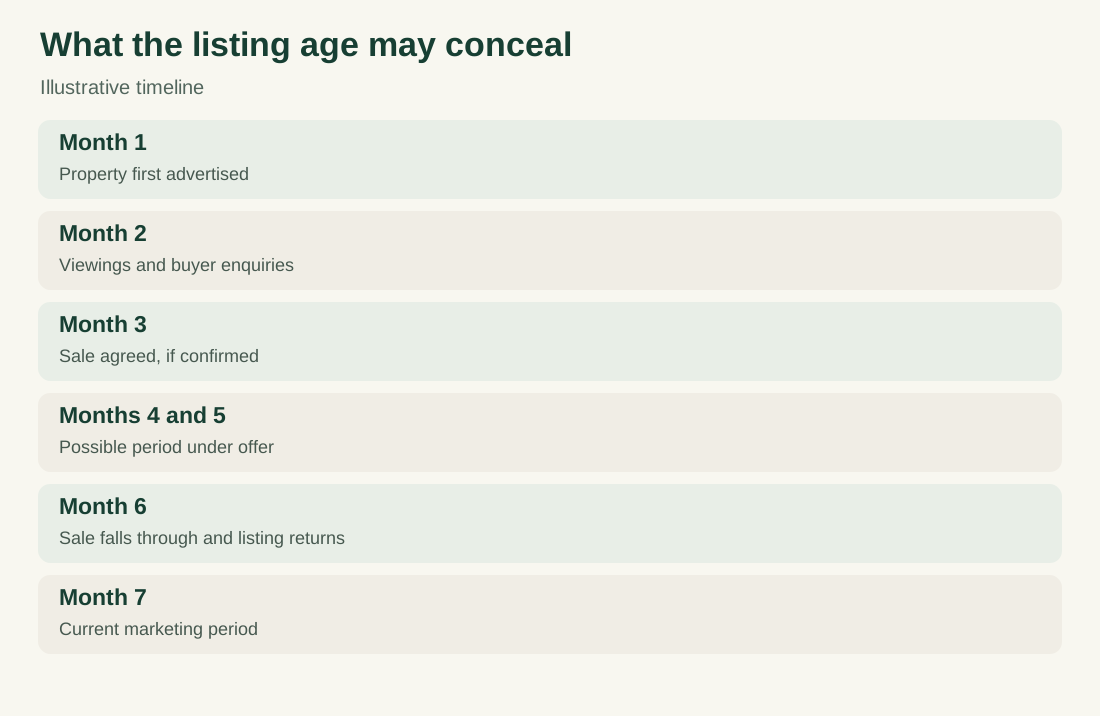 Illustrative example
Month 1: Property first advertised. Month 2: Viewings and buyer enquiries. Month 3: Sale agreed, if confirmed. Months 4 and 5: Possible period under offer. Month 6: Sale falls through and listing returns. Month 7: Current marketing period.
Compare the property with the local pace
Seven months can mean different things in different parts of the market. A conventional family home with many close substitutes is not directly comparable with an unusual listed house or a rural property with a small buyer audience.
Look at similar properties that have completed, remained listed or gone under offer during a comparable period. Remember that advertised status and completed transactions are different measures. Published sale records can lag behind the actual completion.
If most relevant properties are also taking time to find buyers, the duration may reflect broader demand. If comparable homes have progressed while this one has not, ask what distinguishes it. Price, condition, access and presentation are possible explanations, not conclusions.
Investigate failed transactions without assuming a defect
A sale falling through can affect a listing's apparent age. The reason may have nothing to do with the house: a buyer's mortgage, an onward chain or a change in personal circumstances can stop a transaction.
But sometimes a survey, title issue or missing information matters. Ask what the agent can disclose and follow up with appropriate professional checks. Do not treat an agent's reassurance as a replacement for your own survey or conveyancing enquiries.
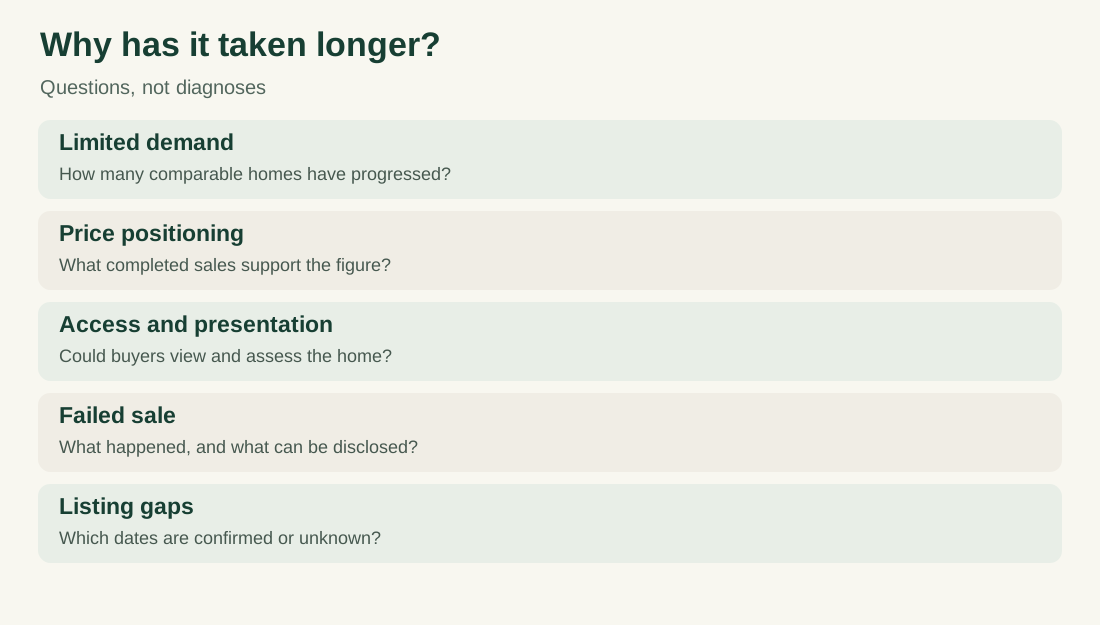
Limited demand: How many comparable homes have progressed?. Price positioning: What completed sales support the figure?. Access and presentation: Could buyers view and assess the home?. Failed sale: What happened, and what can be disclosed?. Listing gaps: Which dates are confirmed or unknown?.
How should the duration affect your approach?
It can justify more questions and a careful look at comparable sales. It may help you understand whether the seller has tested several marketing approaches. It does not, by itself, justify a particular offer below asking.
Illustrative example. Two houses have each been advertised for six months. The first has remained available continuously with little viewing interest. The second was under offer for much of that time before the buyer withdrew. Their identical listing ages describe quite different histories.
If a reduction has appeared during the campaign, what a house price reduction means examines that specific signal. If the asking figure itself seems weakly supported, use the overpricing evidence test.
Bring the discussion back to your decision
Once you understand the history, compare the home with the alternatives you could buy now. Check condition, tenure and financing implications. Consider your own timescale and whether you can proceed reliably.
The amount and terms of an offer are a separate decision. How much to offer on a house deals with those choices. You can read about PMD's buyer report for a home you are considering.
A long marketing period may give you useful questions to ask. It does not tell you what the seller must accept.
Sources
- HM Land Registry, About the Price Paid Data: Describes completed sale price records and their limitations