
Property valuations
How do automated house valuations work, and what does an agent visit add?
An online estimate arrives in seconds, so it is natural to wonder what produced it. Most automated valuations work from the same kinds of evidence: recorded sales, the home's own details and the way prices have moved. Knowing those inputs tells you when an estimate is likely to be close and when a visit will add something.
This is an estimate from comparable sales, not a RICS or mortgage valuation, and not a survey.
What goes into an automated valuation
An automated valuation, often called an online estimate, is a calculation rather than an inspection. Most of them draw on three kinds of evidence.
- Recorded sales. The prices homes near yours actually sold for. In England and Wales these come from HM Land Registry's Price Paid Data, which covers sales lodged for registration. It leaves out sales that were not for value, such as gifts.
- The home's own details. Its type, its size and, where it is on record, its own last sale. Size often comes from the floor area on the home's energy certificate.
- Price movement. A house price index, such as the UK House Price Index, used to restate older sales at today's price level.
The calculation weighs these together and usually returns a figure with a range around it. The range matters as much as the figure: it shows how much the evidence agrees with itself. See how accurate online house valuations are for how to read it.
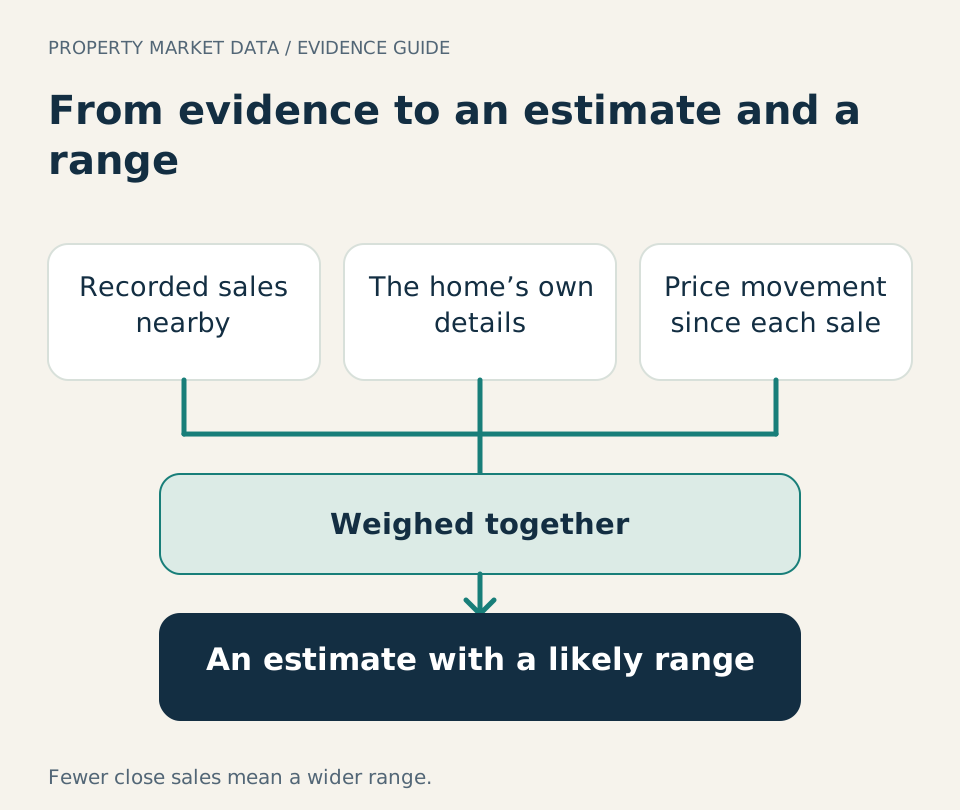
Recorded sales, the home's own details and price movement are weighed together to give an estimate with a likely range. Fewer close sales mean a wider range.
Recent sales are the key evidence, and the slowest to arrive
The closest evidence for any home is what similar homes nearby sold for recently. But recorded sales arrive late. HM Land Registry says the gap between a sale and its registration typically ranges from 2 weeks to 2 months, and that data for the two most recent months is incomplete. When prices are moving quickly, an automated valuation is always looking slightly backwards. That is one reason estimates shift from month to month, as our guide to why online estimates change explains.
The home's own details carry a lot of weight
Floor area is one of the strongest inputs. If the energy certificate records the wrong size, or predates an extension, the estimate will be wrong in the same direction. Check it, and see what to do when property details are wrong.
A home's own previous sale is useful too. Carried forward with a price index, it shows roughly where the home sat in its local market. But it assumes the home has not changed. A loft conversion or a large extension since that sale breaks the link, which is why how much value an extension adds is a question for evidence rather than for an index.
Where automated valuations struggle
Some homes are hard to estimate from records alone:
- Homes with few comparable sales, such as rural houses or unusual designs, where the nearest true match may be miles away or years old.
- Condition. A calculation cannot see a new kitchen, damp in a cellar or a roof near the end of its life.
- Changes no record shows, such as an unregistered conversion or a garage now used as a room.
- Features buyers pay for locally, such as a view, a large plot or an annexe, or the things they avoid, such as a busy road.
The surveyors' professional body has published a roadmap on automated valuation models that discusses the same limits: data coverage, explaining how a figure was reached and knowing when a model should not be relied on alone. Our guide to valuing unusual homes covers the hardest cases.
What an estate agent's visit adds
An agent sees what records cannot: condition, layout, light, noise and how the home will photograph. A local agent also knows which buyers are looking now. That knowledge is valuable, but remember that the agent is also asking for your instruction. The Property Ombudsman's code says any figure an agent advises must be supported by comparable evidence, so ask to see it. Our guide on preparing for an estate agent valuation appointment explains how.
Use the two together
The useful question is not which number is right, but why the numbers differ. In the Illustrative example in the worksheet below, one agent is above the automated range because they saw an extension that no record shows, and the other is lower because they allowed for a roof that needs work. Both explanations can be checked.
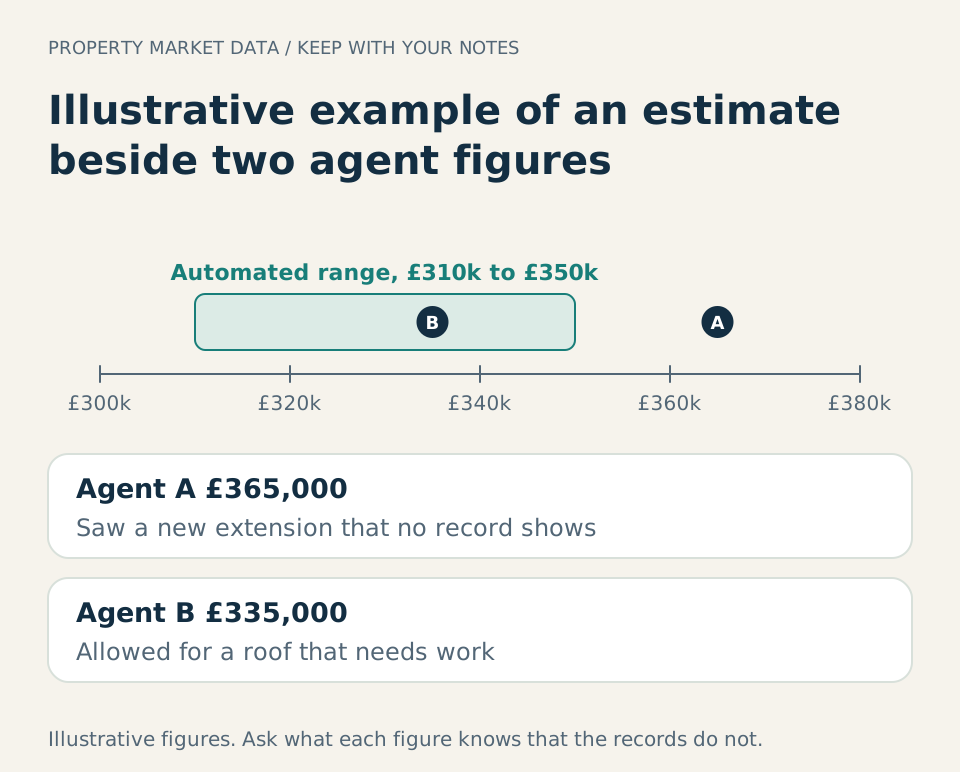 Illustrative example
: an automated range of 310 thousand to 350 thousand pounds, agent A at 365 thousand pounds after seeing a new extension that no record shows, and agent B at 335 thousand pounds who allowed for a roof that needs work.
When an agent's figure sits well outside an estimate's range, ask what the agent knows that the records do not. When there is no good answer, the estimate's comparable sales are the place to start.
How PMD's estimate is built
PMD's estimate is our own calculation, tested against thousands of recorded sales. It finds the sales nearest to your home in place and size, restates older sales to today's prices with the official index, scales each close sale to your home's size where we know it, and sets a likely range with a confidence reading. The full report goes further: its calculation takes into account the work a home needs or has had done, along with a host of other adjustments, and the report shows every step. It covers homes in England and Wales. It is not a RICS valuation or a survey, and nobody visits your home.
Sources
- HM Land Registry, About the Price Paid Data: What sold price records include and exclude, and the delay before a sale is registered
- GOV.UK, UK House Price Index reports: How average prices have moved over time, used to restate older sales
- GOV.UK, Find an energy certificate: The floor area and property details recorded on an energy certificate
- Royal Institution of Chartered Surveyors, Automated valuation models roadmap: The scope and the limits of automated valuation models
- The Property Ombudsman, Code of Practice for Residential Estate Agents: An agent's advised figure must be supported by comparable evidence (paragraph 4b)