
Choosing an estate agent
How to prepare for an estate agent valuation appointment
An estate agent's valuation visit is short, and the figure you hear can shape your whole sale. A little preparation lets you show each agent what has changed, hear how they reached their price and compare every figure on the same footing.
This is an estimate from comparable sales, not a RICS or mortgage valuation, and not a survey.
Why the appointment deserves preparation
An estate agent who comes to value your home is doing two jobs at once. They are forming a view of the price, and they are asking you to instruct them. Both are reasonable, but you will make a sounder decision if you keep them apart in your own mind.
The government's guide to selling a home suggests asking 3 different estate agents to value your property and asking each one for evidence, such as similar homes they have recently sold. It also warns that a high valuation does not necessarily mean you will achieve that price. Preparation is what turns three separate conversations into figures you can compare.
Agents who belong to The Property Ombudsman scheme agree to a code of practice that says any figure they advise, as an asking price or as a likely selling price, must be supported by comparable evidence, and that the evidence must be kept on file. Asking to see it is an ordinary request.
Gather the papers before anyone visits
Collect these before the first appointment, even if some of them are only needed later:
- The energy performance certificate. You can look it up on the government register. Check the floor area it records, because many estimates lean on it, and see how to check the floor area used for a valuation if it looks wrong.
- Title documents from HM Land Registry, so the boundaries and the tenure are clear.
- Planning permissions and building regulations completion certificates for an extension, a loft conversion, a new roof or replacement windows.
- Warranties for past work, such as damp proofing, subsidence repairs or a builder's warranty for alterations.
- For a leasehold flat, the remaining lease length, the service charge and the ground rent.
Listings are expected to show material information such as the price, the council tax band and the tenure. Having these ready also saves time once you instruct an agent.
List what has changed, with dates
Recorded information about a home can be years out of date. An agent will see the rooms, but not what sits behind the walls or when the work was done. Write a short list with dates: a new boiler, a rewire, a replaced roof, a refitted kitchen. Add anything still to be done. Work a home needs matters to buyers as much as work it has had, and an agent who hears about it before the listing goes live can allow for it. For more on this, see how property condition affects a valuation.
Know the local evidence yourself
Look up recent sold prices for homes like yours, in your street and nearby, before the first visit. Sold prices are what buyers actually paid; asking prices are only what sellers hoped for. Remember that sales take time to reach the public record. HM Land Registry says the gap between a sale and its registration typically ranges from 2 weeks to 2 months, so the latest months are always incomplete. Our guide to what sold house prices can tell you explains how to read them.
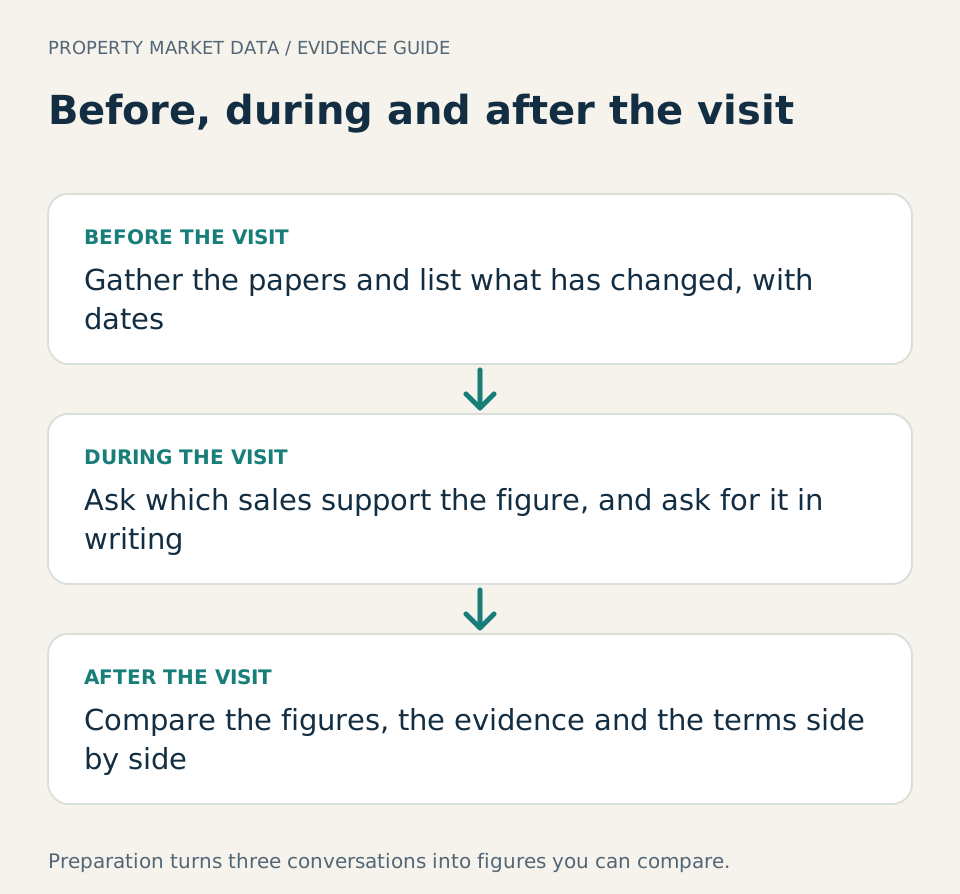
Before the visit: gather the papers and list what has changed. During the visit: ask which sales support the figure. After the visit: compare the figures, the evidence and the terms side by side.
Use the visit to understand the figure
Walk the agent round in a sensible order and point out each change on your list. Then ask three things:
- Which sales are you comparing my home with, and why those?
- What would you suggest as an asking price, and how does that relate to the price you expect it to sell for?
- Can I have the figure, the evidence, the fee and the contract terms in writing?
Do not try to talk the figure up. The aim is to understand how it was reached. If you want a fuller list, see the questions to ask at an estate agent valuation.
Compare the figures on the same footing
After the last visit, put each agent's figure, the sales they relied on, the fee and the length of the contract side by side. In the Illustrative example in the worksheet below, the highest figure rests on the fewest supporting sales. That is a reason to ask more questions, not a reason to choose it.
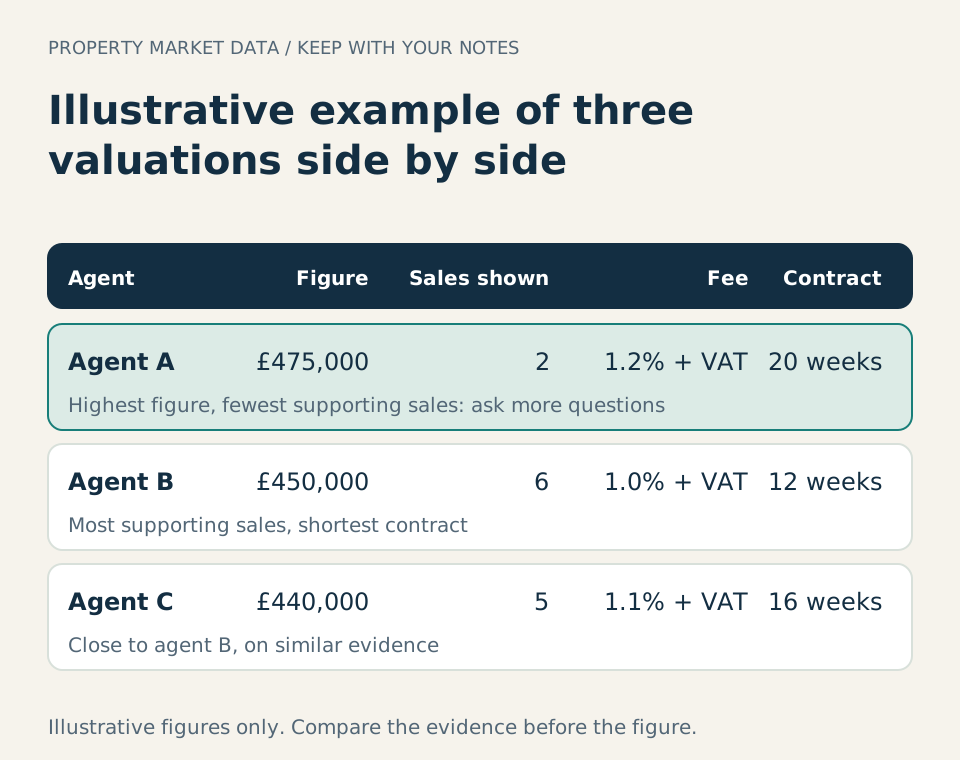 Illustrative example
: agent A suggests 475 thousand pounds from 2 supporting sales, agent B 450 thousand pounds from 6 sales and agent C 440 thousand pounds from 5 sales, each with a different fee and contract length.
Figures differ for real reasons, such as different comparable sales or a different view of condition. Our guides to why estate agent valuations differ and comparing three estate agents go further.
Have your own reference point
A PMD report gives you a written estimate before the first agent arrives. It is PMD's own calculation, tested against thousands of recorded sales, and the report shows its working: the comparable sales, the likely range and what could change the figure. It is not a RICS valuation or a survey, and it does not replace an agent's visit. It gives you a reference point to compare each agent's figure with.
Sources
- GOV.UK, How to sell a home: Asking 3 agents to value a home, asking for supporting evidence and the paperwork a seller gathers
- The Property Ombudsman, Code of Practice for Residential Estate Agents: A figure an agent advises must be supported by comparable evidence kept on file (paragraphs 4b and 4c)
- HM Land Registry, About the Price Paid Data: The delay between a sale and its registration, and why the latest months are incomplete
- GOV.UK, Find an energy certificate: Finding a home's energy certificate and the floor area it records
- National Trading Standards, Part A material information guidance: Price, council tax band and tenure as information every listing should show