
Property valuations
How to read a house valuation report
A house valuation report is more useful when you understand how it reached its conclusion. Read the estimated range, comparable sales and assumptions together. This guide explains what to check, where uncertainty appears and how to turn the findings into better questions before deciding on a price.
This is an estimate from comparable sales, not a RICS or mortgage valuation, and not a survey.
Start with the conclusion, then test the reasoning
A property valuation report should help you understand an estimated value and the evidence behind it. Read the headline figure, but do not stop there. Look for an estimated range, an explanation of how the figure was produced and a clear statement of what is not known.
A narrow-looking estimate is not necessarily more dependable. Its usefulness depends on the quality of the underlying information. An unfamiliar house, missing floor area or limited comparable sales may mean the result needs greater caution.
The most useful way to read a report is to ask five questions in order: what is the estimate, which sales support it, what adjustments were made, how current is the evidence, and what might change the conclusion?
Understand the central estimate and range
The central estimate is a reasoned point within the available evidence. It is not a promise about the price a buyer will pay. The range helps communicate that more than one outcome is plausible.
Check whether the report explains why its range is relatively wide or narrow. Look for weak comparable evidence, disagreement between calculation methods and unusual property features. A report should not turn uncertainty into false precision.
Some reports also show different pricing scenarios. A quick-sale approach, a central assessment and an aspirational asking price describe different decisions. They should not be read as three equally likely achieved sale prices.
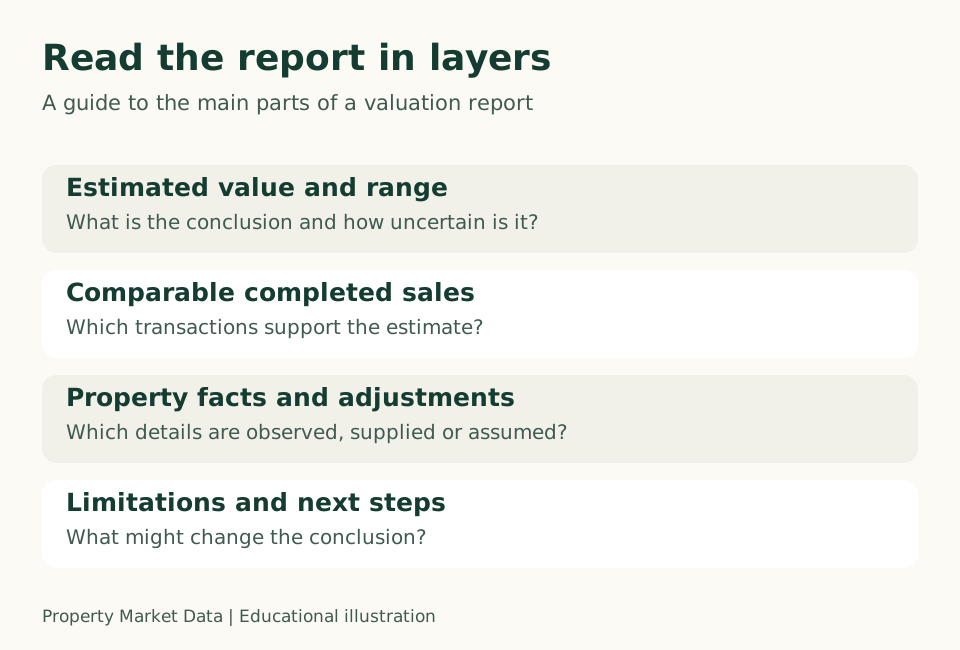
Read the conclusion alongside its supporting evidence and uncertainty.
Examine the comparable sales and their dates
Look at each recorded sale. Ask whether it is the same broad property type, similar in size and condition, and located in a comparable setting. Check the sale date and whether the report explains any adjustments for changes in the market.
HM Land Registry's Price Paid Data records completed transactions, but those records do not tell you everything about a home's current condition. A nearby sale can still be a poor comparison if the properties are materially different.
For a fuller method, see how to choose comparable sales for a house valuation.
Read the assumptions, adjustments and confidence notes
Find out which property facts come from recorded sources and which were supplied by the person requesting the report. If an extension, garden size, parking arrangement or condition has been assumed incorrectly, that may affect the result.
A useful report should show the reasoning for adjustments rather than simply adding or subtracting unexplained amounts. It should also make clear where information is missing.
Illustrative example. Suppose a report assumes that a home has not been extended, but the owner confirms a substantial rear addition. The sensible response is to update the property facts and reconsider the evidence. It is not to assume that the extension adds a fixed percentage of its construction cost.
If a confidence label or score is shown, read its definition. Different providers can calculate confidence in different ways. A score is not a universal probability that the valuation will prove correct.
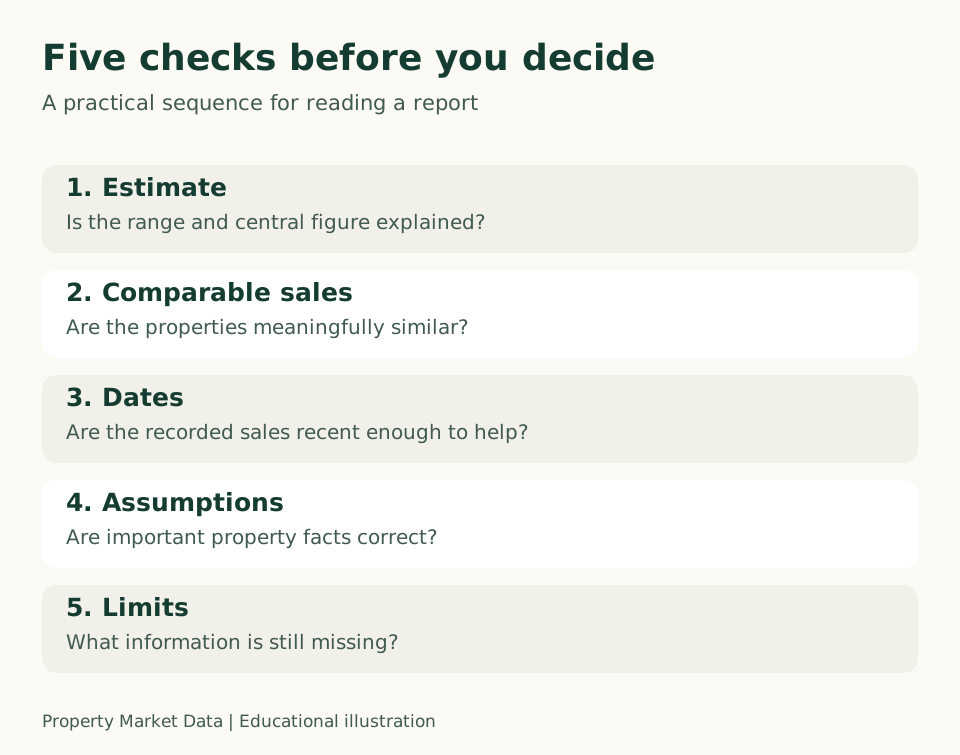
Check the estimate, comparables, dates, assumptions and limitations in order.
Know what the report cannot settle
A desktop report cannot inspect the building or establish the condition of hidden elements. It may not know about defects, alterations, title restrictions or details that are not recorded in the available sources.
A report is also not the same thing as a mortgage lender's assessment or a formal surveyor's valuation. These serve different purposes. See which type of property valuation you need if your decision requires a particular form of assessment.
If you are comparing online estimates, how accurate online house valuations are explains why different services may disagree.
Turn the report into useful questions
Before choosing an asking price or discussing a property with an agent, note the estimated range and the strongest supporting sales. Highlight assumptions you can confirm or correct. Identify the one or two uncertainties most likely to affect your decision.
Ask what additional information would narrow the range. It might be reliable floor measurements, evidence of condition or a closer comparable sale. If the evidence remains limited, retain that uncertainty in your decision.
You can view a sample Property Intelligence Report to see how valuation figures, sales evidence and assumptions can be organised. A report for your own property is designed to bring those strands together, subject to the information available.
If the harder question is what to do with conflicting advice, you can also add a written human review of your report. A member of our team reads your report with your own question in mind and tells you what they make of it. It is a property market opinion and negotiation support. It is not a survey, a valuation or legal or financial advice, and we do not contact the seller or the estate agent for you.
Next step: Treat the estimate as a conclusion to examine, not a number to accept without questions.
Sources
- HM Land Registry, Price Paid Data: Explains completed transaction prices and the scope and timing of recorded sales
- Royal Institution of Chartered Surveyors, Automated Valuation Models roadmap: Discusses limitations of automated valuations and the importance of relevant property information
- Rightmove, How do online valuations work?: Explains how comparable property evidence affects online estimates