
Property valuations
What does a property valuation cost and what are you paying for?
Two services can both be called a property valuation and charge very different fees. Start with the decision you need to make, then compare what each service actually delivers. A cheap report for the wrong purpose is not useful value.
This is an estimate from comparable sales, not a RICS or mortgage valuation, and not a survey.
Compare the job before the price
If you are choosing an asking price, you need evidence about your home and its market. If a lender, scheme administrator or legal adviser has requested a particular report, their instructions may determine the assessment you need. A quotation is meaningful only after that distinction is clear.
The government's home-selling guide distinguishes an estate agent's appraisal from a formal valuation for which a qualified valuer or surveyor charges. That does not make one universally preferable. They do different jobs. Read which type of property valuation suits your decision before comparing fees.
A price comparison should therefore begin with a sentence: “I need this assessment to help me decide…” Finish it before making an enquiry. That sentence helps a provider explain whether its service is suitable and whether additional work is likely.
What should a quotation explain?
Ask for a written description of the work. Does someone inspect the home? Is the result automated, reviewed by a person or prepared by a professional for a stated purpose? What information must you supply, and what happens when the evidence is limited?
Also ask who may rely on the report. A document addressed to one client for one purpose should not be assumed to meet another organisation's requirements. Check delivery arrangements, the treatment of corrections and whether further questions are included.
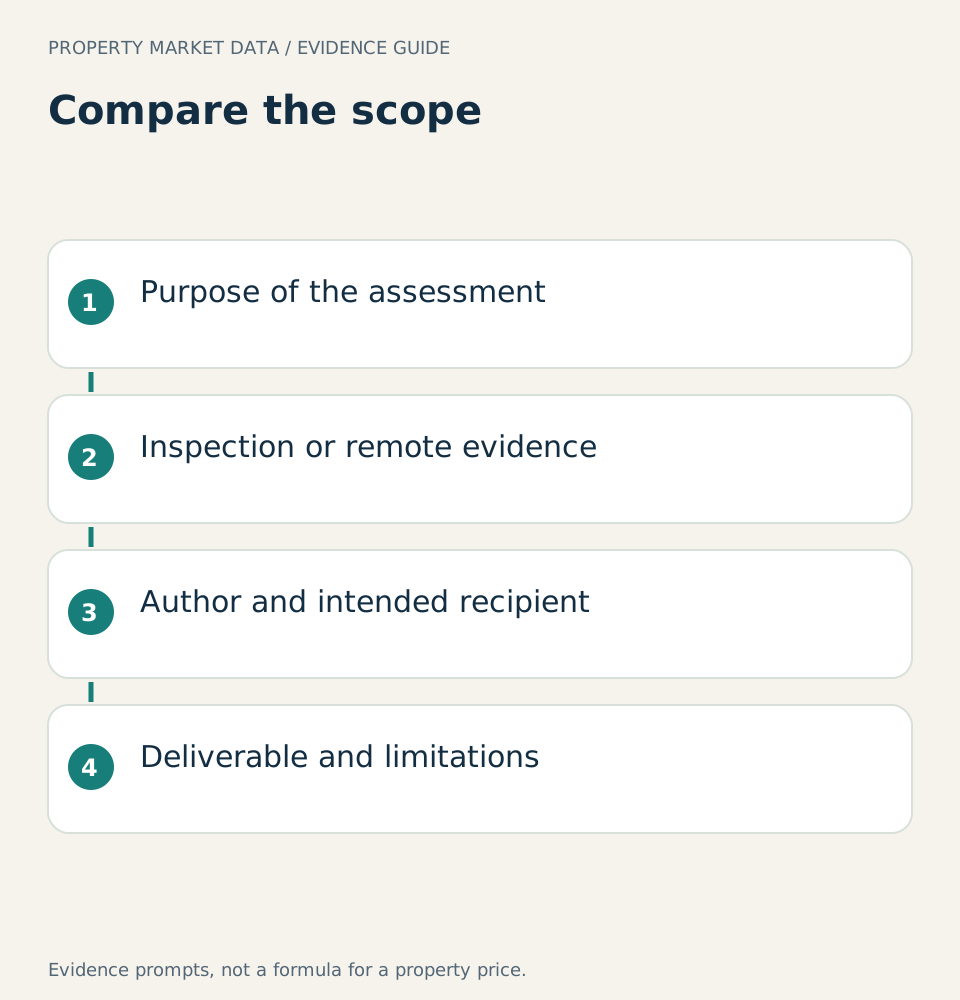
Purpose of the assessment; Inspection or remote evidence; Author and intended recipient; Deliverable and limitations. Read the evidence together before making a property-specific judgement.
A headline fee can conceal a different scope. One service may assemble transaction evidence, while another includes an inspection and a formally instructed opinion. Comparing the two solely by page count or turnaround time misses the work that matters.
Ask about additional charges
Request the full payable price, including the applicable tax treatment and any likely extras. Ask whether travel, unusual-property work, follow-up questions or a later update are included. Do not assume these are standard extras or standard inclusions: the provider should make its own terms clear.
For a specialist formal report, use the questions to ask when commissioning a formal valuation. You need an appropriate instruction, not a service selected by its reassuring name alone.
When does paying for evidence make sense?
Our practical test is whether the report supplies information that changes how you can evaluate the decision. Can you examine the comparable sales? Are the assumptions understandable? Can you recognise the gaps? If you still cannot explain what supports the number, a polished cover has added little.
Use how to read a property valuation report to check the deliverable rather than the marketing description. Ask to see a suitable sample before paying. A fictional sample can explain the format, but it does not demonstrate the provider's measured accuracy.
The worksheet below is deliberately a question list, not a ranking of providers. Different answers may be appropriate for different purposes.
Turn the quote into a comparison
| Check | What to establish |
|---|---|
| Report delivery | Ask whether you receive a written explanation or only a number. |
| Additional work | Find out whether a visit, extra research or a revision is charged separately. |
| Recipient | Check who the report is addressed to and who is permitted to rely on it. |
| Cancellation | Read the terms before instruction, including when paid work begins. |
Keep the original quotation beside the finished deliverable. If an advertised feature is absent, ask the provider to explain the difference before treating the report as complete. A fee comparison becomes useful only when the scope of the work is comparable. A cheaper assessment for a different purpose does not answer the same question.
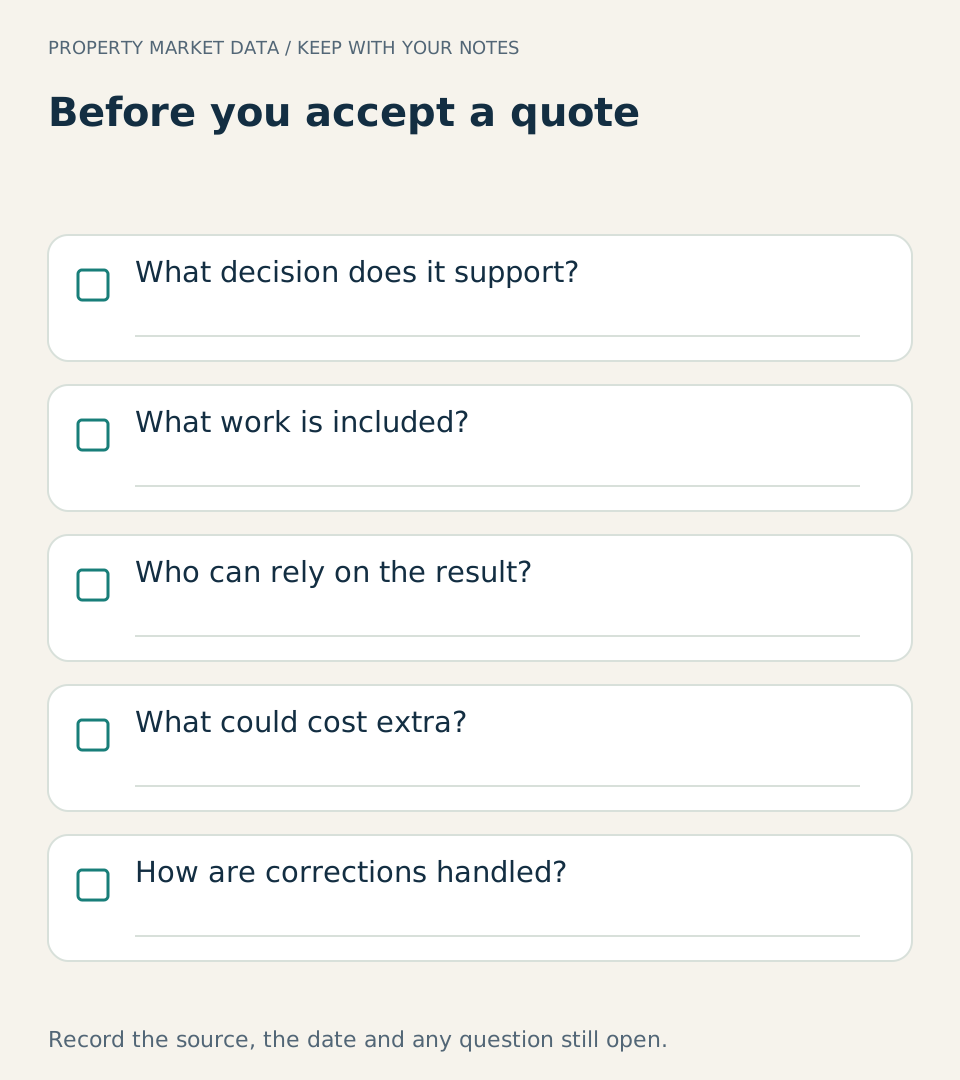
What decision does it support?; What work is included?; Who can rely on the result?; What could cost extra?; How are corrections handled? Record the supporting document and any unanswered question.
What you receive from PMD
PMD's report is an automated estimate supported by comparable sales and local market evidence. It is intended to help you examine a sale or purchase decision. It should not be bought on the assumption that it fulfils an unrelated formal requirement.
You can look at a sample report before choosing. Check the evidence sections and explanations you will receive, then consider whether they address the question you wrote at the start. The report price is £29 including VAT; use the product page to check the current offer and scope.
If you need a lender, tax or scheme-specific assessment, establish the required provider and instructions first. If you need help understanding your PMD report, read about human review. Paying for the appropriate work matters more than choosing the smallest fee.
Sources
- Government guidance, How to sell a home: Estate agent appraisals, selling preparation and checking service scope
- Royal Institution of Chartered Surveyors, Red Book: Professional valuation standards and scoped instructions