
Formal property valuations
What is a Red Book valuation and when should you ask about one?
A formal valuation needs a clear instruction, not simply an impressive report title. Establish the purpose, the relevant date and who will rely on the assessment. Then ask an appropriate professional how the work will meet that instruction.
This is an estimate from comparable sales, not a RICS or mortgage valuation, and not a survey.
What the Red Book refers to
The Royal Institution of Chartered Surveyors publishes valuation standards known as the Red Book. That is professional-standard context, not a label that makes every report suitable for every possible purpose.
Ask a provider what standard and instruction apply to your assessment. Keep its professional credentials separate from the exact service being quoted. A recognised qualification does not remove the need to define the task.
This guide does not reproduce the standards or determine their application to an individual instruction. It helps you ask the questions that make the proposed work understandable.
Begin with purpose and recipient
Say what decision requires the assessment and which organisation or person will use it. The value date, property interest and relevant assumptions should be clear before the provider begins work.
Choosing the appropriate valuation type provides the overview. A market estimate, marketing appraisal and a formally instructed report have different roles. Do not assume that a similar final number establishes identical scope.
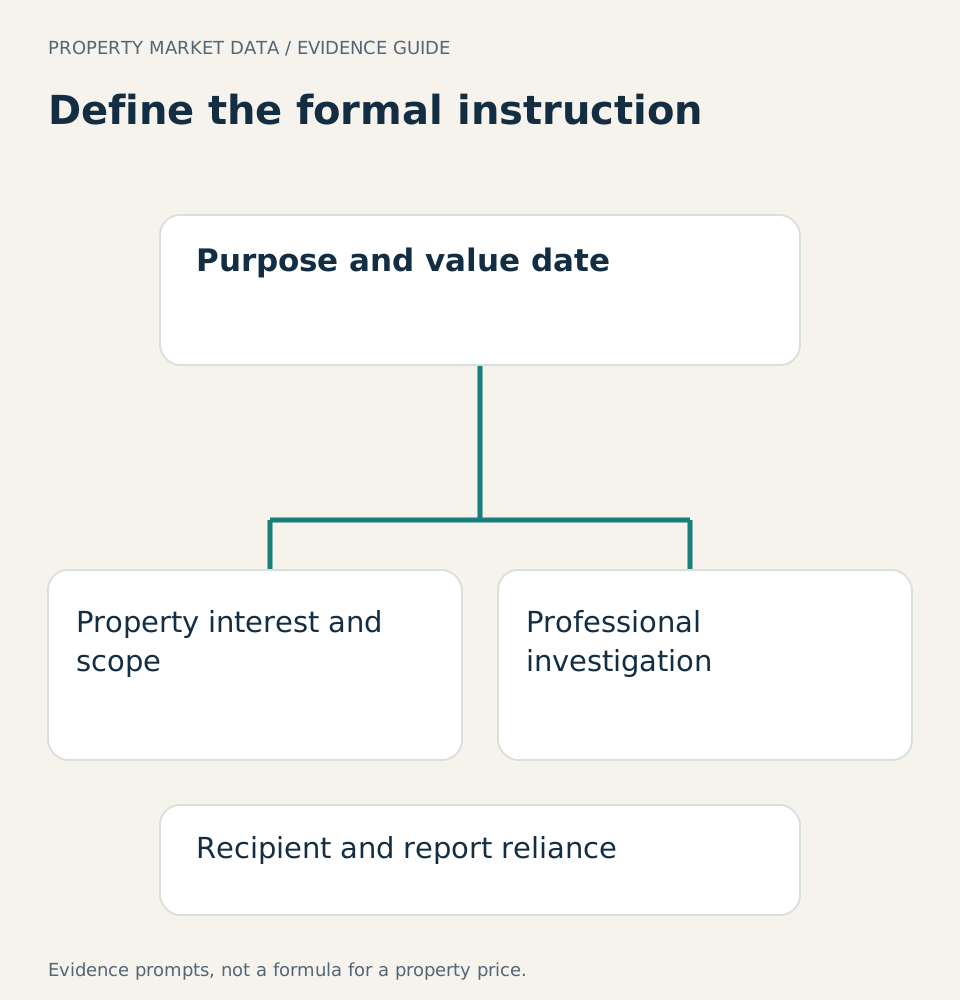
Purpose and value date; Property interest and scope; Professional investigation; Recipient and report reliance. Read the evidence together before making a property-specific judgement.
Ask what the investigation will cover
Confirm the property description, inspection arrangements and evidence work proposed. Ask which facts will be checked and which assumptions remain. An inspection should not be read as a survey of every defect unless that is the actual instructed work.
If the home is unusual or the purpose specialist, ask about relevant experience. A provider should explain whether further expertise or different instructions are needed.
Clarify who may use the report
Ask about the intended user, reliance and purpose stated in the document. Do not assume that a report prepared for one recipient can simply be submitted elsewhere.
For family proceedings, property valuation questions during divorce addresses the separate need to follow legal and court instructions. A standards reference alone does not establish that a privately commissioned report meets those requirements.
Check the professional instruction
| Check | What to establish |
|---|---|
| Recipient | Identify who will use the assessment and for what decision. |
| Basis | Ask the professional to explain the relevant basis and assumptions. |
| Date | Confirm the date to which the conclusion applies. |
| Inspection | Understand the work undertaken and any agreed limitations. |
The report label does not remove the need to read its scope. A professional assessment prepared for one instruction may not be suitable for another recipient or purpose. Ask before reusing it. Keep the engagement terms with the report, so you can understand both the work commissioned and the conclusions eventually supplied.
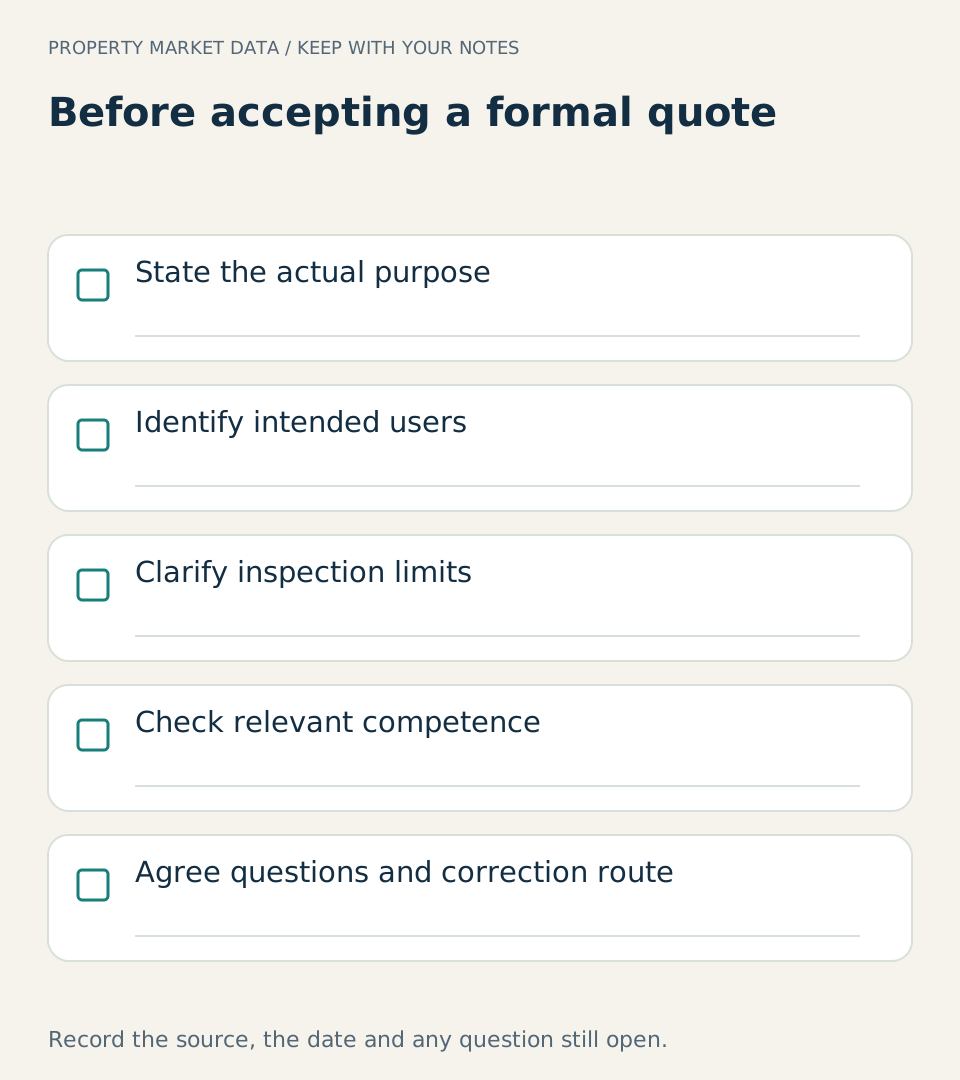
State the actual purpose; Identify intended users; Clarify inspection limits; Check relevant competence; Agree questions and correction route. Record the supporting document and any unanswered question.
Compare the quote on its actual work
Property valuation costs explains why different scopes should not be compared solely by fee. Ask what delivery, questions, corrections and possible additional work are included.
A short clarification before commissioning can prevent an avoidable mismatch. Request a written scope that describes the actual task, not just a product name. Keep it alongside the final report so you can compare what was requested with what was supplied.
If a factual issue appears later, use the agreed question or correction route. Distinguish an error from a professional opinion you disagree with and ask what evidence supports the point.
Read the formal explanation carefully
The useful document should make its date, purpose, property, evidence and limitations understandable. Where a matter remains assumed rather than established, keep that distinction visible.
Do not choose the assessment that produces the most convenient result while ignoring incompatible instructions. Several formal-looking reports may still answer different questions.
PMD's role is different
PMD does not provide a formal Red Book valuation service. Its automated estimate and report are intended for a different research task and should not be represented as satisfying a formal instruction.
If you separately need current comparable and local-market evidence for marketing an eligible home, read the PMD data explanation before considering it.
The valuable distinction is between additional market research and the professional assessment your recipient requires. Establish the latter first, then decide whether any other evidence would help a separate sale or purchase decision.
Sources
- Royal Institution of Chartered Surveyors, Red Book: Professional valuation standards and scoped instructions
- Family Procedure Rules, Experts and assessors: Expert evidence instructions and court-controlled process in family proceedings
- Government guidance, How to sell a home: Estate agent appraisals, selling preparation and checking service scope