
Formal property valuations
What should a property valuation for divorce or separation address?
A property figure used in separation discussions may not be the assessment needed in legal proceedings. Ask what purpose, date and instructions apply before obtaining a report. An online estimate or marketing opinion should not be assumed to settle the formal question.
This is an estimate from comparable sales, not a RICS or mortgage valuation, and not a survey.
Separate negotiation from expert evidence
You may need a starting point for a discussion, an agreed assessment or evidence for proceedings. Those are different situations. Say which one applies when asking your legal adviser or a valuation provider what to do.
The Family Procedure Rules set out a court-controlled framework for expert evidence, including requirements concerning permission and instructions. Do not assume that commissioning a report privately makes it admissible or appropriate for your case.
If proceedings exist, start with the actual orders and advice. This guide cannot interpret an individual's court direction or decide which expert process is required.
Define the property and the question
Ask whether the assessment concerns the whole property, a particular interest or a stated scenario. Identify the relevant date and any assumptions that the professional is being asked to consider.
Keep ownership and legal conclusions with the appropriate adviser. A valuation figure does not determine entitlement, division of assets or whether one party can afford a proposed arrangement.
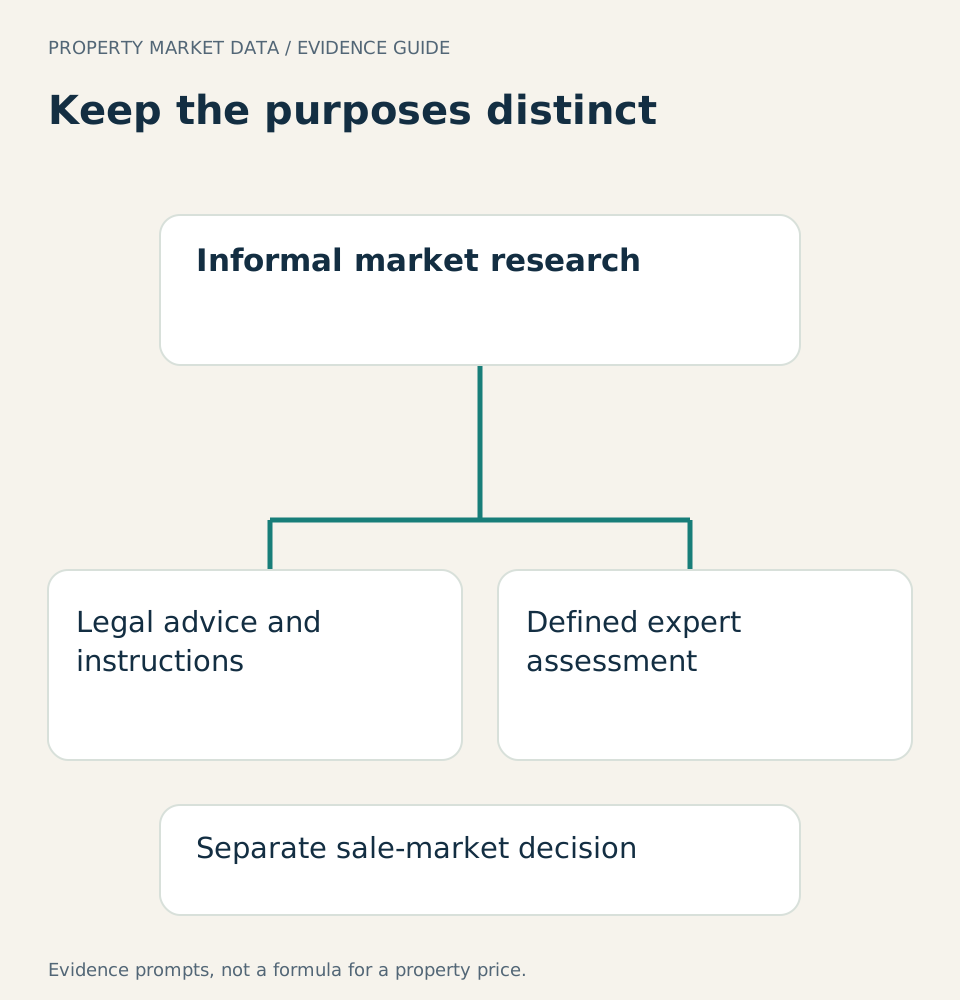
Informal market research; Legal advice and instructions; Defined expert assessment; Separate sale-market decision. Read the evidence together before making a property-specific judgement.
Choosing the appropriate valuation type explains the general purpose distinction. For a formal instruction, questions about a Red Book valuation helps you understand scope and provider competence without assuming a particular label answers every legal requirement.
Information should be consistent
Ask your adviser how material should be supplied and shared. A plan, description or condition assumption that differs between instructions can create a comparison problem before anyone reaches a price.
Keep a record of the documents sent and factual questions raised. Do not describe an unconfirmed feature as established simply because it favours the result you would prefer.
Read disagreement as an evidence question
If assessments differ, compare their purposes, dates, property descriptions and assumptions. Ask the appropriate professional how those differences should be addressed. Avoid treating the higher figure as support for one side and the lower as support for the other without checking the reasoning.
Valuation at a date in the past is relevant where the required date differs from today. A current estimate cannot automatically be carried back to that date by using a broad market percentage.
Agree the instruction before seeking a figure
| Check | What to establish |
|---|---|
| Purpose | Describe the settlement discussion or proceedings the work supports. |
| Relevant date | Ask whether a current or earlier assessment is needed. |
| Information | Identify how both parties will provide relevant property material. |
| Use of report | Confirm recipients and the process for questions or clarification. |
Separate the valuation question from ownership, debt and settlement questions. A property figure alone does not decide who receives what. Where professional instructions or proceedings apply, follow the advice governing the case. Sending different information to different assessors can create a disagreement about assumptions which looks like a disagreement about value.
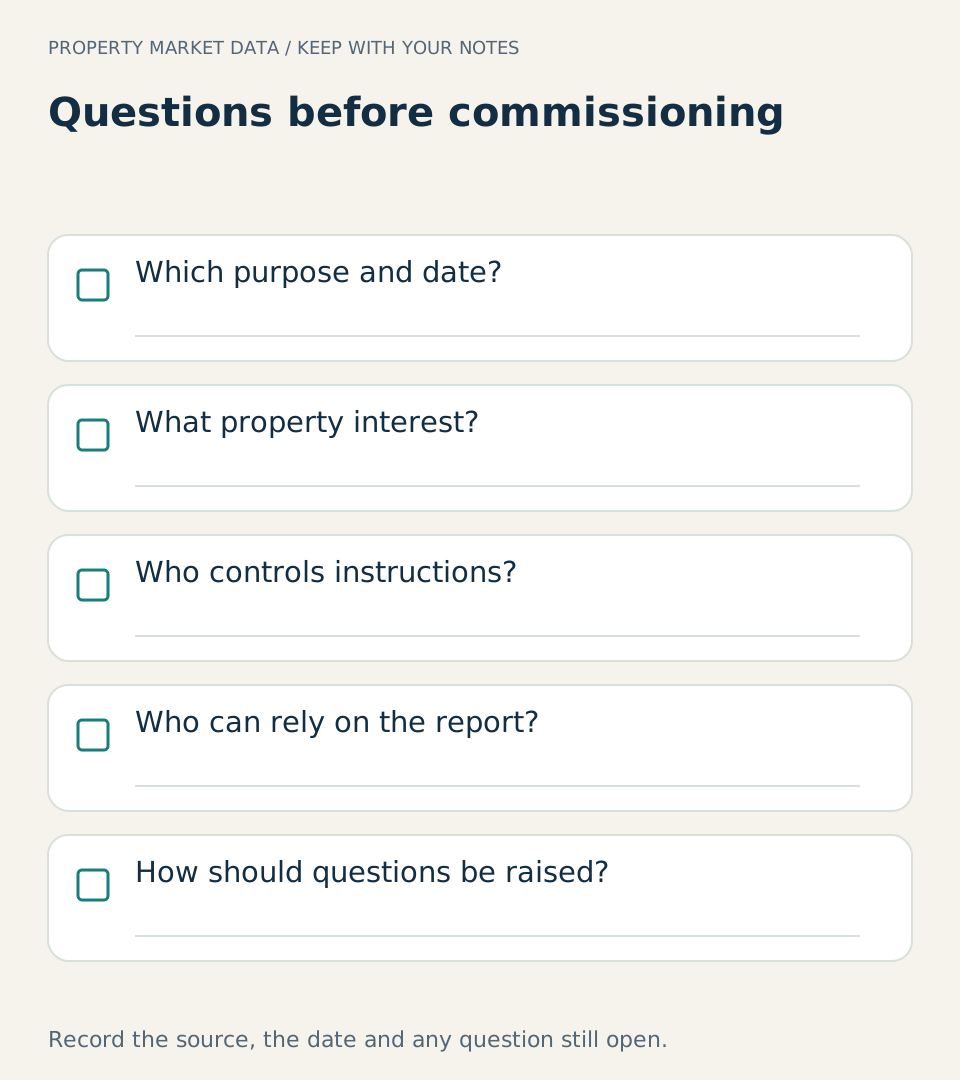
Which purpose and date?; What property interest?; Who controls instructions?; Who can rely on the report?; How should questions be raised? Record the supporting document and any unanswered question.
Questions for the professional briefing
Ask who may rely on the assessment, how the instruction is defined and whether further questions are covered. Clarify the process for correcting a factual error. A request for clarification is different from an invitation to change an opinion to suit a negotiation.
Where legal representatives or the court control the instruction, follow that route. Direct questions through the proper process rather than starting a separate informal discussion that might create inconsistent material.
This is preparation for appropriate advice. It is not a substitute for legal representation or a case-specific valuation instruction.
PMD and a separate property-market decision
PMD does not provide court expert evidence or a divorce-purpose formal valuation. Its automated report and human review should not be presented as satisfying those instructions.
If you separately need to research the market for a proposed sale of an eligible home, a PMD report can organise comparable sales and local context. Keep that research clearly separate from the legal assessment. Read the data limits first.
The useful outcome is a clear record of what each document is for and what it can support. One convenient estimate should not be made to answer every legal, financial and sale question.
Sources
- Family Procedure Rules, Experts and assessors: Expert evidence instructions and court-controlled process in family proceedings
- Royal Institution of Chartered Surveyors, Red Book: Professional valuation standards and scoped instructions
- Royal Institution of Chartered Surveyors, Automated valuation models roadmap: Model scope, explainability and evidence limitations