
Formal property valuations
How is a property valued at a date in the past?
A retrospective valuation asks about a property at a specified date in the past. The evidence must be considered for that date, not simply borrowed from today's estimate. Establish the purpose, the property as it then existed and the appropriate professional instruction.
This is an estimate from comparable sales, not a RICS or mortgage valuation, and not a survey.
Fix the question before looking for a figure
Write the required date and purpose at the top of the briefing. The assessor needs to know whether the question concerns a particular property interest and which recipient will use the result.
HMRC guidance identifies tax circumstances where market value is relevant, and estate guidance addresses a different dated purpose. Those sources help show why the instruction matters. They do not make every historical enquiry the same kind of tax assessment.
Ask the adviser or recipient what is required. A present-day online result should not be submitted as historical evidence without establishing whether it answers the instruction.
Reconstruct the property description
Collect dated plans, photographs and records relevant to the home at the required time. Note alterations that occurred before and after that date. A later extension should not be quietly treated as part of the earlier property.
If you cannot establish an aspect of condition or layout, record the gap. The assessor should explain how uncertainty is handled rather than begin with a confident but invented description.
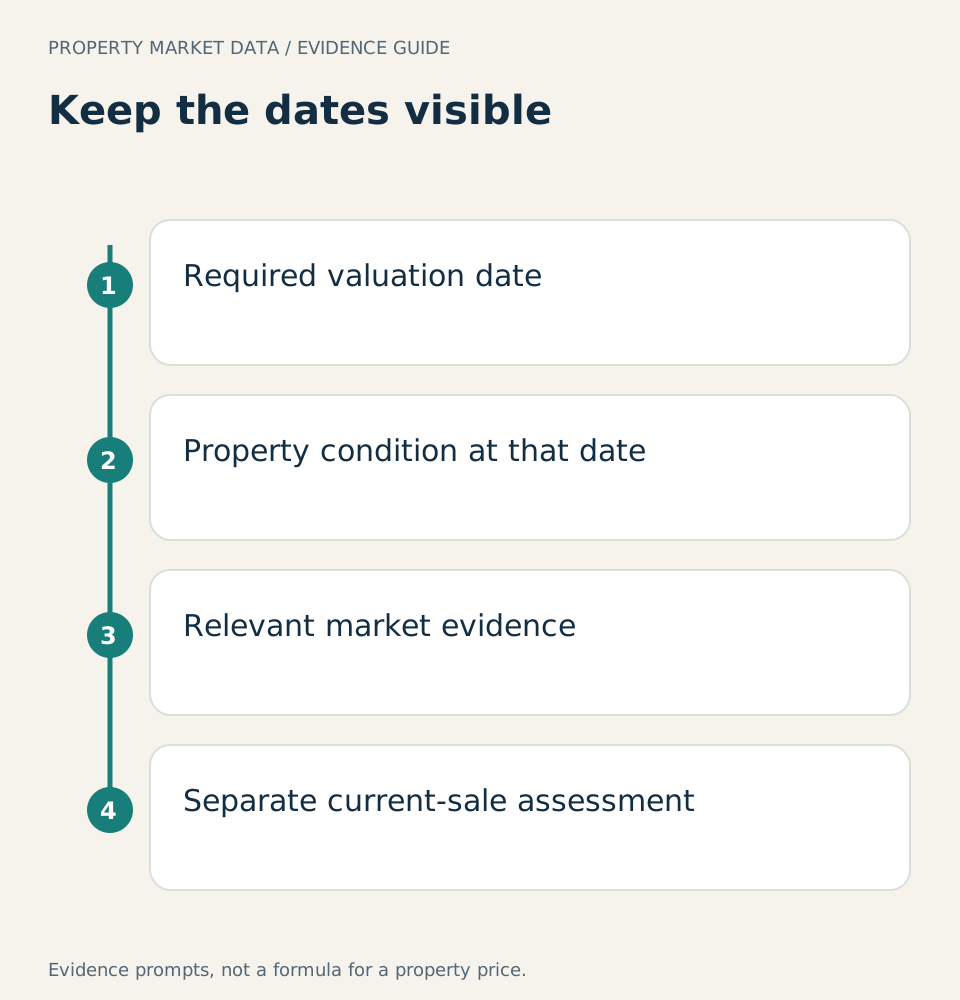
Required valuation date; Property condition at that date; Relevant market evidence; Separate current-sale assessment. Read the evidence together before making a property-specific judgement.
Keep the timing of market evidence clear
Transaction dates, record publication and the date of the property description can differ. How to interpret sold house prices explains why a sale record needs careful reading even in a current assessment.
For a retrospective instruction, ask the professional how the selected evidence relates to the required date. Evidence discovered later and evidence describing a later market are not automatically the same thing.
Avoid a simple backward calculation
A broad market measure may offer context, but it should not be assumed to reconstruct the exact value of this property at an earlier date. The home and relevant buyer evidence may differ from the average being used.
Ask which assumptions a calculation makes and whether the recipient accepts the resulting assessment. A neat formula can conceal the very information the instruction requires.
Build an evidence file for the past date
| Check | What to establish |
|---|---|
| Condition then | Collect dated records of the building and accommodation. |
| Later changes | Identify work which had not happened at the required date. |
| Transactions | Find relevant evidence and explain its timing. |
| Unknowns | Tell the professional where historical information is incomplete. |
The purpose is to reconstruct the property and evidence relevant to that date, not to pretend you have a complete historic inspection. Keep later photographs clearly labelled so they are not mistaken for contemporary records. Explain gaps openly. An assessor can consider limitations in the instruction and report; silently replacing missing evidence with present-day assumptions hides them.
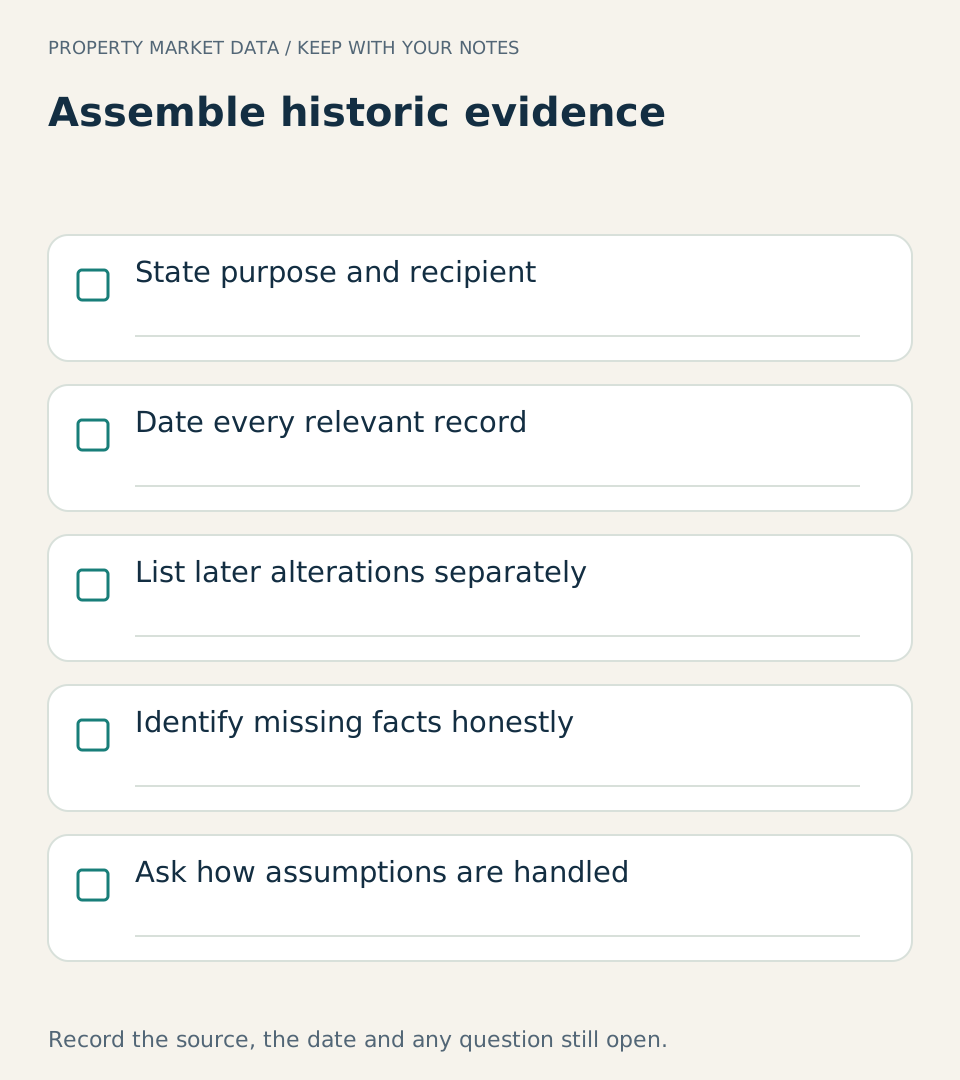
State purpose and recipient; Date every relevant record; List later alterations separately; Identify missing facts honestly; Ask how assumptions are handled. Record the supporting document and any unanswered question.
Connect the historical work to its real purpose
Property valuation for probate considers an estate-related purpose and relevant date. Property valuation for Capital Gains Tax addresses a separate tax enquiry. Use the appropriate guide to organise questions rather than combine their requirements.
A professional report should identify its scope, evidence and material assumptions. Ask who may rely on it and how later questions or factual corrections are handled.
Keep the dated records and instruction together. If several valuations exist, label them by their actual job instead of creating one folder of interchangeable prices.
What if you also intend to sell now?
A present asking-price decision should use evidence for the current property and market. It may be relevant to keep historical work as background, but that does not make it the current sale assessment.
Ask an appropriate person how any legal or tax questions relate to a later transaction. Do not infer a tax conclusion merely from the difference between an old assessment and a new asking price.
PMD's separate current-market role
PMD does not provide a retrospective formal valuation. Its automated report should not be represented as evidence satisfying that instruction.
For a separate sale decision about an eligible home now, PMD can assemble comparable and local-market research. Read the data explanation and keep the dates and purposes distinct.
The central discipline is simple: describe the correct property, at the required date, for the required purpose. A convenient current number cannot bypass that work.
Sources
- HMRC, Estimate an estates value: Estate valuation at the relevant date, distinct from a later sale
- HMRC, Capital Gains Tax and market value: Situations where market value rather than transaction price is relevant
- HM Land Registry, Price Paid Data: Recorded transaction evidence and broad property-type categories