
Formal property valuations
What valuation do you need for probate and inheritance tax?
An inherited home's current asking price and its estate valuation may answer different questions. Establish the relevant date, the estate's requirements and the evidence needed before commissioning work. A current online estimate should not be assumed to provide the estate figure.
This is an estimate from comparable sales, not a RICS or mortgage valuation, and not a survey.
Begin with the estate question
For estate reporting, the starting point is the value of the property at the date of death, not its asking price today. Government guidance asks you to value assets at that date. Establish which property interest belonged to the person who died before commissioning the assessment.
The official estate guidance explains valuing the estate for Inheritance Tax and reporting its value. Its property guidance allows a property or land assessment from an estate agent or chartered surveyor. It does not say that every probate situation universally requires the same named report.
Ask the person handling the estate what evidence is required for the circumstances. Describe the property and relevant date clearly. Where the position is complex or uncertain, appropriate professional advice is more useful than selecting a report from a generic checklist.
Keep that instruction separate from the question of what the home might sell for now. The timing, purpose and recipient need to be clear before a provider begins work.
Build a dated property record
Our suggested estate record includes the property identity, relevant condition information, documents and the date each item describes. Ask how evidence from after the relevant date should be treated. A present photograph may not show the state of the home at the time being assessed.
If a historical assessment is needed, how a property is valued at a date in the past explains the evidence task. Do not replace it with the latest number from a website simply because that result is easier to obtain.
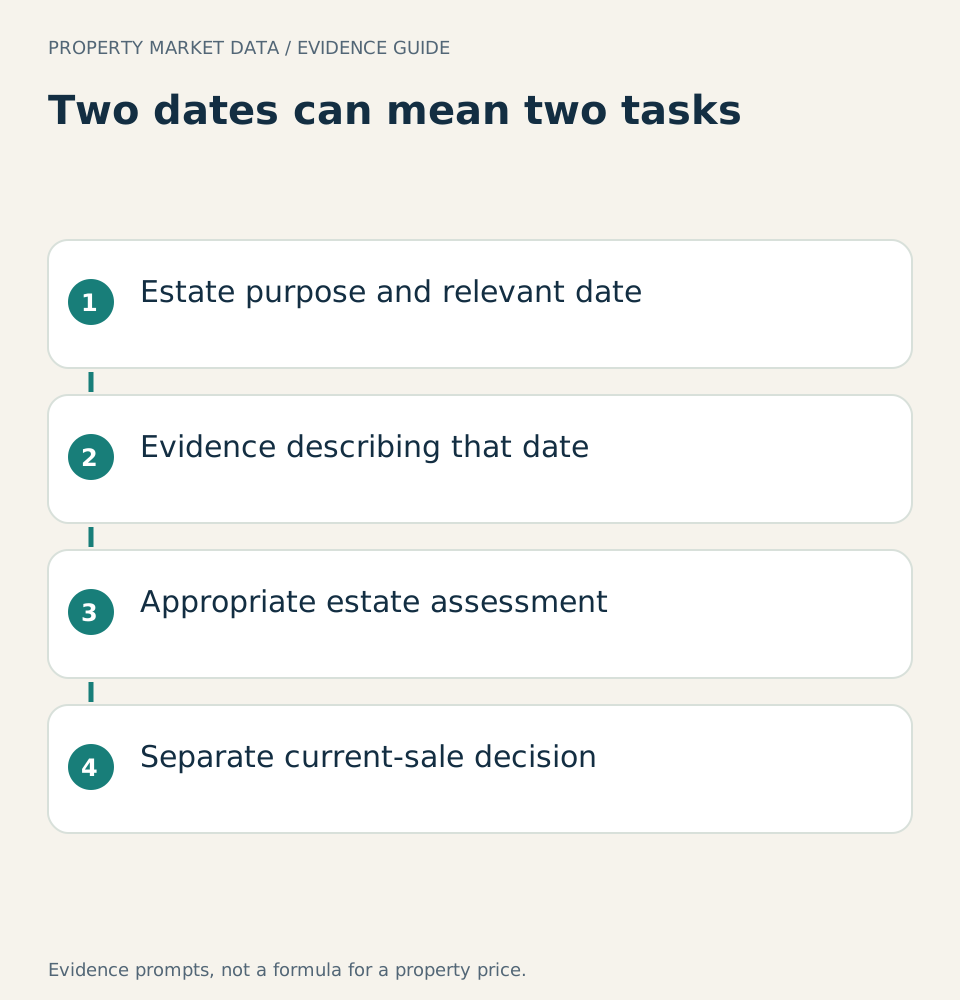
Estate purpose and relevant date; Evidence describing that date; Appropriate estate assessment; Separate current-sale decision. Read the evidence together before making a property-specific judgement.
State uncertainty rather than filling gaps
If you cannot establish a feature or condition at the relevant date, tell the assessor. Keep an estimate from memory labelled as such. Professional judgement should address the evidence and its limitations rather than work from an invented description.
Record who supplied the assessment, its purpose and any assumptions. Retain the report and the material provided so the reasoning can be followed if questions arise later.
Decide what work to commission
Use the guide to property valuation types to distinguish market research, appraisal and formal assessment. Then obtain instructions relevant to the estate, rather than assume a product label establishes suitability.
Ask a provider about experience with the purpose, the relevant date and the report's intended use. Clarify scope, fees and what additional work might be necessary. Do not commission two incompatible instructions and then average the results.
Brief the estate assessment clearly
| Check | What to establish |
|---|---|
| Property interest | Identify what the estate owned and any relevant co-ownership. |
| Required date | State the date the assessment must address. |
| Evidence available | Provide records of condition and material circumstances at that date. |
| Administration | Ask the adviser what report and supporting records are needed. |
Keep the estate assessment and later sale file distinct, even when they concern the same building. Repairs, occupation and market evidence can change between the two decisions. A later offer may be relevant evidence to discuss with the adviser, but it is not automatically the required estate figure. Retain the reasoning behind the assessment as well as the final number.
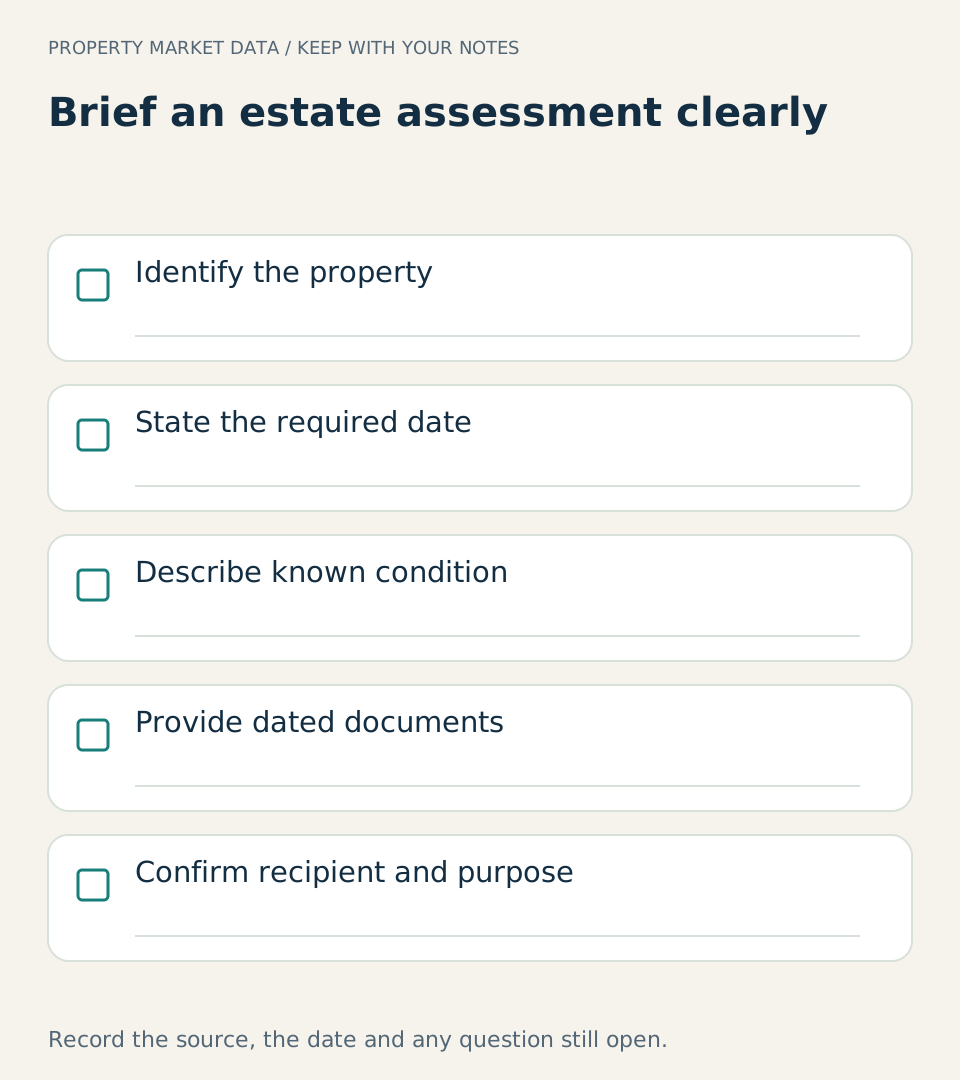
Identify the property; State the required date; Describe known condition; Provide dated documents; Confirm recipient and purpose. Record the supporting document and any unanswered question.
A later sale is a separate decision
Setting a selling price for an inherited home concerns the current market and a proposed sale. That guide should not overwrite the estate valuation question.
A later achieved price can prompt questions for the estate's advisers, but its implications depend on the circumstances. Do not treat a difference as proof that an earlier assessment was dishonest or automatically correct the estate figure yourself.
The official estate process and appropriate advice should guide how records or changes are handled. This article does not determine an individual's tax liability or the legal authority to sell.
Where PMD fits
PMD does not supply an estate or probate-purpose valuation service. Use the official guidance and the estate's professional instructions for that task. An automated current estimate should not be submitted on the assumption that it meets the requirement.
If you separately need to research a present sale of an eligible home, PMD can help organise comparable and local-market evidence. Read the report scope before considering that separate use.
Keep the two decisions labelled: evidence for the estate at the relevant date, and evidence for a sale now. That distinction is more useful than trying to make one number perform both jobs.
Sources
- HMRC, Estate valuation for Inheritance Tax: Estate records and property valuations by estate agents or chartered surveyors
- HMRC, Estimate an estates value: Estate valuation at the relevant date, distinct from a later sale