
Selling your home
How should you set a selling price for an inherited home?
An estate valuation and a later selling price may concern the same home at different times. Establish the legal position with the estate's advisers, then assess current market evidence for a sale. Do not assume the earlier figure is automatically today's asking price.
This is an estimate from comparable sales, not a RICS or mortgage valuation, and not a survey.
Keep the estate purpose visible
Official estate guidance concerns the property at the relevant estate date and the evidence needed for that process. A current marketing discussion is a separate decision. Label the records so they are not casually substituted for one another.
Property valuation for probate explains that purpose. The estate's appropriate advisers should establish requirements and any implications of a later sale. This guide does not determine an individual's tax position or who has authority to act.
Before instructing an agent or making sale commitments, clarify the legal route. A convenient property estimate is not evidence that the transaction can proceed.
Establish the home as it is now
Collect a current factual description and identify what has changed since the earlier assessment. An unoccupied home, work carried out or deterioration may create new questions. Do not assume that a family member's memory describes present condition.
How condition affects a property assessment explains the need for suitable evidence. A sale strategy should not certify the building simply because someone has tidied or decorated it.
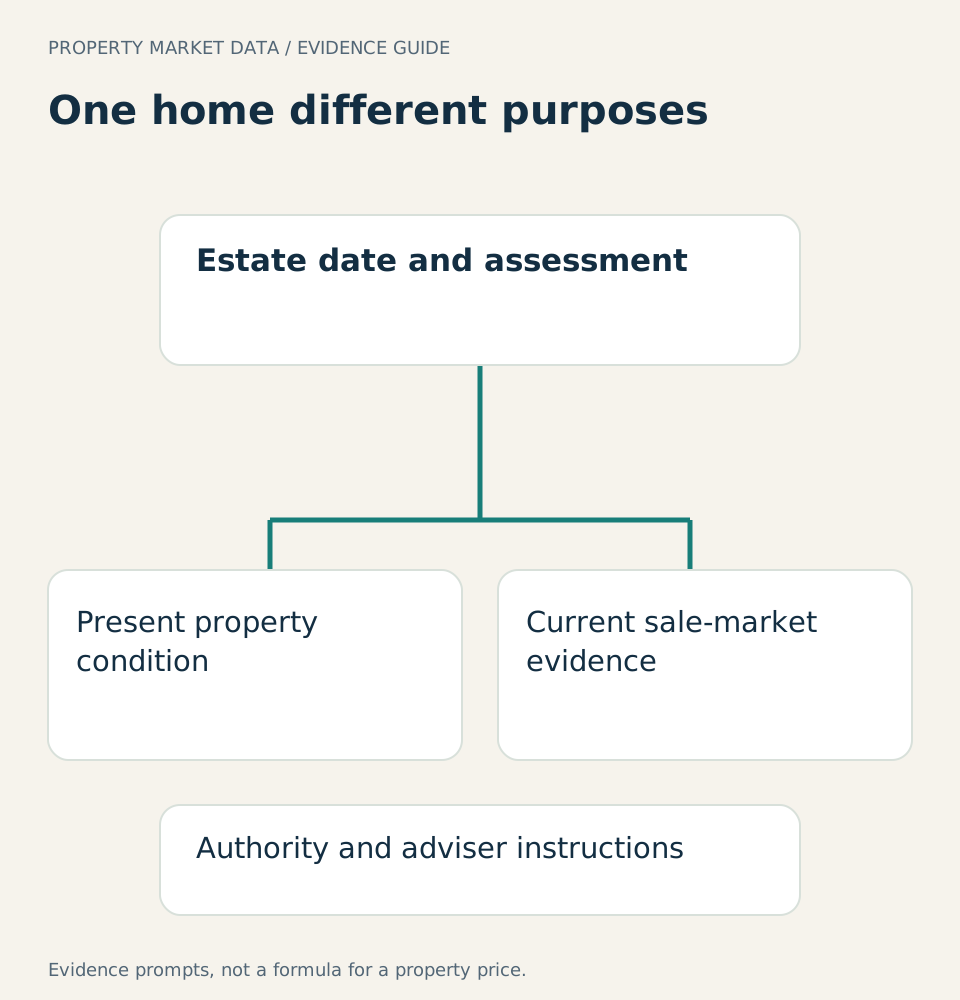
Estate date and assessment; Present property condition; Current sale-market evidence; Authority and adviser instructions. Read the evidence together before making a property-specific judgement.
Ask about information gaps before launching
Have the estate's advisers help identify relevant documents and material questions. Separate missing paperwork from a confirmed defect or restriction. An unknown should be investigated or described appropriately, not silently filled in to make the listing simpler.
A factual record can help agents compare the home and buyers understand it. Avoid personal details that are not relevant to the property transaction.
Review present comparable evidence
Setting an initial asking price addresses the market strategy. Ask the agent what current transactions and competing homes support the recommendation and how the property's actual circumstances are handled.
The earlier estate figure may be useful background, but its date and purpose need to remain clear. Do not demand that a current estimate matches it without examining the evidence.
Separate estate records from sale preparation
| Check | What to establish |
|---|---|
| Estate figure | Keep its date and purpose with the supporting explanation. |
| Present condition | Record changes since the estate assessment. |
| Sale authority | Ask the estate adviser about the relevant authority and process. |
| Marketing evidence | Use current comparisons for the sale discussion. |
An inherited home may have been unoccupied, repaired or cleared since the earlier assessment. Record those changes rather than treating the two figures as directly interchangeable. If a prospective offer raises a question about estate reporting, take it to the adviser. The sale strategy can be researched separately without presenting a current PMD estimate as an estate or tax assessment.
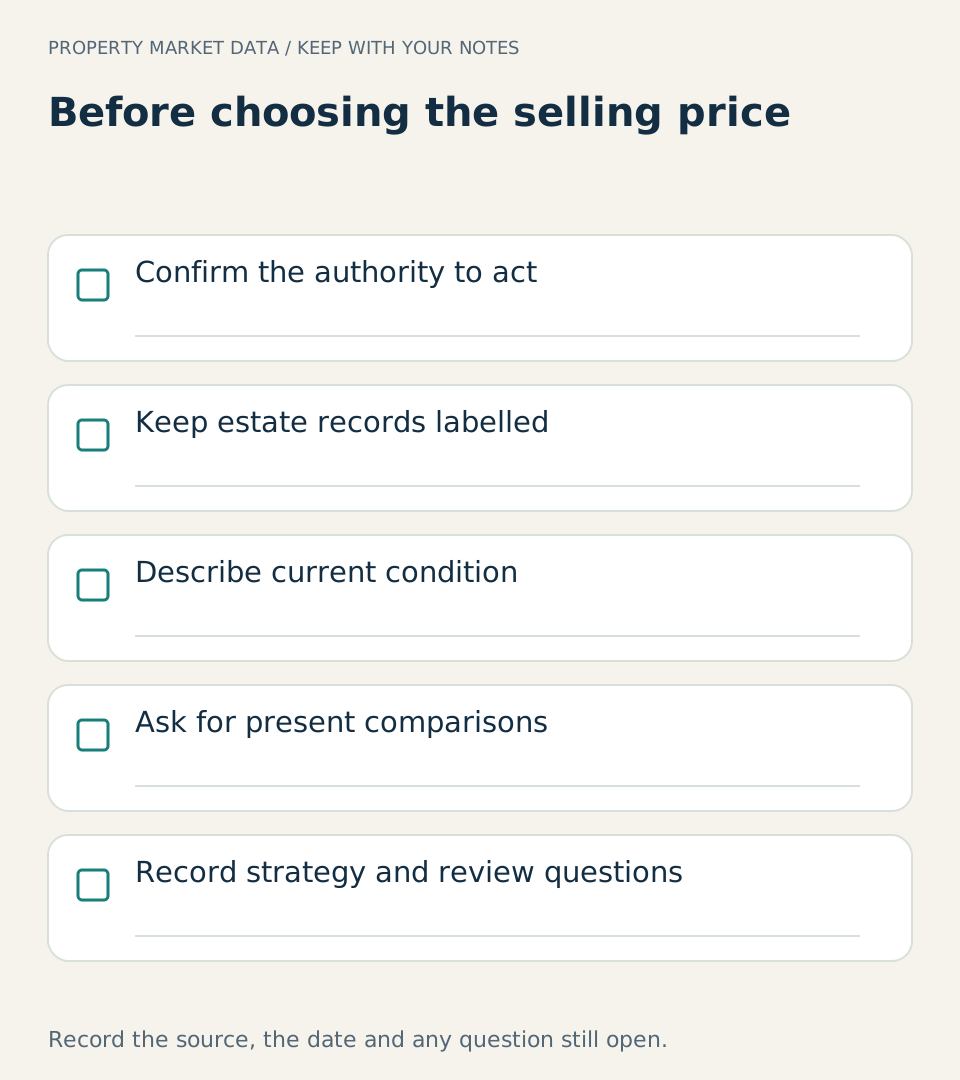
Confirm the authority to act; Keep estate records labelled; Describe current condition; Ask for present comparisons; Record strategy and review questions. Record the supporting document and any unanswered question.
Manage several opinions with a shared brief
If several authorised people are involved, a common factual property pack can help keep discussions focused. Ask the legal adviser how decision-making and authority should work. This is not a substitute for agreement or legal instructions.
Record the reasoning for the chosen strategy, what remains uncertain and when it will be reviewed. Choosing the highest suggestion may not address the property's evidence or the estate's needs.
When an offer arrives, ask for the buyer's position and the evidence relevant to the proposal. The relationship between the offer and any tax assessment belongs with the appropriate adviser.
What PMD contributes to the sale enquiry
PMD can organise current comparable sales and local-market context for an eligible home. That can inform a discussion about today's marketing strategy. It does not provide the estate valuation or determine authority to sell.
View the sample and read the data explanation before deciding whether the research adds useful information. A human review gives a written property market opinion on your own PMD report, within the service's stated scope.
Keep the present sale assessment beside, rather than in place of, the estate records. That makes the pricing conversation clearer and preserves the distinction between professional estate requirements and a current property-market decision.
Sources
- HMRC, Estate valuation for Inheritance Tax: Estate records and property valuations by estate agents or chartered surveyors
- HMRC, Estimate an estates value: Estate valuation at the relevant date, distinct from a later sale
- Government guidance, How to sell a home: Estate agent appraisals, selling preparation and checking service scope