
Formal property valuations
When might you need a property valuation for capital gains tax?
For some disposals, the tax question involves market value rather than simply the price paid. Establish whether that applies to your circumstances with appropriate advice. A present-day estimate is not automatically the figure required for a tax calculation.
This is an estimate from comparable sales, not a RICS or mortgage valuation, and not a survey.
Ask why a valuation is being requested
A property valuation may be relevant when tax uses market value rather than the amount paid. HMRC lists gifts and sales below value to help the buyer among those situations. The required date depends on the transaction. Ask your tax adviser which basis and date apply before ordering a report.
HMRC's market-value guidance identifies circumstances in which market value is used for Capital Gains Tax. The first task is to establish the applicable transaction and purpose, rather than select a figure from a general house-value tool.
Tell your tax adviser how the property was acquired and disposed of, including relevant relationships and documents. This guide does not calculate your liability or determine which rule applies to a particular transfer.
Keep the legal or tax question separate from an assessment of what the home might sell for now. The same property can require evidence for more than one date or purpose.
Confirm the relevant date and interest
Ask exactly what needs valuing and as at which date. Is it the whole property or a particular interest? Which assumptions should the professional consider? Those instructions should be established before work begins.
For the historic evidence task, read how retrospective property valuation works. A broad current market index or an owner's remembered estimate should not be assumed to provide the required historical assessment.
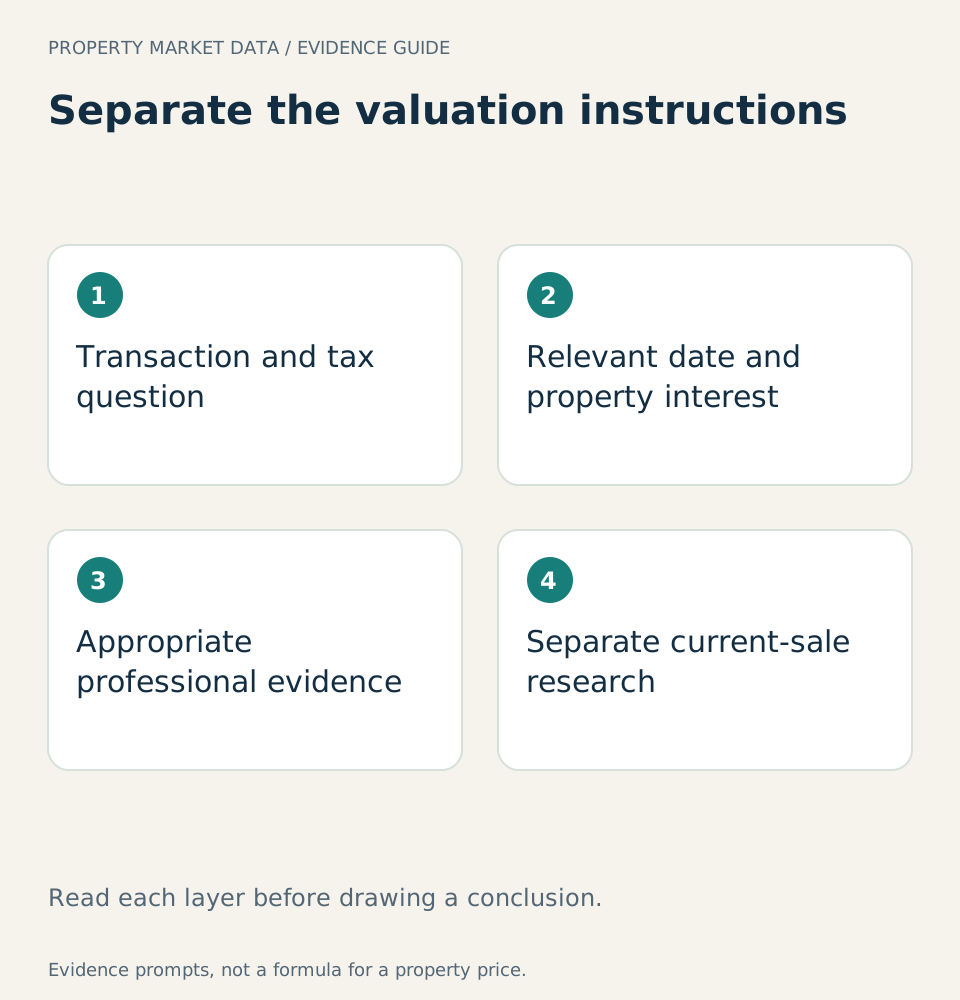
Transaction and tax question; Relevant date and property interest; Appropriate professional evidence; Separate current-sale research. Read the evidence together before making a property-specific judgement.
Keep a factual transaction record
Our suggested record includes the property identity, acquisition and disposal documents, relevant dates and known changes. Mark uncertain information rather than attempting to complete every gap from memory.
The adviser or valuer can then explain what further evidence is required. A tidy spreadsheet cannot turn an undocumented assumption into a verified transaction fact.
Commission the appropriate work
The different types of property valuation provides an initial explanation of purposes. Where a tax-related assessment is needed, ask an appropriate professional about the instruction, relevant experience and intended use of the report.
Confirm fees and what the deliverable will explain. A large document is not automatically more suitable, and a short estimate is not automatically adequate. Scope and evidence are the important distinctions.
Do not submit a PMD report on the assumption that HMRC will accept it for a formal purpose. PMD does not provide a Capital Gains Tax valuation service.
Prepare the tax valuation question
| Check | What to establish |
|---|---|
| Transaction | Describe what happened rather than assuming the sale price is the tax value. |
| Relevant interest | State the property interest involved. |
| Required date | Ask the tax adviser which date needs assessment. |
| Evidence | Keep records explaining condition and circumstances at that date. |
Do not choose a favourable historical figure and ask for paperwork to justify it. Start with the adviser instruction and obtain evidence for that question. A current estimate can help a separate present-day property decision, but does not establish a historic tax basis. Keep advice, assessment and transaction records together so the reasoning remains traceable.
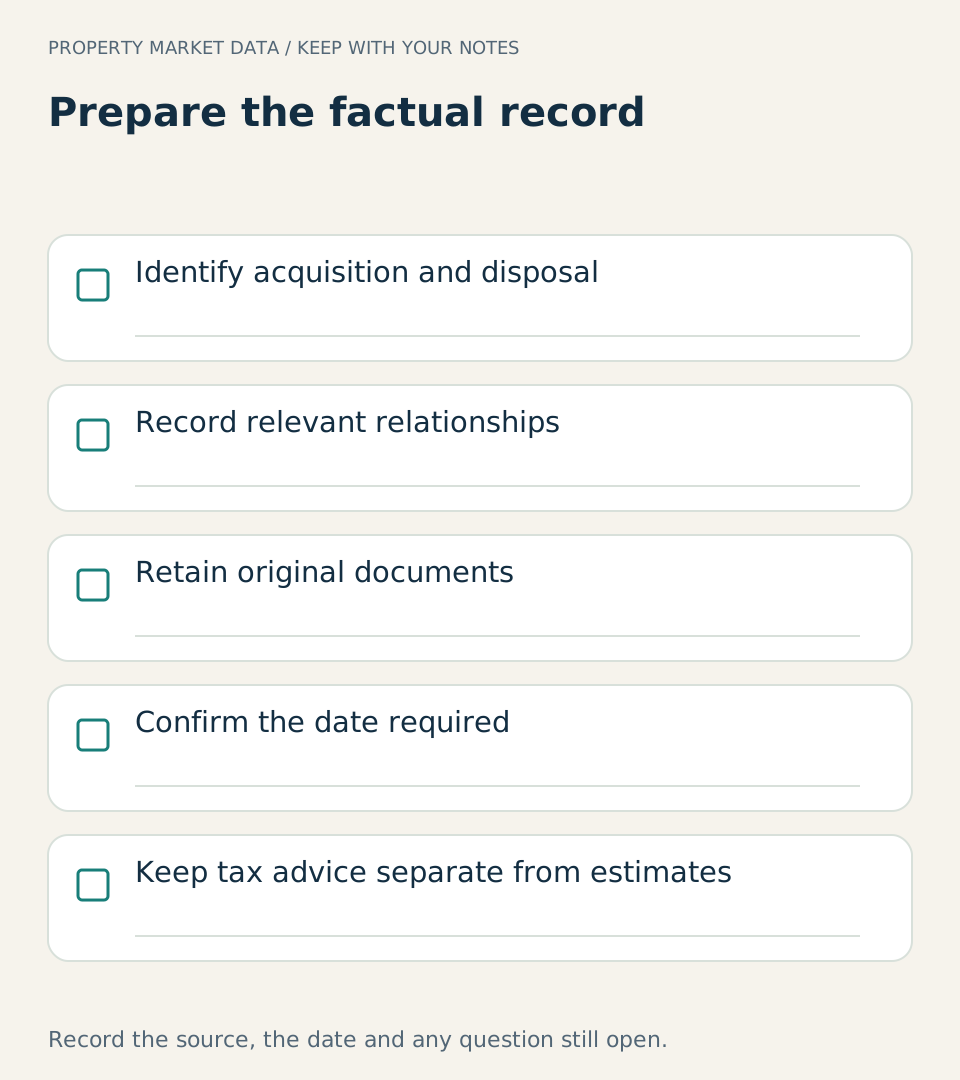
Identify acquisition and disposal; Record relevant relationships; Retain original documents; Confirm the date required; Keep tax advice separate from estimates. Record the supporting document and any unanswered question.
Related-party purchases need their own questions
Buying a home from family addresses fairness, evidence and the separate questions for legal, tax and lending advisers. An agreed family price does not eliminate the need to establish which tax rules apply.
Avoid describing a transaction as a tax-saving arrangement on the strength of an online estimate. Obtain appropriate advice before relying on assumptions about gifts, discounts or relationships.
Keep the market assessment and the advice about tax treatment together in your records, while recognising that they answer different questions.
What should the valuation explanation make clear?
Ask for the stated date, purpose, property description, relevant evidence and material assumptions. Where information is missing, the report should make its limitations understandable.
If further questions arise, follow the process advised for the assessment. A disagreement should be examined through the evidence and instructions rather than resolved by choosing whichever number produces the preferred tax outcome.
A separate current-sale use for PMD
If you are also planning to market an eligible home, PMD can help you examine current comparable sales and local market conditions. That is a separate decision from the tax assessment. Read its data explanation before choosing.
Keep the documents labelled by their actual job. Tax evidence should meet the relevant professional instruction; present sale research should explain the current market. Neither should be quietly substituted for the other.
Sources
- HMRC, Capital Gains Tax and market value: Situations where market value rather than transaction price is relevant
- HMRC, Market value rule: Market value considerations for relevant non-arm-length transactions
- Royal Institution of Chartered Surveyors, Red Book: Professional valuation standards and scoped instructions