
Buying and offers
How do you assess a fair price when buying a home from family?
A family sale can feel simpler than an ordinary purchase, but agreeing a figure does not answer every question. Separate what the home could sell for, what the parties want to agree and what advisers or a lender require. Keep each decision explicit.
This is an estimate from comparable sales, not a RICS or mortgage valuation, and not a survey.
Begin with a shared factual description
Identify the property, what is included and the proposed transaction. Keep the description consistent when asking for advice. Family familiarity does not establish current condition, title or the absence of material issues.
Write down which questions are genuinely about price and which concern the arrangement between the parties. That prevents a valuation estimate being used as an answer to ownership, funding or tax treatment.
HMRC's market-value guidance identifies circumstances in which tax uses market value rather than simply the transaction price. Appropriate advice should establish whether that matters to your proposed transaction.
Keep fairness and market evidence distinct
The parties may have personal reasons for their agreement. Those reasons should be stated rather than described as evidence of a market value. A price both people are comfortable with is not automatically the number required by another recipient.
Deciding what to offer on a house explains a general purchase-evidence approach. In a family transaction, use the research to understand the property rather than pretend the relationship has no bearing on the arrangement.
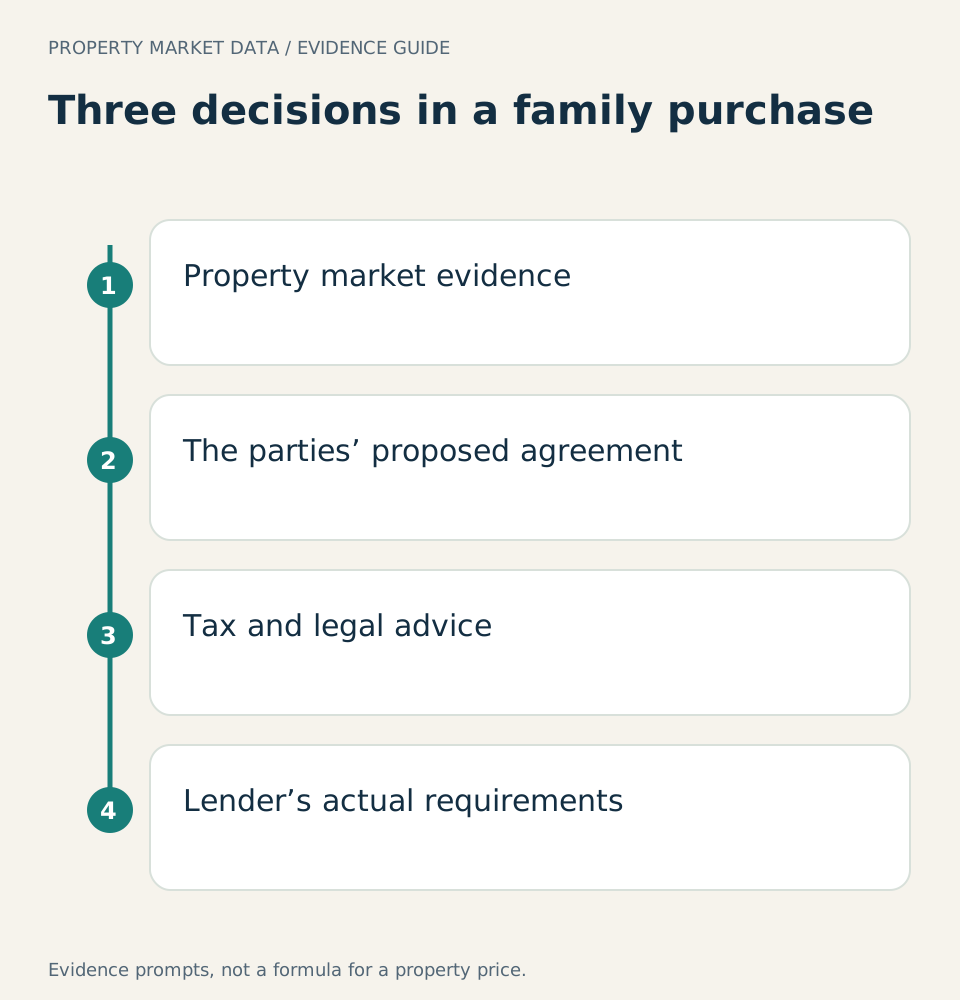
Property market evidence; The parties’ proposed agreement; Tax and legal advice; Lender’s actual requirements. Read the evidence together before making a property-specific judgement.
Agree what the evidence is for
Ask whether the assessment is intended to inform the parties, support a professional instruction or address a lender requirement. Avoid ordering several different services without identifying their jobs.
Keep any assumed discount or benefit out of tax conclusions. A generous intention should not become a claim about the treatment of a transfer without advice.
Put tax and lending questions to the right people
Property valuation for Capital Gains Tax identifies the separate purpose question. This article does not calculate tax, recommend a gift structure or determine the implications of a relationship.
Mortgage and remortgage valuations explains why the lender's assessment is distinct from your own research. Give the lender or adviser the actual transaction information and ask what evidence is required.
Give each party a clear question
| Check | What to establish |
|---|---|
| Seller | Establish the evidence behind the price being proposed. |
| Buyer | Research the property, condition and practical affordability. |
| Lender | Explain the relationship and transaction terms accurately. |
| Advisers | Ask about conveyancing and tax treatment for the actual arrangement. |
A family agreement can feel settled before its important details have been checked. Put the proposed terms in writing for the advisers without assuming that agreement makes the price suitable for every purpose. Distinguish a gift element, if any, from the market assessment. Both parties benefit from understanding what the evidence supports and which questions need separate advice.
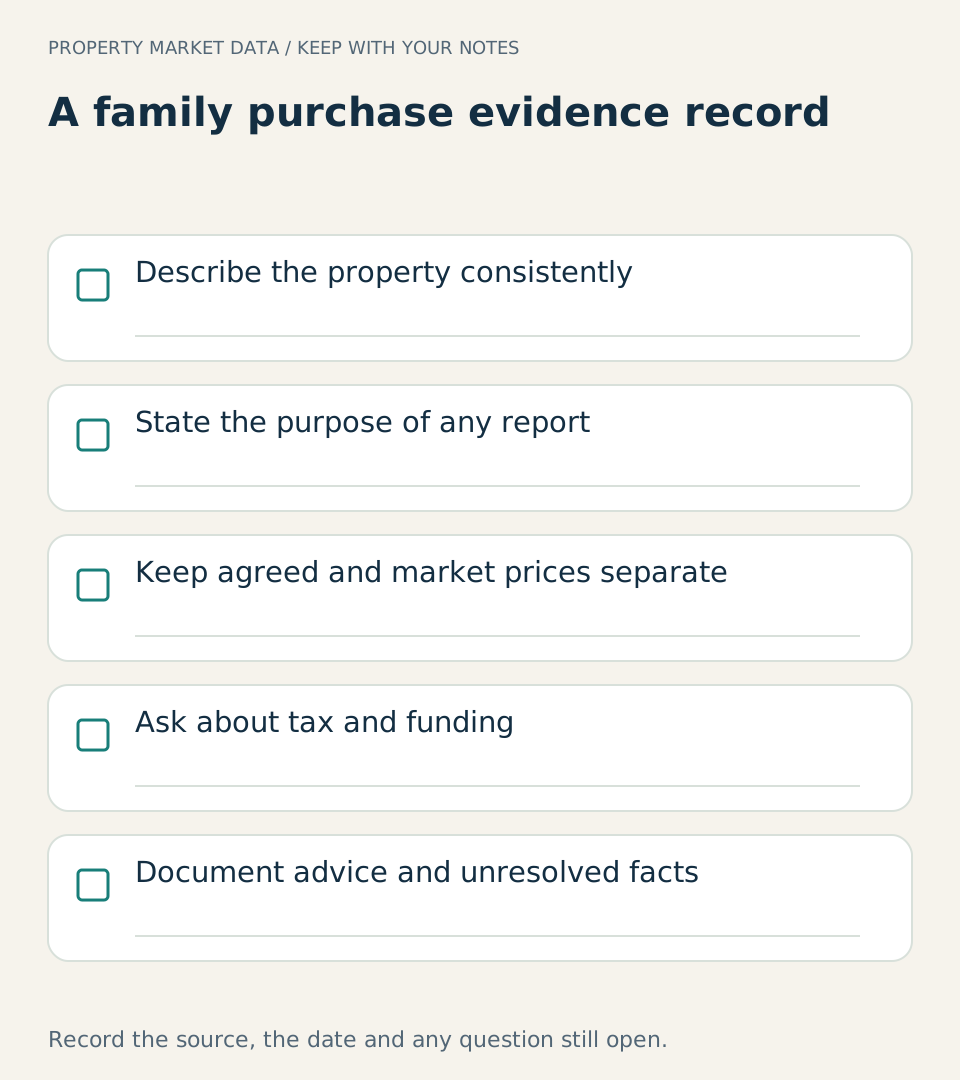
Describe the property consistently; State the purpose of any report; Keep agreed and market prices separate; Ask about tax and funding; Document advice and unresolved facts. Record the supporting document and any unanswered question.
Keep a written decision record
Our suggested record identifies the market evidence, the proposed price and the professional questions still open. Retain the relevant advice and documents. A clear record is useful even where everyone currently agrees.
Do not assume that understanding between relatives removes the need for appropriate conveyancing or professional advice. The transaction still concerns a particular property and legal interests.
Ask the advisers how the arrangement should be documented. A property report can inform the price discussion without determining what terms are appropriate for the parties.
Investigate the home on its own facts
The same material-property questions arise even if you know the seller well. Current condition, use and relevant documents should be checked through appropriate channels. Personal trust is not a structural survey or a title check.
Where a fact is missing, record the uncertainty. Avoid relying on a remembered price from an earlier family discussion as though it is present market evidence.
How PMD can help
A PMD buyer report can organise comparable sales and local-market context for an eligible home. Use it as part of the property discussion, not as proof of tax treatment, lender acceptance or fairness between particular people.
Read the data explanation before deciding whether the report adds information. A separate professional valuation may be needed for another purpose.
Keep the family agreement, the property's market evidence and the professional requirements on separate lines. They can inform one another without being collapsed into a single convenient number.
Sources
- HMRC, Capital Gains Tax and market value: Situations where market value rather than transaction price is relevant
- HMRC, Market value rule: Market value considerations for relevant non-arm-length transactions
- Government guidance, How to buy a home: Purchase evidence, funding, conveyancing and transaction stages