
Property valuations
How do you compare two written property valuation reports?
Two reports can disagree without answering the same question. Before comparing the final figures, check the purpose, valuation date, property description and evidence. A side-by-side reading is more useful than choosing the report with the higher estimate.
This is an estimate from comparable sales, not a RICS or mortgage valuation, and not a survey.
Put the instructions beside the numbers
Find the purpose statement in each report. Was the assessment prepared to support a sale discussion, help a lender or meet a particular formal instruction? Reports with different purposes may not be directly comparable.
Then record the valuation date and any inspection or information date. You need to know which property and market each result describes. Do not infer that similar cover designs or similar report titles establish equivalent work.
Professional valuation standards place importance on defined instructions and scope. For your reading exercise, start with those practical details before evaluating the conclusion.
Compare the home each report describes
Write down the address, dwelling type and relevant accommodation shown. Note differences in floor area, condition assumptions or treatment of separate buildings. A discrepancy here deserves investigation before an argument about price.
If one report assumes a fact that another leaves unresolved, record that distinction. An assumption is not automatically wrong, but it should not be treated as a verified feature merely because it appears in a table.
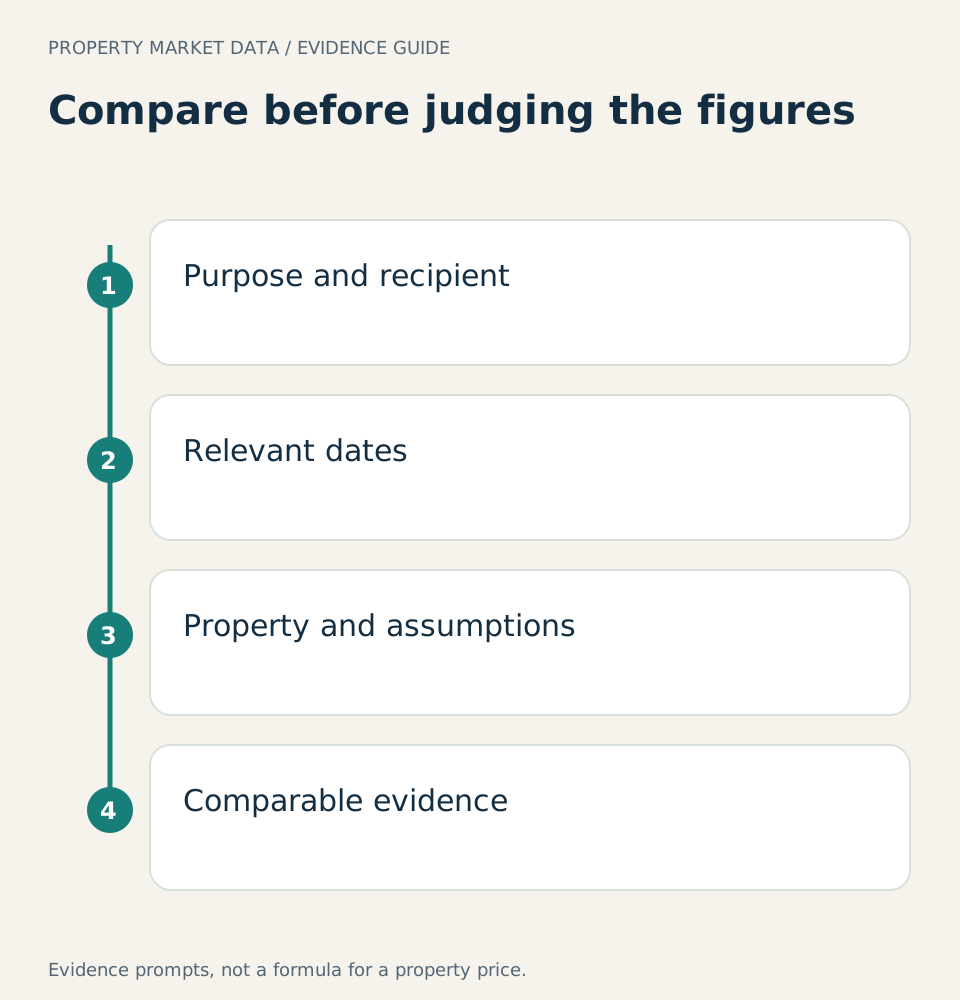
Purpose and recipient; Relevant dates; Property and assumptions; Comparable evidence. Read the evidence together before making a property-specific judgement.
Use the guide to reading a property valuation report if either document is difficult to interpret individually. This article concerns the comparison between documents, not a second walkthrough of every report section.
Look beyond the number of comparable sales
A longer list is not necessarily more informative. Ask why the chosen homes are relevant and whether their dates and characteristics support the conclusion. A detailed explanation of a few useful comparisons can be easier to assess than a large unexplained list.
How to choose comparable sales explains that evidence-selection question. Keep your notes focused on what each report tells you, rather than assuming its calculations from the final number.
Identify the reason for a difference
Our suggested comparison log has a line for each material difference and a question to ask. Perhaps the date differs, a building is omitted or a condition assumption is stronger. The next step is clarification of that issue, not a vote on the two figures.
Do not average results from different instructions and describe the average as an agreed valuation. That operation creates another number without resolving why the original results differ.
If the disagreement is between agents' proposed marketing prices, why estate agent valuations differ is the more relevant guide. A written report comparison should not become a renamed method for choosing the highest-priced agent.
Build a fair report comparison
| Check | What to establish |
|---|---|
| Date | Separate a difference in timing from a difference in method. |
| Property description | Resolve mismatched area, tenure or condition assumptions first. |
| Evidence | Compare the relevance of sales, not simply how many are listed. |
| Intended use | Check whether both reports answer the same decision. |
Read the explanations before looking again at the final figures. If one report assumes a repaired property and another describes present condition, their numbers may differ for a reason. Ask each author a focused question about the disputed assumption. Choosing the higher result without resolving that difference leaves the disagreement intact.
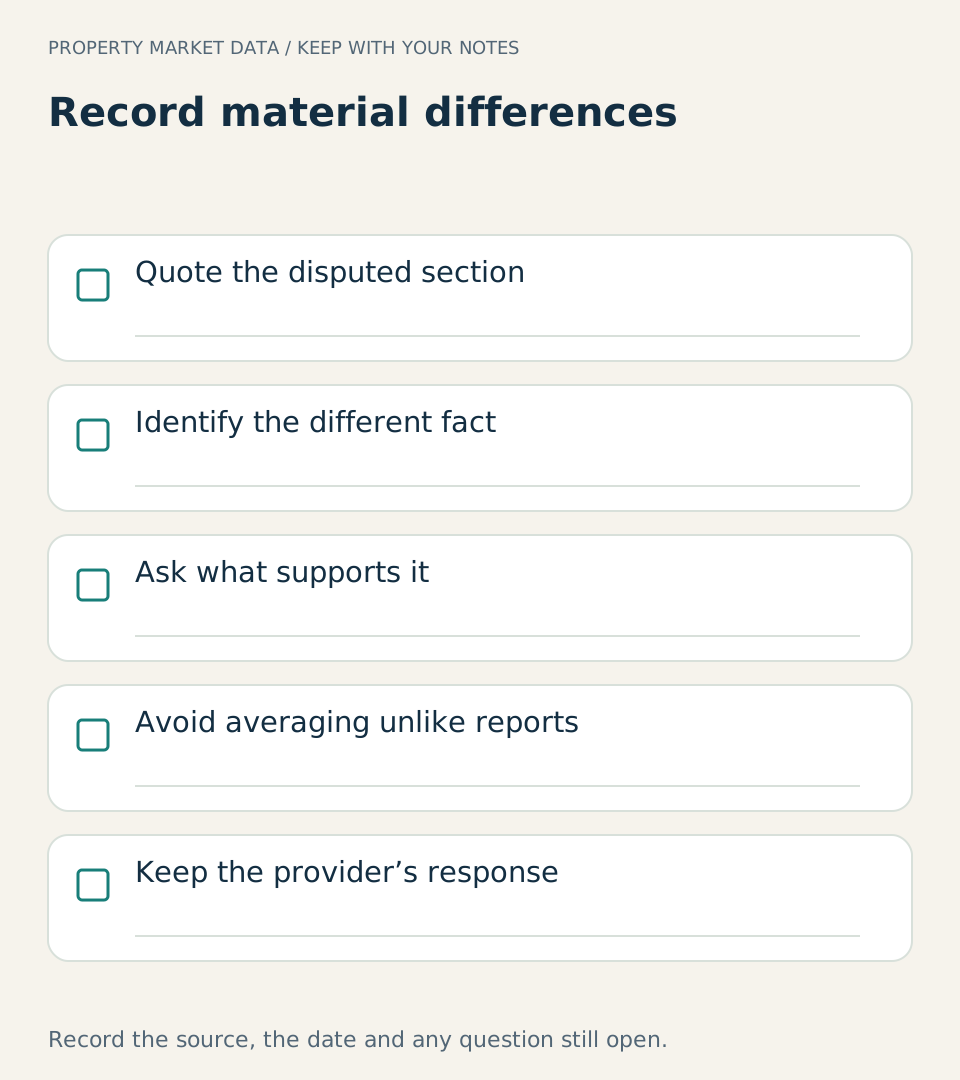
Quote the disputed section; Identify the different fact; Ask what supports it; Avoid averaging unlike reports; Keep the provider’s response. Record the supporting document and any unanswered question.
Ask questions the provider can answer
Quote the section you do not understand and ask what evidence supports it. Distinguish requests for a factual correction from requests for an alternative opinion. Keep the response with your notes.
If a report is for a formal recipient, ask that recipient or your adviser how discrepancies should be addressed. Do not circulate a document beyond its stated scope assuming everyone can rely on it.
Compare PMD on its actual purpose
A PMD report helps you examine an automated estimate through comparable sales and local evidence. View the sample to understand its structure, then compare like with like when evaluating another service.
If you are still unsure what your PMD report shows, human review can add a written property market opinion on it, within its stated scope. It does not make a PMD report equivalent to a lender, tax or court assessment. The useful outcome is a clearer understanding of the evidence and the remaining questions.
Sources
- Royal Institution of Chartered Surveyors, Red Book: Professional valuation standards and scoped instructions
- Royal Institution of Chartered Surveyors, Automated valuation models roadmap: Model scope, explainability and evidence limitations