
Marketing and market data
Postcode territory exclusivity for estate agents: how it works and what to check
Some marketing services for estate agents are sold by postcode territory, with one agency in each area. Exclusivity can be worth having, but only when you know exactly what is exclusive, for how long, and what happens when either side ends the agreement.
This is an estimate from comparable sales, not a RICS or mortgage valuation, and not a survey.
What a postcode territory is
A postcode has two halves. The first half, such as NR13, is the outward code, which names a postcode district. Districts are a convenient unit for a territory: they are recognised by everyone, they map cleanly onto the towns and villages an agency serves, and sold price records can be counted for each one.
When a marketing service is sold by territory, the provider allocates each district to one agency. That agency's name then appears on the provider's content for that area, such as local market pages and articles.
Why some services are sold this way
Local marketing works because it is local. If two competing agencies bought the same service for the same district, they would receive near identical market pages and articles, competing with each other for the same readers and the same searches. Allocating each district to one agency keeps the content distinct and gives the agency a reason to invest in building it up over time.
What exclusivity covers, and what it does not
This is the part to read carefully. Exclusivity in a territory agreement is a promise by the provider about its own service. It usually means the provider will not grant the same exclusive territory to another agency while yours is in place.
It does not stop other agencies trading in the district, advertising there, canvassing there or buying other marketing services. It does not make you the only agent homeowners can find. And it cannot promise leads or instructions: those still depend on your agency's service, prices and reputation.
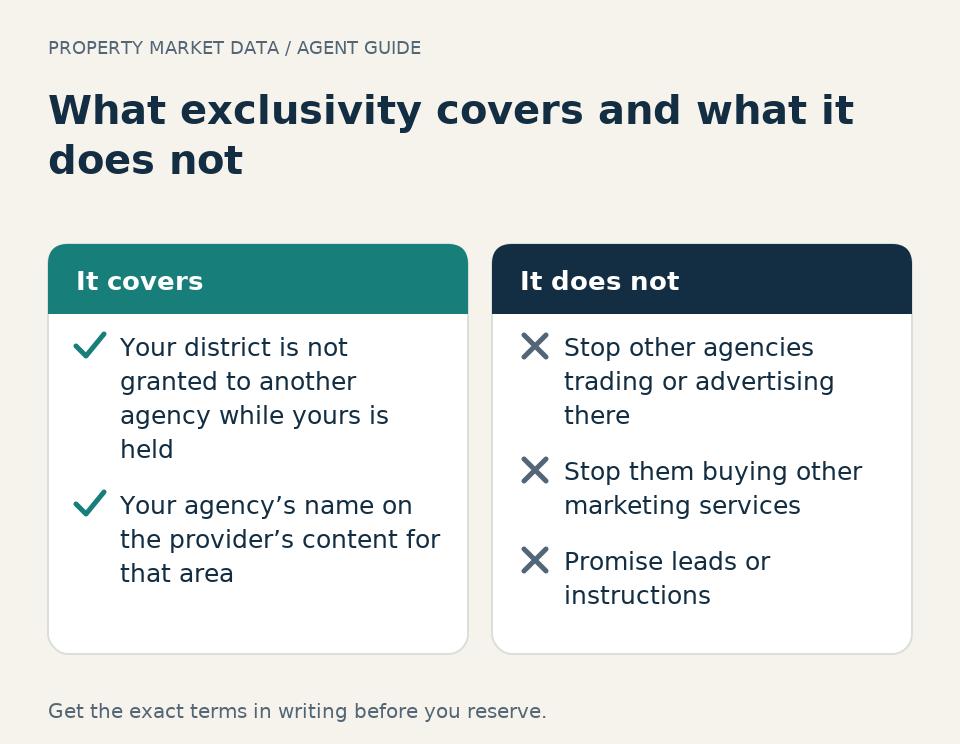
Exclusivity means the provider does not grant the same territory to another agency while yours is held. It does not stop other agencies trading or advertising in the area, and it does not promise leads or instructions.
A provider that is clear about this is easier to rely on than one that implies an area is yours in any wider sense.
Questions to ask before you reserve
Before you commit to any territory, get the answers in writing:
- Which districts exactly, and how are they defined?
- How long does exclusivity last, and what notice does either side give?
- What happens to your districts if you leave, and can they be offered to another agency?
- How is the price of each district set, can it change, and is there a setup fee?
- What is included in the subscription, and what is charged separately?
- Can you add districts later if they are still available?
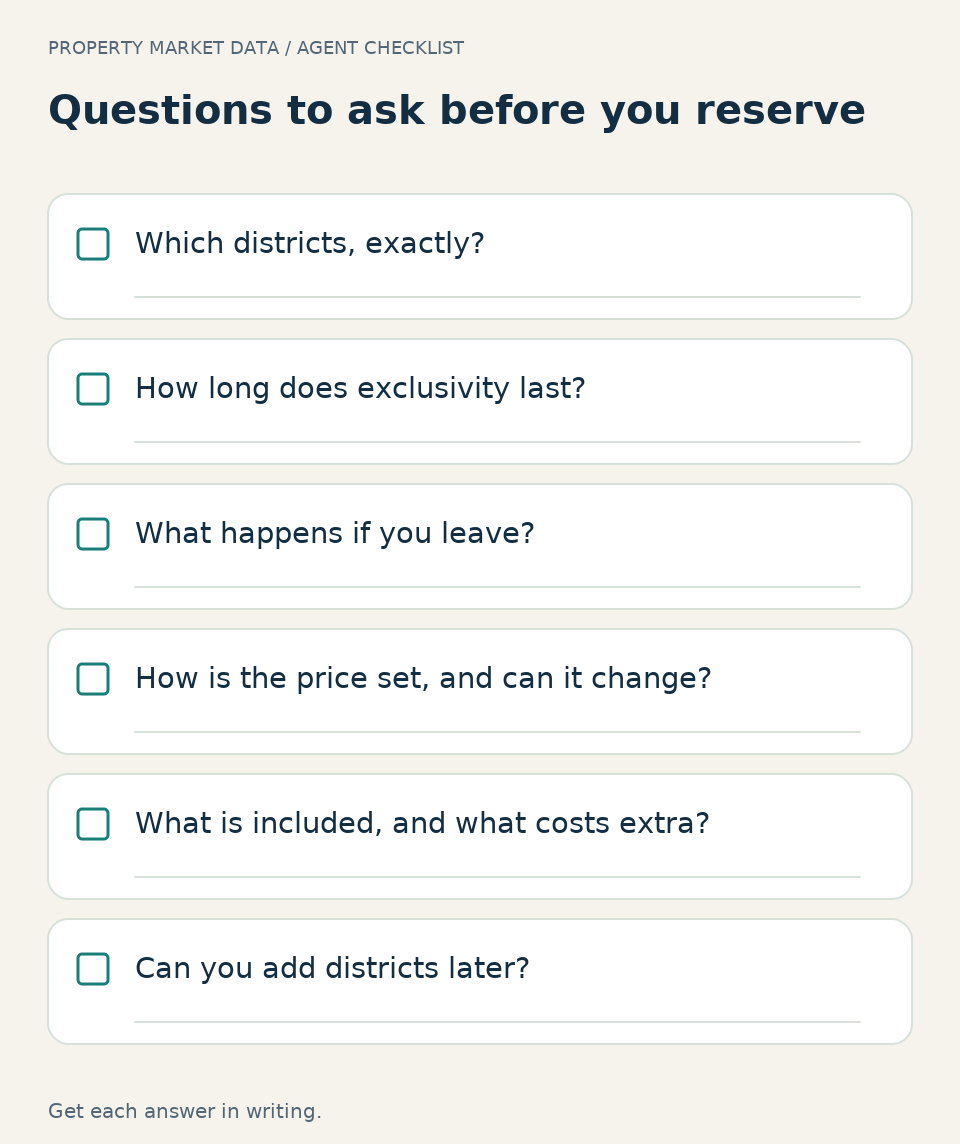
Ask which districts exactly, how long exclusivity lasts, what happens if you leave, how the price is set and whether it can change, what is included and whether you can add districts later.
How to choose your districts
Start where you already list most homes. A territory adds most where your branch already has local knowledge, a sale board presence and a reputation to build on. Then look at activity: the number of completed sales recorded in each district shows how much of a market there is, and HM Land Registry's Price Paid Data lets you compare districts on the same basis. A large district with few sales may be worth less than a small, busy one.
Be realistic about coverage. Claiming districts you cannot serve well adds cost without adding instructions, and a homeowner who reads your market page and then finds you cannot help them is a missed opportunity, not a lead.
How PMD's territories work
PMD allocates each postcode district to one agency. While a district is allocated to you, PMD does not grant the same exclusive PMD territory to another agency, as set out in your agreement. It covers the PMD territory only: it does not promise leads or instructions, and it does not stop other agencies operating in the area. Each district is priced by its real sales volume, and the pricing page shows the monthly cost for any district you choose. Reserving holds your districts under your agency's name with no payment details and no obligation, and a one-off setup fee applies only when you go live. If you cancel, your districts may be released and offered to another agency, as your agreement sets out. For what the subscription includes, see what to automate in your agency's marketing and using market data at valuation appointments.
Sources
- PMD, Estate agent pricing and what is included: How PMD allocates and prices postcode districts, and what the subscription includes
- PMD, Estate agent questions and answers: What one agent per area means, and what happens to a district when an agency leaves
- HM Land Registry, About the Price Paid Data: Sold price records for England and Wales, used to compare sales volume between districts