
Marketing and market data
How estate agents can use market data to support a valuation and win the instruction honestly
Sellers now arrive at a valuation having seen online estimates and sold prices. An agent who brings the evidence, explains it plainly and leaves it behind in writing is easier to believe than one who simply quotes the highest figure in the room.
This is an estimate from comparable sales, not a RICS or mortgage valuation, and not a survey.
Sellers arrive informed
A seller who books three valuations has usually done some homework. The government's guide to selling a home tells sellers to ask 3 agents and to ask each one for evidence, such as similar homes they have recently sold. Many have also typed their address into an online estimate before you arrive. The appointment is no longer the first time they have seen a number. It is the first time someone has explained one.
That changes what persuades. A figure without evidence sounds like a sales pitch. A figure with the sales behind it, set out plainly, sounds like advice.
The code already asks for the evidence
The Property Ombudsman's code for residential estate agents says that any figure you advise, as an asking price or as a possible selling price, must be given in good faith, must reflect available information about the property and current market conditions, and must be supported by comparable evidence. It adds that you must never deliberately misrepresent the market value of a property, and that the evidence on comparables must be kept on file.
So an evidence pack is not extra work for the appointment. It is the record the code expects you to keep, presented to the seller as well.
What to bring to the appointment
- Comparable sales. Completed sales of similar homes nearby, with prices and dates. Remember that HM Land Registry's records arrive late: a sale typically takes from 2 weeks to 2 months to be registered, so your own knowledge of the market fills the most recent gap.
- Size and condition. Floor area from the energy certificate, checked against what you see, and a note of how condition compares with each sale.
- Current competition. The homes now on the market at a similar price, how long they have been listed and any reductions.
- The local trend. How prices in the area have moved, from the UK House Price Index, so older sales can be read at today's level.
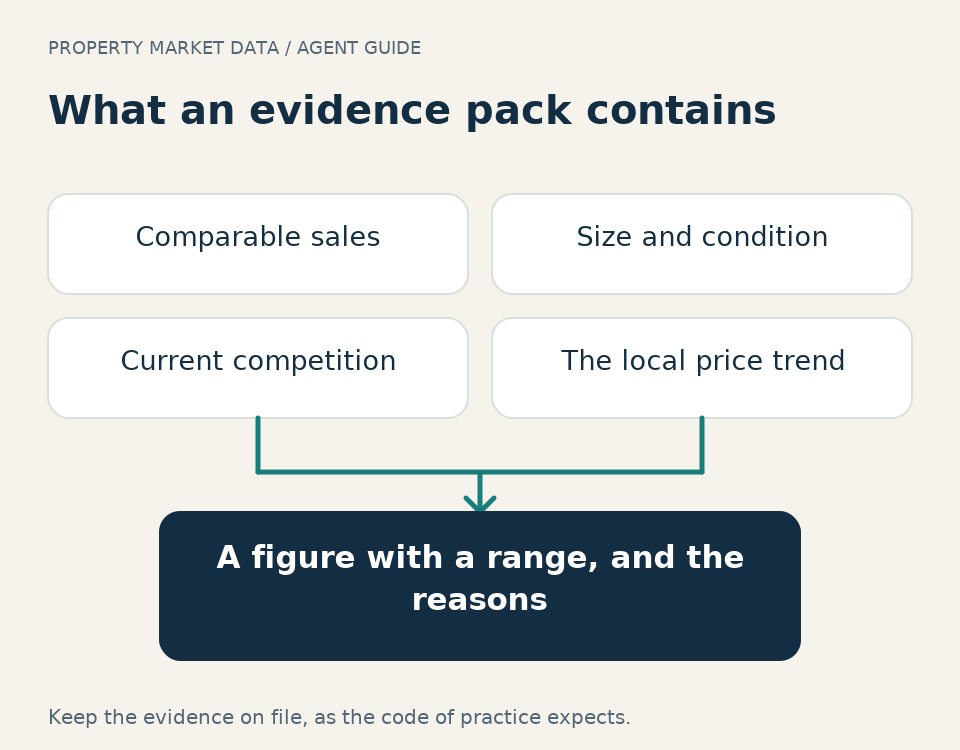
Comparable sales, size and condition, the homes currently on the market and the local price trend are brought together into a figure with a range.
Present the figure as a range, with reasons
Explain why you chose each comparable and why you left others out. Show how size and condition move the figure. Give a range and say where in it you expect the home to sell, then talk about asking price strategy as a separate step. Sellers can tell the difference between the price you expect and the price you suggest advertising at, and they appreciate being told which is which.
In the Illustrative example below, each sale carries its date, size and a short note of how it differs from the home you are valuing. A table like this answers most of the questions a seller will ask before they ask them.
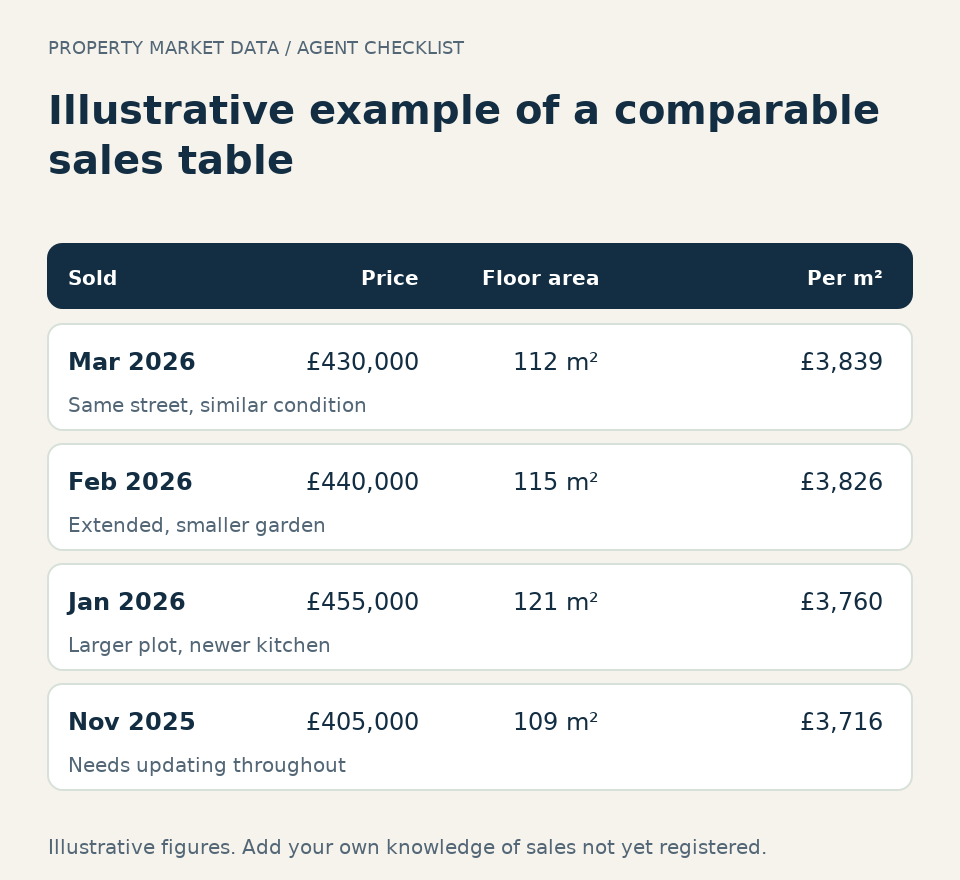 Illustrative example
: four nearby sales between 405 thousand and 455 thousand pounds, each with its date, floor area, price per square metre and a note of how it differs from the home being valued.
Why the evidenced figure lasts longer
A figure the evidence cannot support tends to come back weeks later as a conversation about a price reduction, usually after the seller has stopped trusting the agent who suggested it. An evidenced figure gives you something to point back to: if the market moves, you can show what changed. That is a stronger position for the whole sale, not just for the appointment.
Leave it behind in writing
Sellers often decide after the third appointment, at the kitchen table. A written appraisal they can read at their own pace keeps your reasoning in the room when you are not. It also matches the code's requirement that comparable evidence is kept on file.
How PMD prepares it
PMD's Valuation Engine assembles the evidence before you leave the office. Type the address and the report brings together sold prices, comparable homes, local demand, market conditions and a suggested range, presented under your agency's brand. Show it on screen at the appraisal, print it as a leave-behind or email it afterwards. The estimate is PMD's own calculation, tested against thousands of recorded sales, and you apply your local knowledge on top. It is an estimate from comparable sales, not a RICS valuation, a mortgage valuation or a survey. For the marketing that follows the instruction, see what to automate in your agency's marketing, and read more about the Valuation Engine.
Sources
- The Property Ombudsman, Code of Practice for Residential Estate Agents: An advised figure must be given in good faith, reflect current conditions and be supported by comparable evidence kept on file (paragraphs 4b and 4c)
- GOV.UK, How to sell a home: Sellers are told to ask 3 agents and to ask each for evidence such as similar homes recently sold
- HM Land Registry, About the Price Paid Data: The delay between a sale and its registration
- GOV.UK, UK House Price Index reports: Local price movement over time
- PMD, Valuation Engine for estate agents: What the PMD appointment report contains