
Formal property valuations
Which valuation is needed to repay a Help to Buy equity loan?
A Help to Buy equity loan repayment uses a specific valuation process. Start with the instructions for your actual scheme and confirm the appropriate provider before paying. An ordinary online estimate does not replace the report requested for the repayment.
This is an estimate from comparable sales, not a RICS or mortgage valuation, and not a survey.
Check the scheme before applying general advice
This article concerns the Homes England Help to Buy equity loan process in England. Other schemes or arrangements may have different instructions. The geographic coverage of a PMD report does not determine the rules of an equity loan.
Homes England publishes guidance on arranging the market valuation for repayment, including surveyor, report and timing requirements. Read that current guidance for the applicable loan before making a booking.
Write down what transaction you are planning: sale, repayment from your own funds or repayment alongside refinancing. Ask the scheme administrator what the process requires in your circumstances.
Give the provider a precise brief
Homes England requires a valuation from a surveyor qualified and registered with the Royal Institution of Chartered Surveyors. You arrange and pay for the work. Tell the surveyor it is for equity-loan repayment and supply the administrator requirements; an ordinary agent appraisal or automated estimate cannot perform that task.
State the scheme and purpose, identify the property and provide the relevant instruction. Ask whether the provider can meet the actual requirements. A description such as “house valuation” may be too broad to establish that.
Commissioning a formal property valuation explains the scope questions. Confirm the professional requirements rather than infer them from a report sample or a fast delivery promise.
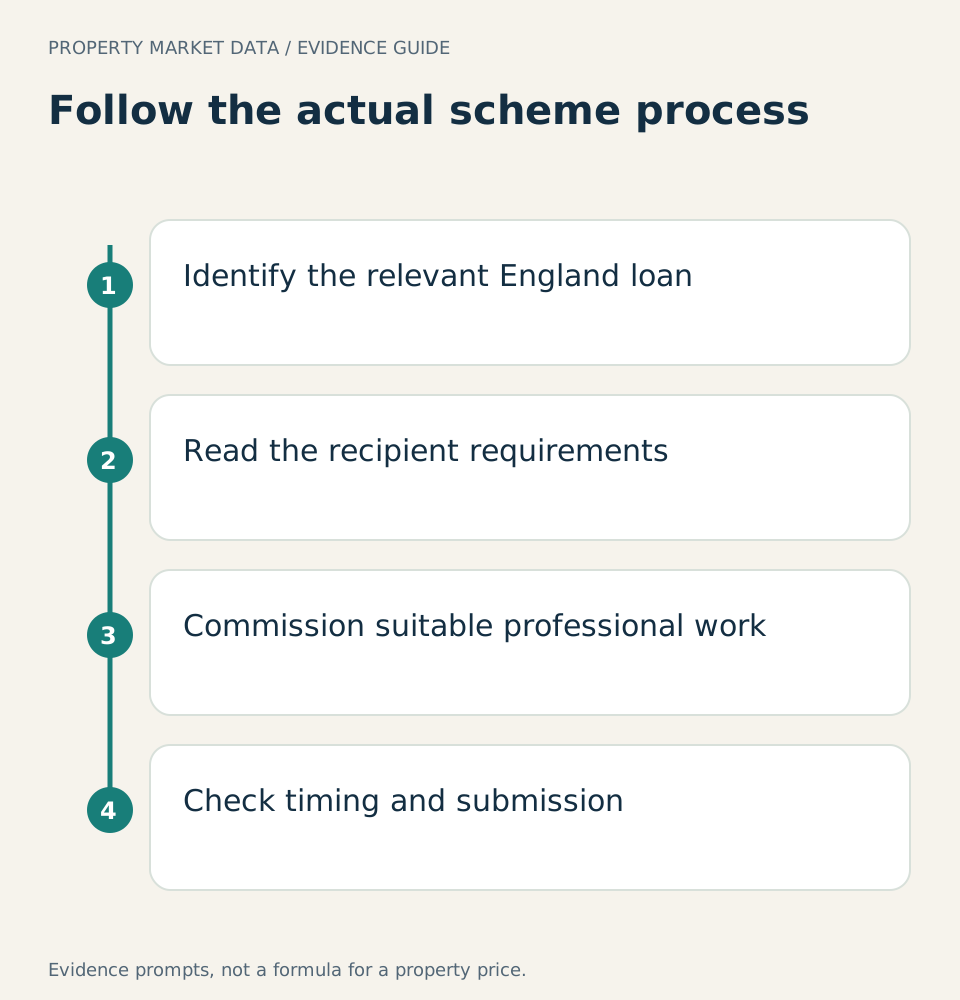
Identify the relevant England loan; Read the recipient requirements; Commission suitable professional work; Check timing and submission. Read the evidence together before making a property-specific judgement.
Resolve material property questions early
Ask which information the surveyor needs about changes, unusual features or building issues. Homes England's instructions identify circumstances that may need specialist attention. Do not wait until after receiving a report to disclose something material.
Give the adviser or surveyor original documents where requested. An estimate of a change's effect on value is not confirmation of planning permission or construction condition.
Plan the timing with the recipient
Homes England says the original report is valid for three months from its production date and should be sent within five days. Its guidance sets separate extension procedures if repayment is delayed. Check those instructions before booking; a newer marketing estimate does not extend the accepted report. Ask the administrator and provider what current validity and update instructions apply.
When an older property valuation needs checking again explains the general reuse question. It does not override the scheme's requirements or supply an expiry rule for your application.
Prepare for the scheme instruction
| Check | What to establish |
|---|---|
| Administrator | Identify the organisation handling your equity-loan case. |
| Current guidance | Read its report and surveyor requirements before booking. |
| Property information | Provide details which could require special treatment. |
| Timing | Ask how the assessment fits the intended repayment or sale. |
Do not order an ordinary market report first and assume it can be converted into the required scheme document. Tell the instructed professional about relevant building or cladding information. Check the next administrative step before relying on a report date. A separate current sale comparison can help your marketing preparation, but remains a different piece of work.
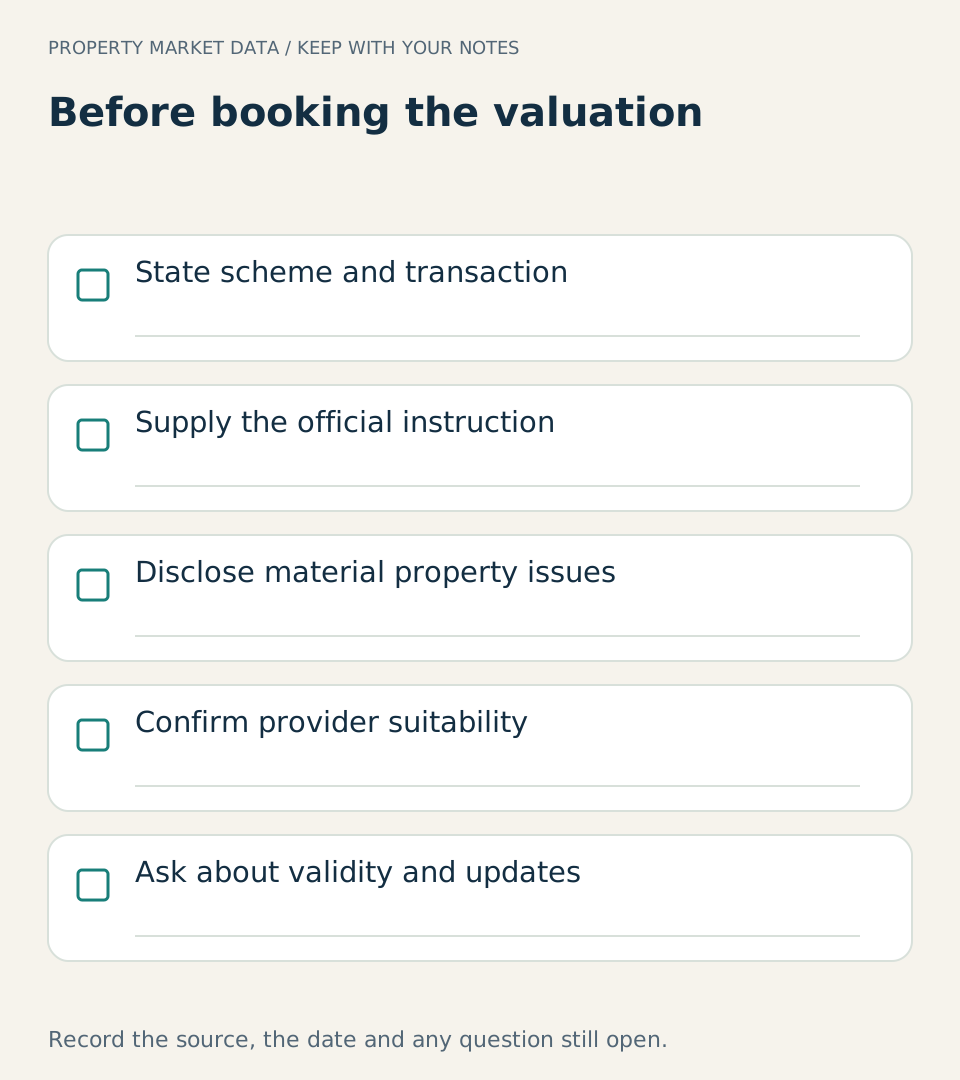
State scheme and transaction; Supply the official instruction; Disclose material property issues; Confirm provider suitability; Ask about validity and updates. Record the supporting document and any unanswered question.
Build the timetable from the steps the scheme actually requires. Avoid assuming that the valuation can be commissioned at any point and remain suitable indefinitely. Confirm what happens if the transaction takes longer or the required information changes.
Check the report against the instruction
Before relying on the document, confirm that it identifies the correct property, purpose and relevant date and addresses the required scope. Ask how factual errors or missing information should be dealt with.
Choosing a property valuation type can help explain why an agent appraisal, automated estimate and scheme-specific report are different. Do not swap them because their final figures appear similar.
Use official guidance for the repayment decision
The administrator's process and suitable professional advice should guide the formal work. This article does not calculate the repayment or determine which amount is due. Do not base that decision on a generic market estimate.
PMD does not provide the Help to Buy repayment valuation. An automated report should not be ordered to fulfil that requirement.
A separate sale-market enquiry
If you also need evidence for marketing an eligible home, PMD can organise current comparable sales and local context. That research is separate from the required repayment assessment. Read the report scope before deciding whether it adds information.
Keep the two records distinct: the professional valuation accepted for the scheme process, and any additional research used for a present sale discussion.
Sources
- Homes England, Help to Buy valuation instructions: Surveyor, report and validity instructions for the applicable England equity-loan scheme
- Government guidance, Cladding and specialist valuations: Help to Buy homes with cladding and the need to establish valuation requirements
- Royal Institution of Chartered Surveyors, Red Book: Professional valuation standards and scoped instructions