
Property valuations
When does an old house valuation need checking again?
An earlier valuation may remain useful background without being suitable for today's decision. Check what has changed and who needs the assessment. There is no single expiry rule that you should apply to every online estimate, appraisal and formal report.
This is an estimate from comparable sales, not a RICS or mortgage valuation, and not a survey.
Begin with the purpose of the original assessment
Find the document or explanation, not just the remembered figure. What was it prepared to do? An old asking-price discussion, a lender assessment and a scheme-specific report may have different instructions and users.
If another organisation needs the result, ask that organisation what it will accept. For example, Homes England publishes particular valuation and update instructions for its Help to Buy process. Those instructions should not become a universal rule for all house valuations.
For your own sale research, the practical question is whether the evidence still helps you assess the present home and market. Age alone does not tell you which information remains relevant.
Record what changed since the assessment
Our suggested change log separates the property, the evidence and the decision. Note alterations to accommodation, a change in condition or a different use you are considering. Then identify new transactions or other information that may affect the comparison.
Finally, note whether the decision changed. You may originally have been curious about a home and now be preparing to instruct an agent. That can require more detailed questions even if the building itself is unchanged.
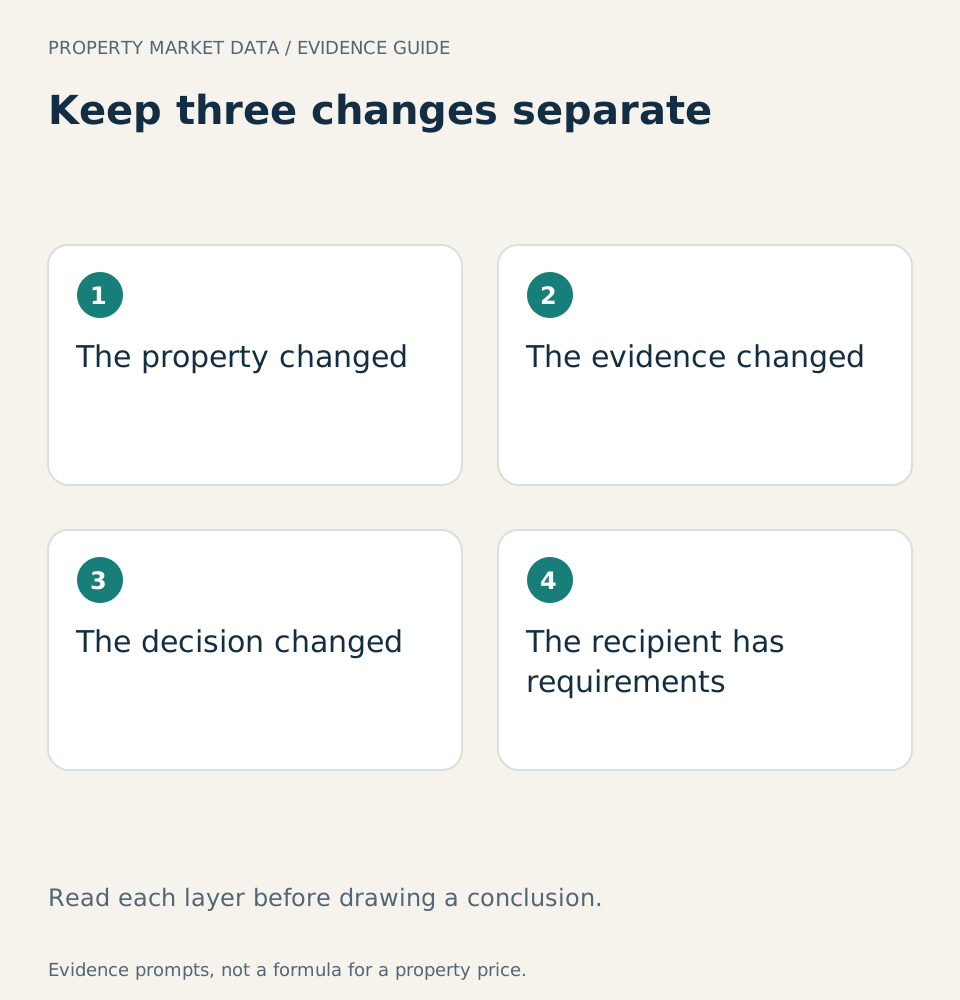
The property changed; The evidence changed; The decision changed; The recipient has requirements. Read the evidence together before making a property-specific judgement.
Do not assume that an unchanged online number confirms there has been no material change. Nor should you assume that any fresh number proves the earlier assessment was poor. Why online property estimates change addresses that separate issue.
Check the evidence date as well as the issue date
A report can be issued recently while relying on older observations or sales. Read the explanation of what was considered. If the key facts are still uncertain, a newer cover date does not resolve them.
Ask the provider whether an update would involve fresh evidence, a new inspection or simply reissuing information. The appropriate service depends on what needs checking.
Reuse, refresh or commission a different assessment
Reusing an earlier document as background can help you form questions. Presenting it as a current answer is a different step. Make that distinction clear to anyone you discuss it with.
If your current purpose involves borrowing, read how lender and remortgage valuations differ from your own estimate. Let the lender or adviser establish the required process rather than selecting a report because it is already available.
For general interpretation, how to read a property valuation report helps identify scope, dates and assumptions before you decide what requires updating.
Write down what changed
| Check | What to establish |
|---|---|
| Physical property | Record alterations, repairs or newly discovered condition issues. |
| Market evidence | Identify newer relevant transactions rather than a general headline. |
| Intended use | Check whether the recipient and decision are still the same. |
| Formal instructions | Ask the recipient about validity and update requirements. |
A report can remain informative while no longer being suitable for its original instruction. Preserve the old assessment as a record of what was known then. When ordering an update, explain the change you want considered. That is more useful than asking for a fresh number without saying why the earlier work may no longer answer your question.
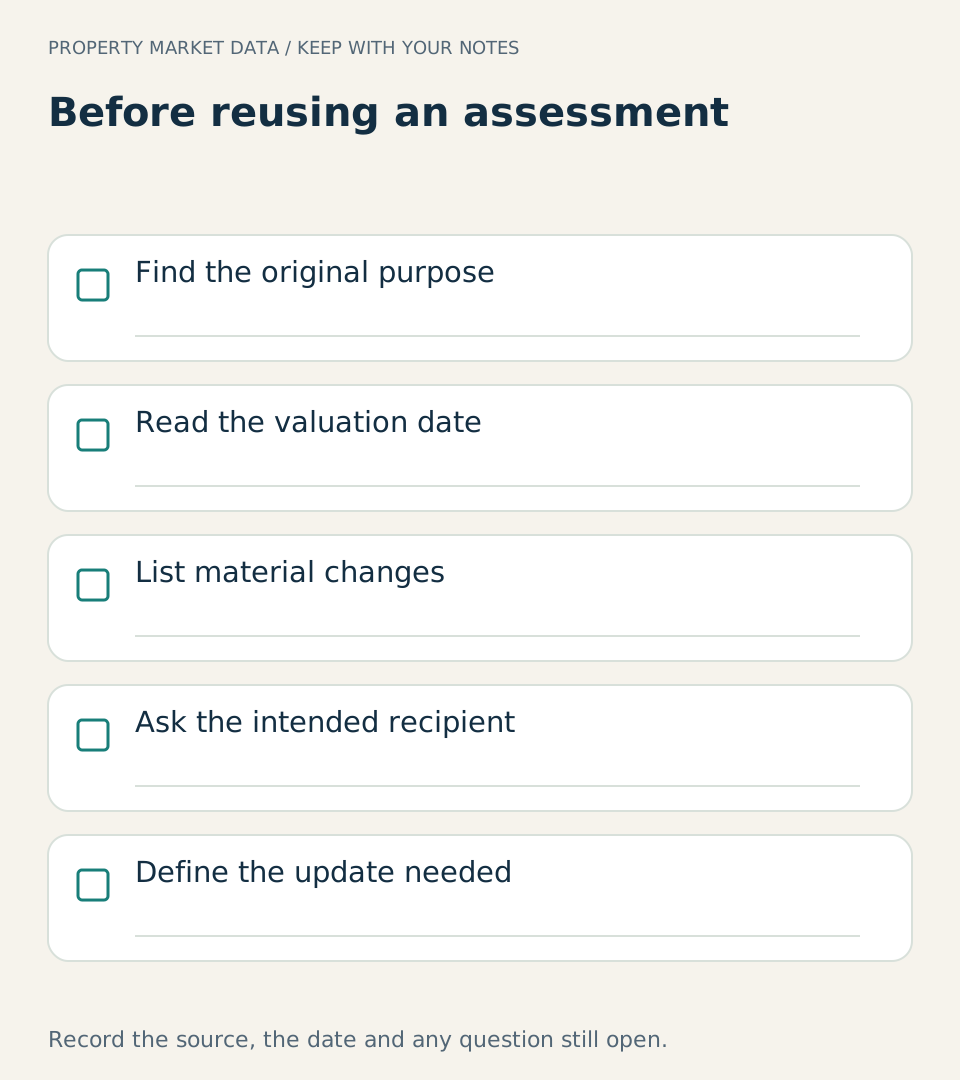
Find the original purpose; Read the valuation date; List material changes; Ask the intended recipient; Define the update needed. Record the supporting document and any unanswered question.
Avoid a false choice between old and new
You do not have to discard all earlier evidence to obtain a current view. A useful update can explain which material remains relevant and what has changed. Ask for that comparison where it is part of the provider's scope.
Keep notes of the questions you want answered. That makes it easier to select work that addresses the gap, rather than purchasing another document simply for a newer date.
Use PMD for a present sale decision
A current PMD report can assemble comparable sales and local market evidence for a home you are assessing now. Read the data explanation and the report's limitations; do not infer that it renews or replaces an earlier formal assessment.
If you already have evidence for your property, compare its scope and dates with the new report. Where a significant uncertainty remains, ask an appropriate person to address it. Updating the decision should involve updating the relevant information, not merely the number you remember.
Sources
- Homes England, Help to Buy valuation instructions: Surveyor, report and validity instructions for the applicable England equity-loan scheme
- Royal Institution of Chartered Surveyors, Automated valuation models roadmap: Model scope, explainability and evidence limitations
- HM Land Registry, Price Paid Data: Recorded transaction evidence and broad property-type categories