
Property valuations
Free online estimate or a paid property report: which do you need?
Free online estimates are everywhere, and many are a reasonable first look. A paid property report costs money but shows its working. The right choice depends on the decision in front of you, how typical your home is and what you are willing to share to get a figure.
This is an estimate from comparable sales, not a RICS or mortgage valuation, and not a survey.
What a free online estimate is
Property websites, portals and many estate agents offer a free house price estimate. You type an address and a figure appears, sometimes with a range. Behind it is a calculation from recorded sales, the home's details and price trends, as our guide to how automated house valuations work explains.
Free estimates are a sensible first look, particularly for a typical home in a street where similar homes sell often. They are also, for many providers, a way to find people thinking about selling. That is not a reason to avoid them, but it is a reason to know what you are giving in return.
What a free estimate usually does not show
Most free estimates give the figure without the evidence. You often cannot see:
- which sold homes it compared yours with, and when they sold;
- whether it used your home's real floor area, or an assumption;
- how it treated a recent extension or a home that needs work;
- how sure it is, beyond a broad range.
That matters because sold price records arrive late. HM Land Registry says a sale typically takes from 2 weeks to 2 months to be registered, so the newest months are incomplete. A figure that hides its dates hides how current it is. The surveyors' professional body makes a similar point in its roadmap on automated valuation models: a figure is more useful when the user can see how it was reached.
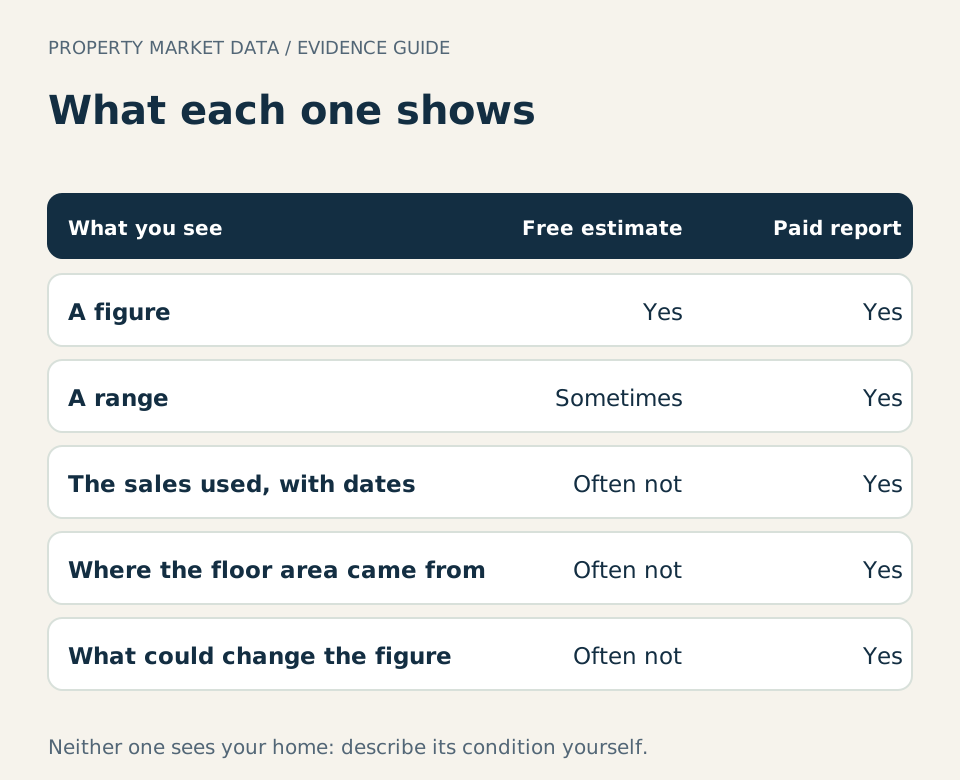
A free online estimate usually shows a figure and sometimes a range. A paid property report also lists the sales used and their dates, the source of the floor area, the likely range and what could change the figure.
What a paid property report adds
A paid report should show its working. Look for the comparable sales listed with prices and dates, older sales restated to today's prices, the source of the floor area, a range with a reading of how sure it is, and a plain list of what could change the figure. Some reports also cover the area around the home, such as flood risk records, planning history and schools.
A PMD owner report costs £29 including VAT. Its estimate is PMD's own calculation, tested against thousands of recorded sales. The report labels where every key figure comes from, and its calculation takes into account the work a home needs or has had done, along with other adjustments. It is not a RICS valuation or a survey, and nobody visits your home.
What each one asks of you
A free estimate costs nothing, but you may be asked for your name, email address or phone number first. Marketing by phone, email and text is covered by the Privacy and Electronic Communications Regulations, and the Information Commissioner's Office explains the rules businesses must follow. Read the provider's privacy notice before you type your number. Our guide to online valuations and unwanted sales calls covers this in detail.
A paid report asks for money instead. It is still worth checking what the provider does with your details and whether it passes them to anyone.
Which one fits your decision
Match the tool to the decision rather than the other way round.
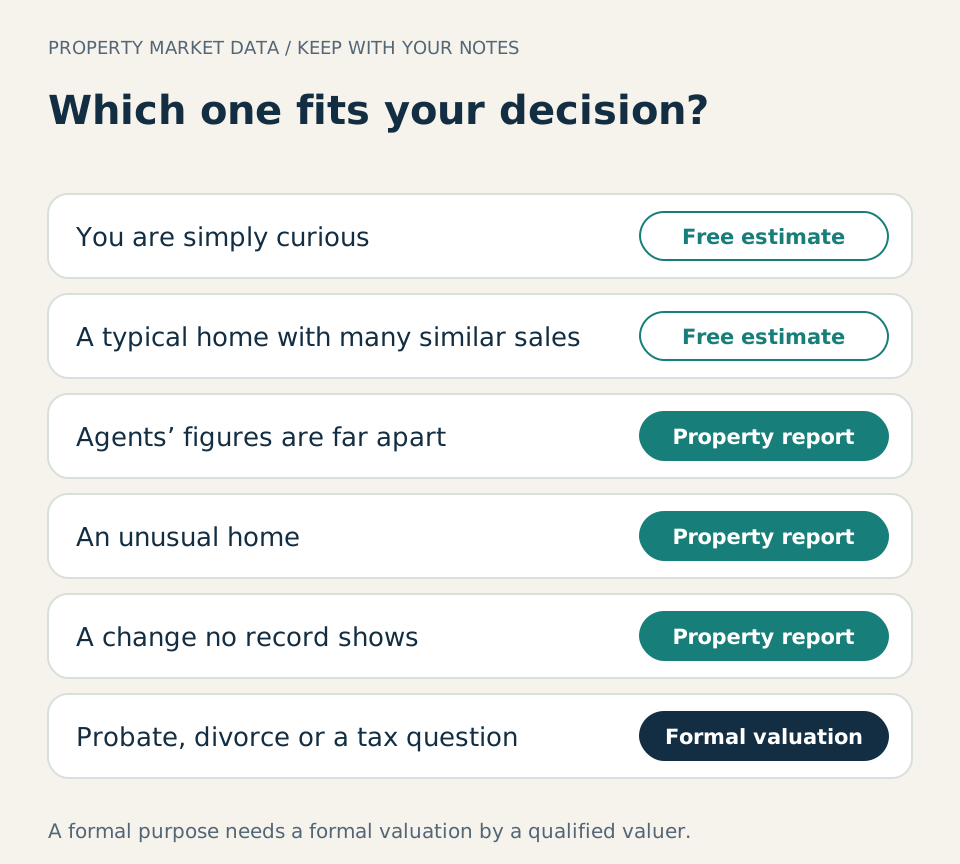
A free estimate is often enough for curiosity or a typical home with many similar sales. A report is more useful when agents' figures are far apart, the home is unusual or has changed. A formal purpose needs a formal valuation.
A free estimate is often enough when you are simply curious, or when your home is one of many similar homes that sell regularly. A report earns its cost when you are about to set an asking price, when agents' figures are far apart, when your home is unusual or when it has changed in ways no record shows.
For a formal purpose, such as probate, a divorce settlement or a tax question, you may need a formal valuation by a qualified valuer, which neither option provides. Our guide to which type of property valuation you need explains the difference.
What neither one can do
Neither a free estimate nor a paid report sees your home. Condition, light, noise and layout are only known if you describe them. Use either one as preparation for the conversations that follow, and keep a note of anything the figure could not know. When you invite agents round, our guide to preparing for an estate agent valuation appointment will help you make the most of it.
Sources
- Rightmove, How online valuations work: How data-based online estimates are produced and what they cannot see
- HM Land Registry, About the Price Paid Data: The delay before a sale is registered and the coverage of sold price records
- Royal Institution of Chartered Surveyors, Automated valuation models roadmap: Why explaining how an automated figure was reached matters
- Information Commissioner's Office, Guide to PECR: The rules on marketing by phone, email and text